
On the last Sunday of May, something quiet and powerful moves through Haiti. In churches from Port-au-Prince to the smallest mountain chapel, the pews fill with families, and over each heart blooms a single flower. A boy in a pressed white shirt wears a bright red hibiscus; an old woman beside him wears one of pale lavender. They have come, as Haitians do every year, to honor the woman the whole society calls its center — the manman. This is Fèt Manman, Haitian Mother’s Day, and in a nation that has survived revolution, occupation, earthquake, and exile, no figure is more revered than the mother who held the family together through all of it.
A Day Set Apart on the Calendar
Most of the Western Hemisphere — the United States, Canada, much of Latin America — celebrates Mother’s Day on the second Sunday of May. Haiti chose differently. Here, Fèt Manman, or Fête des Mères in French, falls on the last Sunday of May, a placement that is no accident. It anchors the celebration at the close of a month already heavy with national feeling. Just days earlier, on May 18, Haitians fly the bicolor flag for Drapo Ayisyen. In the diaspora, the entire month is observed as Haitian Heritage Month, a tradition first celebrated in Boston in 1998 and now marked in cities across North America.
So when the last Sunday arrives and families gather to honor their mothers, the celebration carries a double charge. To love your mother, in this season, is also to love the country she gave you. Maternal pride and national pride braid together into a single act of devotion — a reminder that for Haitians, the family and the nation have always been versions of the same story.
The Poto Mitan: Why the Mother Is Everything
To understand why Fèt Manman matters so deeply, you have to understand a phrase Haitians use to describe their mothers: poto mitan. In Vodou temples, the poto mitan is the central pillar that holds up the roof and connects the human world to the divine — the axis around which everything turns. Applied to a woman, it is the highest compliment a culture can pay. The mother is the central pillar of the household, the one who bears the weight so the rest of the family can stand.
This is not mere sentiment. Across Haitian history, women have been the load-bearing structure of both family and economy. They run the machann markets that feed the cities, carrying baskets and balancing budgets that keep neighborhoods alive. They are, in a country with a fragile health system, the first line of defense for a sick child — nurse, pharmacist, and prayer-warrior all at once. When fathers emigrated for work, when political violence scattered families, when the earth itself broke open in 2010, it was again and again the manman who absorbed the shock and rebuilt around it. Fèt Manman is the one day the nation says aloud what it knows every other day of the year: that Haiti stands on the backs of its mothers.
A Flower Over the Heart
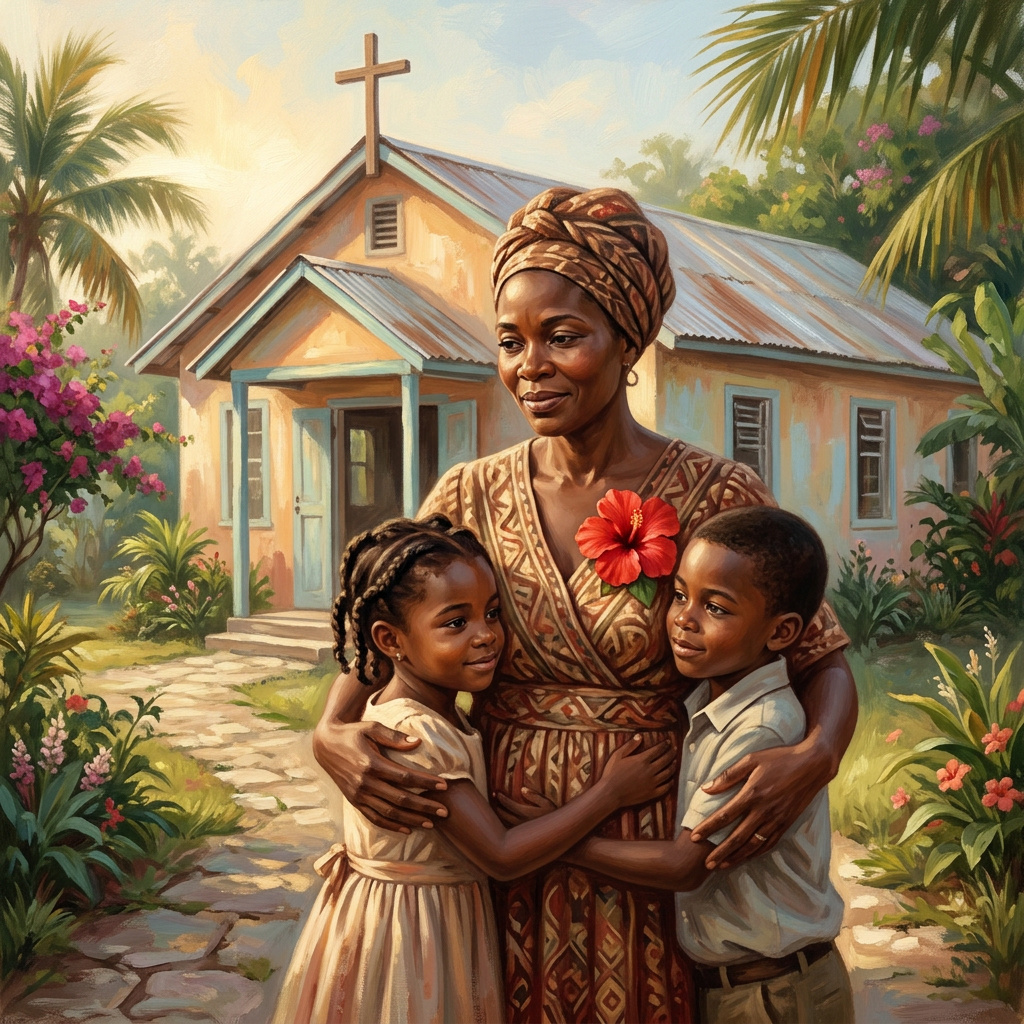
The most beautiful and distinctive custom of Fèt Manman is the wearing of a single flower — and the color of that flower tells a story without a word being spoken. A red flower, often a bright hibiscus, means your mother is living: a celebration worn openly and proudly. A white flower means she has died recently, the grief still fresh. And a lavender or purple flower marks a mother who joined the ancestors long ago, the sharp ache softened into tender remembrance.
Walk into a Haitian church on this Sunday and you can read the whole congregation at a glance. The crimson blooms of the young, the white of the newly bereaved, the lavender of those who have carried their loss for decades — a living chart of love and loss, pinned over hundreds of beating hearts. It is one of the quietest and most moving traditions in the Haitian calendar, a way of honoring not only the mothers who are present but the ones whose seats are now empty.

Church, Song, and the Sound of Kompa
The day usually begins in church. Morning services overflow with prayers and hymns devoted to mothers, reflecting the deep spiritual foundation of Haitian life. Children climb to the front to recite poems and sing — and tears flow freely, both from the mothers being serenaded and from the children doing the serenading. To say “Bòn fèt manman!” or “Bòn fèt dè mè!” is the greeting of the day, traded between neighbors and pressed onto handmade cards written carefully in Kreyòl.
After church, the celebration moves home, and the kitchen becomes the heart of the house. Families prepare the dishes that mean love in Haiti — perhaps diri kole ak pwa, griot with pikliz, a rich sòs pwa, and the cherished foods that mother herself is famous for making. And then comes the music. Radio stations and family speakers fill with kompa, the romantic national rhythm, and the airwaves brim with songs written specifically to honor mothers. Couples and generations dance together in living rooms and courtyards, and the gravity of the morning’s church service gives way to joy.
Fèt Manman in the Diaspora
For the millions of Haitians living abroad, Fèt Manman is one of the threads that keeps them tied to home. In Little Haiti in Miami, in Brooklyn and Boston and Montreal, the last Sunday of May unfolds with the same devotion as in Port-au-Prince. Families gather around tables that mix English and Kreyòl, where grandmothers tell stories that carry the homeland across an ocean and into the ears of children who may never have set foot on Haitian soil.
There is something especially poignant about the holiday in the diaspora. So many Haitian mothers became immigrants precisely as mothers — leaving everything familiar, working punishing hours, sending remittances back to family they might not see for years, all so their children could have a future. The flower pinned to a child’s chest in a Brooklyn church carries the full weight of that sacrifice. And because Fèt Manman falls during Haitian Heritage Month, the celebration of one’s own mother blends seamlessly into a celebration of la patrie — the motherland herself.
In a country that has asked so much of its women, Fèt Manman is more than a greeting card holiday — it is a national act of gratitude, repeated quietly each spring with a flower over the heart. The manman is Haiti’s poto mitan, the central pillar holding up the roof, and on the last Sunday of May the whole nation pauses to honor her, living or departed, present or scattered across the globe. At HaitiPAM, we celebrate the mothers whose strength, sacrifice, and love have carried Haiti through every chapter of its extraordinary story. Bòn fèt manman.

Leave a Reply