

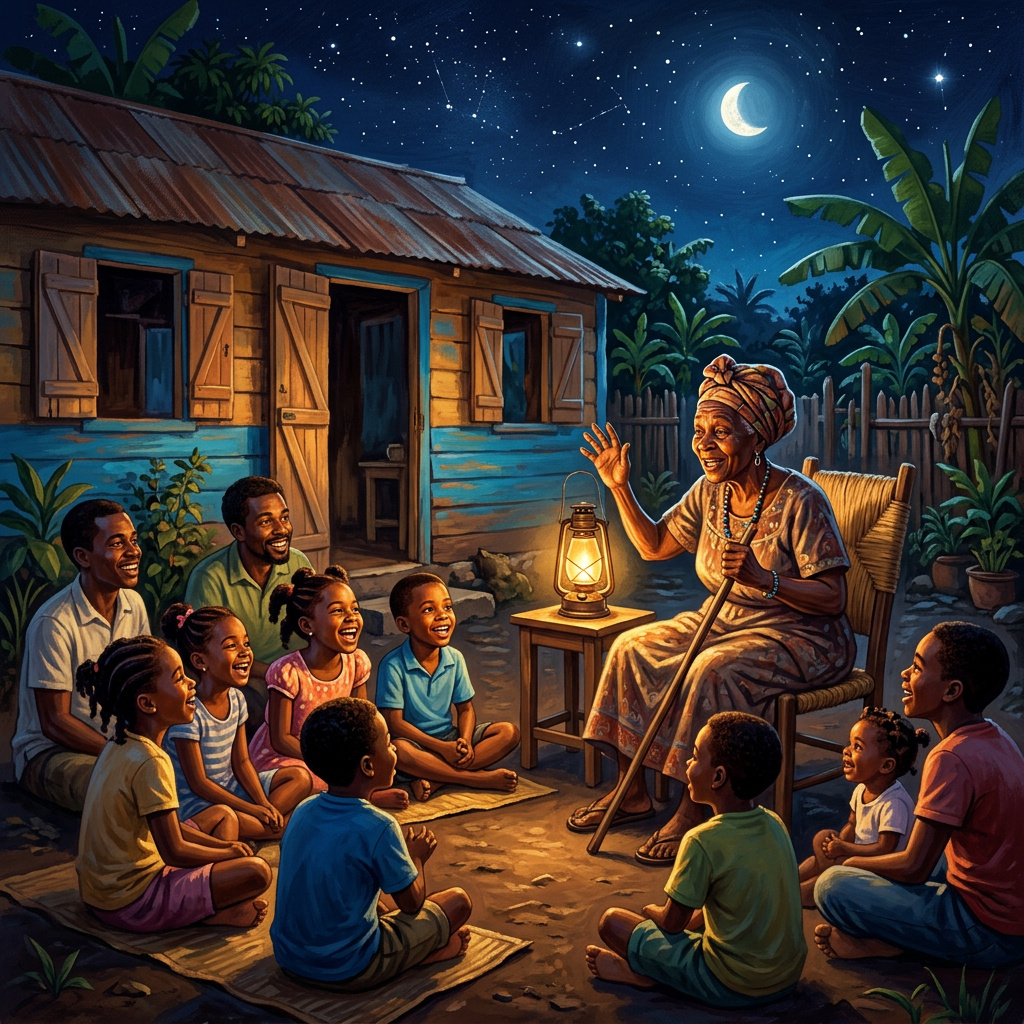
The lamp is low, the dishes are done, and somewhere beyond the lakou a dog is barking at nothing. An old woman settles onto a straw chair, and before anyone has asked her for a story, she leans forward and calls out a single word: “Krik?” Every child in the yard, and most of the adults, answer at once: “Krak!” With that exchange a contract has been signed. She will tell, and they will listen. They will also interrupt, laugh, sing the refrain and argue about the ending. For the next hour the yard belongs to Bouki and Ti Malis, the most famous pair of rascals in Haitian Kreyòl.
Long before Haiti had a printing press, schools that taught in Kreyòl or radio dramas, this is how the nation kept its stories. They were passed from mouth to ear, generation after generation, in a language that the colonial elite dismissed as broken French. The tales survived because they were never just entertainment. They worked as a school, a court of law and a running joke about power, all at the same time.
A Contract Spoken in Two Words
The Krik? Krak! call and response is the doorway into every kont, or folktale. The teller asks whether the audience is ready, and the audience’s answer proves they are awake and willing. If the teller hears a weak “krak,” she may refuse to begin until the crowd answers with more spirit. Nobody in this audience is passive. Listeners are expected to join in the songs embedded in the tales, shout warnings to the characters and groan at their foolishness.
A second formula opens the riddle game that often comes before the stories. The teller calls “Tim tim?” and the crowd answers “Bwa chèch!” (dry wood). Then the riddle comes. “What dresses in white to stay at home?” The quickest child shouts the answer: the bed. When nobody can solve one, the group gives up with the words “Mwen bwè pwa,” and the teller is free to reveal the answer and gloat. The riddles are small and domestic, built from cooking pots, mangoes, roosters and roofs. They sharpen young minds in the most Haitian way possible, through competition, wit and laughter.
No one knows exactly where the formulas began. The great Haitian ethnologist Jean Price-Mars weighed two possible origins: storytellers on the West African coast who greeted their audiences in similar ways, and the sailors and settlers of colonial France. He never settled the question. What he did insist on was that Haitians had taken the formulas and made them their own. The structure may be borrowed, but the voice is Haitian.
Meet the Rascals: Bouki and Ti Malis
Haiti has many tales, but the beloved ones star a pair who could not be more different. Bouki is big, strong, hardworking and endlessly hungry. He is not wicked, only greedy and gullible, a man who believes every promise because he wants the reward so badly. Ti Malis, often called Uncle Malis even though he is the smaller of the two, is quick, cunning and lazy. He would sooner spend a whole day planning a trick than an hour working in the garden.
The pattern hardly ever changes. Bouki works, Malis schemes, and Bouki ends up hungry, beaten or humiliated while Malis walks off with the food. In one well-known tale, a king who loves dancing but hates paying for it offers 5,000 gourdes to anyone who can perform the mysterious Kokioko. Malis spies on the king, learns the steps and patiently teaches them to Bouki. Bouki dances, wins and is so drunk on his triumph that he lets Malis lead him into one more dance, while Madame Malis slips away with the money. The audience laughs at Bouki even as they recognise themselves in him.
In everyday Kreyòl the names have outlived the stories. Call someone a bouki and you mean a fool, someone easy to cheat. To say someone has malis is to admire, and warn others about, their cunning. The folktale has become vocabulary.
A Hyena and a Hare Cross the Atlantic
The pair are older than Haiti. In Senegal and across the Wolof- and Fula-speaking lands of West Africa, a famous cycle of tales sets a greedy, foolish hyena against a small, clever hare. In Wolof, the hyena is called bouki. The hare is Leuk. Enslaved Africans carried these stories with them through the Middle Passage and into the plantations of Saint-Domingue. In the new world, the animals gradually took on human shape. They gained wives, gardens and godchildren, and they began to deal with kings and landowners, the people who held power in colonial and post-colonial Haiti.
Haiti was not their only destination. In Louisiana folktales a hyena named Bouki still contends with a rabbit called Lapin, which shows how widely the original cycle travelled. Haitian tellers did the most with it. They gave Bouki and Malis a full social life, a fluent Kreyòl tongue and enough adventures to fill whole evenings.

Laughing at Power in Plain Sight
Why would a people who survived slavery love a story where the strong man always loses? Scholars have read Bouki and Malis as a portrait of Haitian society itself. Under one reading, Bouki is the bosal, the African-born captive who was new to the colony and its rules, while Malis is the Creole born on the island who knows how to manoeuvre through them. A later reading sets the rural peasant against the slick city-dweller. The Italian scholar Sara Del Rossi has tested these theories by analysing how the tales are put together, and has found that the class tensions of Haitian history are woven through them.
Every reading lands on the same idea. In a world where the powerful wrote the laws, the powerless survived by their wits. Malis is not admired because he is good, since he is often cruel. He is admired because he refuses to be a victim. Bouki’s endless hunger was the hunger of the cane fields and the mountain gardens, and that is why the laughter carries an edge. These tales let people tell the truth about exploitation in a form that nobody in authority would bother to ban, because it was only a children’s story about two fools.
From Wake Nights to the Printed Page
Traditionally these stories belonged to the night. They were told after the day’s work, on moonlit porches, and especially at veye, the wakes where families kept vigil over their dead. Laughter, riddles and stories carried the mourners through until dawn. Many tellers still warn that a kont must never be told in daylight. Some tellers end a story with a wink, claiming they were right there when it happened until someone gave them a kick that sent them flying back to the yard to tell it.
Oral traditions are fragile, and one woman did more than anyone to protect this one. Suzanne Comhaire-Sylvain, born in Port-au-Prince in 1898 and daughter of the anti-occupation activist Georges Sylvain, became the first Haitian woman to earn a doctorate. She wrote her dissertation on Haitian Kreyòl at a time when most of the Haitian elite considered the language unworthy of study. Comhaire-Sylvain collected tales across the country, and around 1940 she published Le Roman de Bouqui, the first anthology devoted entirely to Bouki and Malis, which gathered fifty tales from the living tradition.
Others followed. In 1978 the American storyteller Diane Wolkstein published The Magic Orange Tree, a collection of tales she had heard told in Haiti, with notes on the tellers and their audiences. In Florida, Liliane Nérette Louis gathered the tales of her childhood in When Night Falls, Kric! Krac! (1999). In 1995, Edwidge Danticat titled her acclaimed story collection Krik? Krak!. That choice declared that Haitian literature in any language still begins with the old call and its answer.
Why the Lamp Still Burns
Today, a child in Port-au-Prince is more likely to meet Bouki in a school reader, a cartoon or a radio skit than on a grandmother’s porch. In the diaspora, from Flatbush to Montreal, parents tell the tales to children who reply “Krak!” with an American or Québécois accent. Storytellers and teachers in Haiti and abroad warn that the rarer tales are disappearing as the old tellers die. They are recording them, performing them and teaching them in Kreyòl classrooms.
Still, the heart of the tradition has never depended on paper. As long as someone calls “Krik?” and someone else answers “Krak!”, the circle forms again. Bouki is still hungry, Malis is still plotting, and a language once dismissed as broken goes on proving itself whole.
Bouki and Ti Malis crossed an ocean in the memories of people who were allowed to carry nothing else. They outlived the colony that tried to silence the language they spoke, and they still make Haitians laugh at the powerful, at hunger and at themselves. That is the story of Haiti in miniature: survival through wit, memory kept by the voice, and a people who answered every attempt to erase them with “Krak!” At HaitiPAM, we gather these stories so the circle around the lamp keeps growing. Krik?
Leave a Reply