

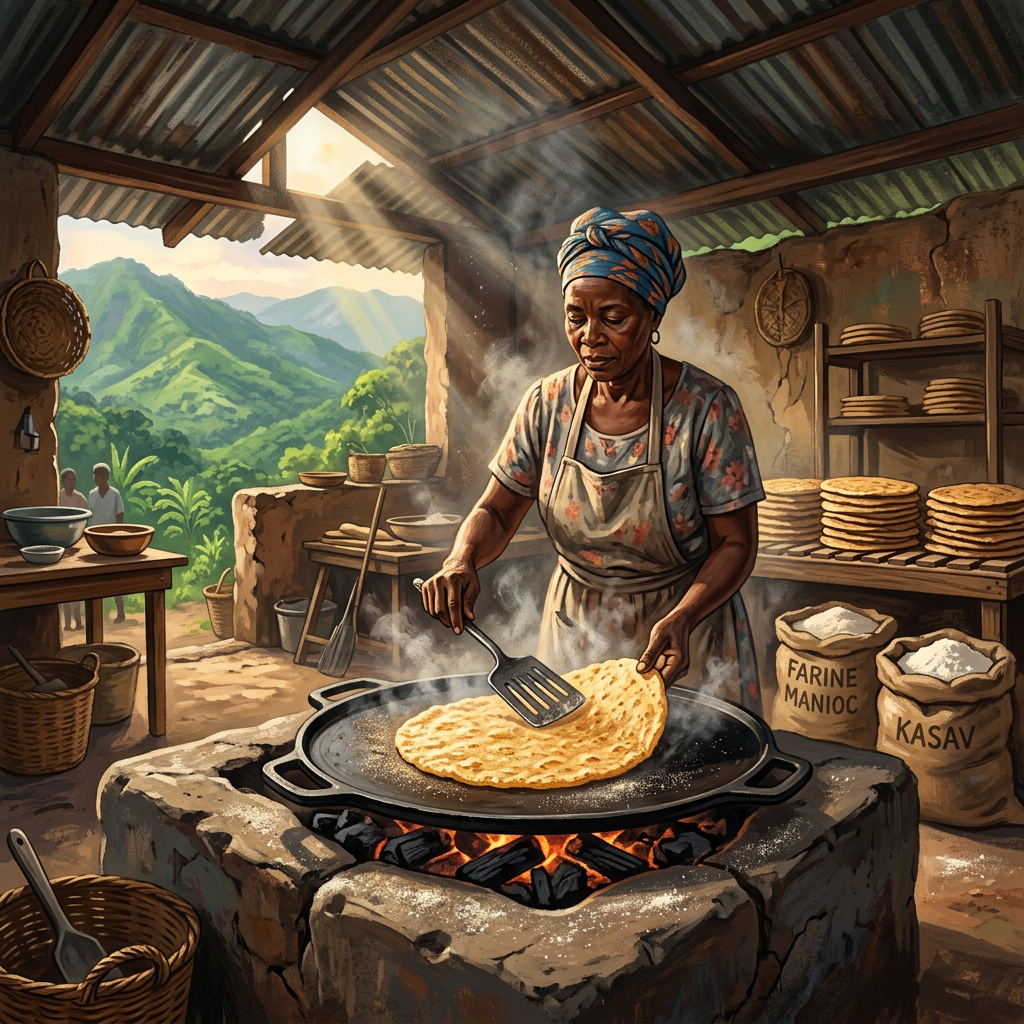
Before dawn on the outskirts of Cap-Haïtien, the charcoal is already glowing. Under a roof of corrugated zinc that keeps out the rain but none of the heat, a row of round iron plates sits over concrete hearths, and on each one a pale circle of cassava flour slowly turns into bread. A baker pats the edges with a wooden paddle, flips the whole disc by hand, and waits. Half an hour later it comes off golden on both sides, crisp at the rim, ready to be cut into squares with a wooden knife. It is a scene that would have made sense to someone living on this island six hundred years ago. That is the point. Kasav is the oldest bread in Haiti, and the country has never stopped baking it.
A Bread Older Than the Name Haiti
Long before Columbus reached the north coast in December 1492, the Taíno, the Arawak-speaking people who called this island Ayiti, the “land of high mountains,” lived on manioc. They had carried the plant and the knowledge of how to process it with them from the South American mainland, and on Ayiti they built a whole food system around it. Their word for the finished bread, recorded by the Spanish as caçábi, is the root of the Spanish casabe, the English “cassava,” and the Haitian Kreyòl kasav.
The bread fit island life perfectly. Manioc grows in poor soil, shrugs off drought, and can wait in the ground for months until it is needed. Once baked and dried, the flat rounds kept for weeks without spoiling, which made them food for canoe voyages, for storehouses, and for lean seasons. When the first Europeans arrived hungry, it was cassava bread that the Taíno caciques set before them.
The Taíno themselves did not survive the century that followed. War, forced labor, and epidemic disease destroyed them within a few generations. Their bread survived anyway, and that may be the most remarkable fact in Haitian food history.
How a Poisonous Root Becomes Bread
Kasav is traditionally made from bitter manioc, and bitter manioc is dangerous. Raw, the root carries compounds that release cyanide, enough to make a person seriously ill. The genius of the Taíno method is that every step exists to remove that threat.
The roots are peeled (in today’s northern workshops, often with the sharpened metal lid of a tin can), washed, and grated into a wet pulp. The pulp is then squeezed hard to drive out the toxic juice. The Taíno used a long woven tube for this; Haitian producers today use presses and sacks, but the principle is identical. What remains is sifted into a coarse flour, and the starch that settles out of the liquid is saved for other uses. Researchers who have tested Haitian kasav have found that the pressing step is what does most of the work: bread made without it kept far more cyanide, even after cooking.
Then comes the fire. The flour is spread in a wide circle on a platin, a round iron griddle set over charcoal. There is no yeast, no fat, no leavening of any kind. Heat alone binds the grains together into a single sheet. The baker shapes and creases the edge, turns it once, and lets both faces brown. The finished rounds are dried again before they are packed, which is why a good kasav snaps rather than bends, and why it can sit in a market stall for weeks.
From Taíno Hands to African Hands
If the Taíno disappeared so quickly, who kept the bread alive? The answer is the enslaved Africans brought to Hispaniola, and later to French Saint-Domingue, in their hundreds of thousands. They learned to grow and process manioc, absorbed the Taíno know-how, and passed it down, mother to daughter and village to village, alongside their own West and Central African food traditions. Manioc was already familiar in parts of Africa by then, carried across the Atlantic by Portuguese traders, so the bread landed on prepared ground.
For people who were being starved by the plantation system, a crop that could grow on a provision plot or a mountainside and a bread that would keep for weeks were survival tools. That same durability made manioc valuable to maroons in the hills and, later, to the free peasantry that took shape after independence in 1804. Kasav became part of the inheritance of the people who made Haiti. It is, in a very literal sense, a food that links the island’s first nation to its second.

The North’s Signature: Kasav ak Manba
Kasav is eaten all over Haiti, but it belongs above all to the North. Cap-Haïtien is its capital, and producers there will tell you the best roots come from the plains around Caracol and Trou-du-Nord in the Northeast. Travelers coming home from Okap often carry stacks of it wrapped in paper as gifts for family in Port-au-Prince or Miami.
The classic way to eat it is with manba, Haitian peanut butter, ideally homemade and spiked with hot pepper, spread thick across a crisp square. Some people break it into a bowl of hot milk or coffee in the morning so it softens into something close to porridge. Others eat it plain with avocado, or alongside fried herring.
Modern bakers have built a whole menu on that old base. Sweet kasav is folded with coconut, ginger crushed in a wooden mortar, cinnamon, sugar, or sweetened condensed milk; savory versions carry salt, peanut, or smoked herring. One young Cap-Haïtien business that invested in one of the city’s oldest kasav workshops now offers around eleven flavors. The thick, soft, coconut-studded rounds sold as kasav dous are a long way from the thin, plain discs of the Taíno, but they come off the same iron.
From “Poor People’s Food” to Prized Heritage
For much of the twentieth century, kasav carried a stigma. Imported wheat bread was the mark of modern, urban life, and a cassava cake was what you ate when you could not afford a baguette. Older producers in the North remember when buyers turned their noses up at it.
Then the prices changed. When the COVID-19 pandemic disrupted supply chains and wheat costs soared, a loaf of bread became a luxury in many Haitian households, and kasav, made entirely from a crop grown at home, suddenly looked like the smarter choice. It is naturally gluten-free, contains no fat, and keeps for weeks without refrigeration in a country where electricity is unreliable. Demand climbed, and customers began traveling to Cap-Haïtien from across the country to buy it.
The trade feeds a whole chain of livelihoods: the farmers who still plant manioc with machetes, the motorcycle-taxi drivers who haul the roots to town, and the thirty or more workers who may fill a single workshop on a busy day. A veteran producer with more than three decades in the business has argued that with proper tools and support, northern farmers could grow several times as much manioc as they do now. In a country that imports most of its wheat and much of its rice, that is not a small claim. Kasav is one of the clearest examples of a Haitian food that could replace an import with a harvest.
A Caribbean Heritage, Recognized
In December 2024, at a meeting in Asunción, Paraguay, UNESCO inscribed the “traditional knowledge and practices for the making and consumption of cassava bread” on its Representative List of the Intangible Cultural Heritage of Humanity. The nomination was a joint one, prepared over two years by Haiti, Cuba, the Dominican Republic, Honduras, and Venezuela, and it was the first time five countries of the hemisphere had come together on a single entry of this kind.
The listing honors a family of breads with many names: kasav in Haiti, casabe in Cuba and the Dominican Republic, ereba among the Garífuna of Honduras, and cousins like Jamaica’s bammy. UNESCO’s citation stresses that the knowledge is passed on mostly informally, in households and communities, and that the bread carries both Indigenous and African heritage. For Haiti it was the country’s second entry on the list, following the 2021 inscription of soup joumou, the independence soup. Both honors make the same point. Haiti’s history can be read in what its people cook.
Every round of kasav that comes off a platin in Cap-Haïtien is a small act of continuity: a Taíno technique, carried by enslaved Africans, kept alive by Haitian peasants, and now sold with coconut and ginger to a new generation. Few foods anywhere connect a nation so directly to the people who first named its land. At HaitiPAM, we tell these stories because Haiti’s past is not behind it. Sometimes it is right there on the table, spread with manba.
Leave a Reply