

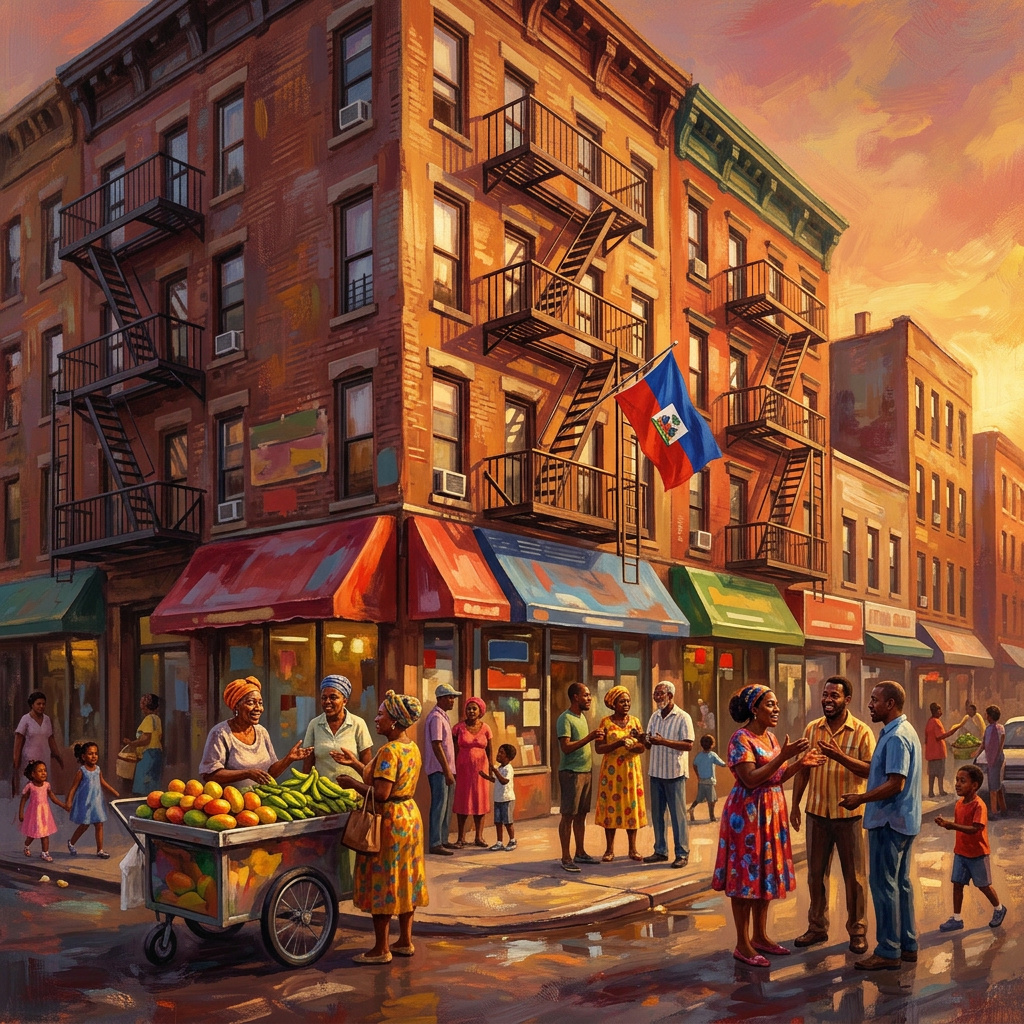
Step out of the subway at Newkirk Avenue on a Saturday morning and, before you have climbed the stairs, you will hear it. A woman on her phone is arguing in rapid Kreyòl about the price of plantains. Kompa is leaking from a car idling on Nostrand Avenue. Somewhere a radio host is running through the day’s news from Port-au-Prince, and a man selling phone cards has an opinion about every item. The recorded voice on the platform has already told you where you are: This is Newkirk Avenue–Little Haiti. You are in Brooklyn, New York. You are also, in every way that matters to the people around you, in Haiti.
For more than half a century, the Flatbush neighborhood has been the beating heart of the largest Haitian community in the northeastern United States. It is a place built by exiles, sustained by remittances and radio, and hardened by a fight for dignity that once shut down the Brooklyn Bridge. Haitians have a name for the world their emigrants built abroad: the dizyèm depatman, the Tenth Department. If that department has a capital, a strong case can be made that it runs along Church Avenue.
Exiles of the Duvalier Years
The story of Haitian Brooklyn begins with a dictatorship. When François “Papa Doc” Duvalier consolidated power after 1957 and later declared himself president for life, he made Haiti dangerous for anyone who read too much, spoke too freely, or belonged to the wrong family. The first to leave were doctors, lawyers, teachers and professionals — the educated middle class that the regime saw as a threat. Many went to New York, where they found work, enrolled their children in city schools, and waited for a return that kept being postponed.
Through the late 1960s and 1970s the migration changed shape. It grew larger and more working-class, drawing people from the provinces as well as the capital, and it moved into the neighborhoods of central Brooklyn: Flatbush, East Flatbush, and later Canarsie. Rent was manageable, the housing stock was solid, and each new arrival made it easier for the next. A cousin sent money for a ticket; a godmother found a room; a church congregation found a job. Chain migration, the sociologists called it. In Flatbush, it looked like a family reunion that never ended.
Building a Haiti on Nostrand Avenue
By the 1980s, Flatbush had become the social and economic enclave of Haitian New York. Along Nostrand, Church and Flatbush Avenues, the storefronts told the story: Haitian groceries stocked with djon djon mushrooms and Barbancourt rum, bakeries selling pen patat and pâté kòde, tailors, dry cleaners, travel agencies, money-transfer counters and the dollar-cab dispatch offices known as taxi stations. The neighborhood holds the highest concentration of Haitian-owned businesses in New York City.
Just as important were the institutions no one could see from the street. Catholic and Protestant churches held services in Kreyòl and French. Hometown associations gathered people from the same small town in Haiti to raise money for a school or a clinic back home. Haitian-language radio became the community’s nervous system, carrying news, obituaries, political debate and dedications late into the night. The weekly newspaper Haïti Observateur, founded in New York in 1971, gave the exile community a printed voice that the Duvalier government could not censor.
What emerged was not a copy of Haiti but a translation of it. Children grew up switching between Kreyòl at the dinner table and English at school. Kompa bands played Brooklyn ballrooms on Saturday nights. And money moved constantly southward: remittances from Flatbush and communities like it became one of the largest sources of income in Haiti itself.
The Day Haitians Closed the Brooklyn Bridge
The community’s defining moment came out of an insult. In 1983, early in the AIDS crisis, the U.S. Centers for Disease Control listed Haitians among the groups it considered at elevated risk, alongside homosexual men, hemophiliacs and heroin users. The “4H” label, as it came to be known, followed Haitians everywhere. Children were bullied at school. Workers lost jobs. Landlords turned applicants away. Haitian doctors pointed out that nationality was not a risk factor, but the stigma stuck.
Then, in 1990, the Food and Drug Administration issued guidelines that discouraged blood banks from accepting donations from anyone born in Haiti or sub-Saharan Africa. For Haitian New York, it was one humiliation too many. Community groups, student organizations from the City University campuses, churches and Kreyòl radio stations spread the word, and on April 20, 1990, tens of thousands of people gathered at Grand Army Plaza. Contemporary reports counted at least 50,000 marchers; community memory puts the figure far higher.
They marched down through Brooklyn, across the Brooklyn Bridge and into Lower Manhattan, closing the span to traffic and filling the streets toward Wall Street. They carried Haitian flags and handmade signs and chanted against the FDA. It was one of the largest demonstrations New York had seen in years, and it worked: by the end of 1990, the agency had reversed the ban. For a generation of Haitian New Yorkers, April 20 remains a date spoken with pride — the day a community that had been told to keep its head down stood up and was counted.
The Tenth Department
That same year, Haiti itself was changing. In December 1990, Jean-Bertrand Aristide won the country’s first free presidential election, and he understood what Brooklyn, Miami, Montreal and Boston meant to his nation. Haiti was divided into nine administrative departments; Aristide and his supporters spoke of the diaspora as the dizyèm depatman, a Tenth Department without borders, whose citizens were no less Haitian for living abroad. The phrase gave emigrants something they had long been denied: a place in the national story rather than a footnote to it.

The metaphor had real weight. When Aristide was overthrown in 1991, Flatbush became a center of opposition to the military regime, hosting rallies and funding resistance. When the 2010 earthquake devastated Port-au-Prince, Brooklyn churches and community centers turned into collection depots overnight, and families spent days waiting by the phone. When Nippes was carved out as Haiti’s tenth official department in 2003, the phrase slowly fell out of formal use — but the idea never left. Ask in any Flatbush barbershop, and you will hear that the diaspora is still a department of its own.
Little Haiti, Made Official
For decades the neighborhood’s identity lived in its streets rather than on its maps. That changed in 2018, when New York City formally designated a Little Haiti cultural district in Flatbush, roughly bounded by Church Avenue to the north, Brooklyn Avenue to the east, Avenue H and Parkside Avenue to the south, and East 16th Street to the west. Street signs honoring Toussaint Louverture followed. In 2019 the community launched an annual Haitian Culture Day parade and festival, which now draws crowds in the tens of thousands.
The most symbolic change came underground. Championed by State Assemblywoman Rodneyse Bichotte Hermelyn, the daughter of Haitian immigrants, the Newkirk Avenue subway station was renamed Newkirk Avenue–Little Haiti in November 2021. The community chose to rededicate it on November 18 — the anniversary of the Battle of Vertières, the 1803 victory that sealed Haitian independence. It was a quiet statement of history: two centuries after Haiti won its freedom, its children had written their name into the map of New York.
Flatbush Today
Flatbush is changing, as every New York neighborhood does. Rising rents have pushed many families further out, to Canarsie, to Queens, to Long Island and beyond. Younger Haitian Americans are as likely to post in English as speak Kreyòl. Yet the neighborhood keeps renewing itself. Newer arrivals, many fleeing Haiti’s recent crisis, still find their first rooms here. New cafés sit beside old bakeries. And every Labor Day, when the West Indian carnival sweeps down Eastern Parkway, the Haitian flag flies as loudly as any.
Walk down Church Avenue in the evening and you can still read the whole history in a single block: the travel agency that has booked flights to Port-au-Prince since the 1970s, the church flyer announcing a Kreyòl Mass, the transfer counter where a teenager sends forty dollars to a grandmother in Jacmel. It is a neighborhood that has never had to choose between being Haitian and being American. It simply decided to be both.
From the exiles who fled Papa Doc to the marchers who closed the Brooklyn Bridge, Haitian Flatbush proves that a nation is not only a territory — it is a people who carry it with them. Wherever the Tenth Department takes root, from Brooklyn to Montreal to Miami, it keeps Haiti’s language, faith and fierce dignity alive. Here at HaitiPAM, we’ll keep telling the stories of every department, including the one that lives across the sea.
Leave a Reply