
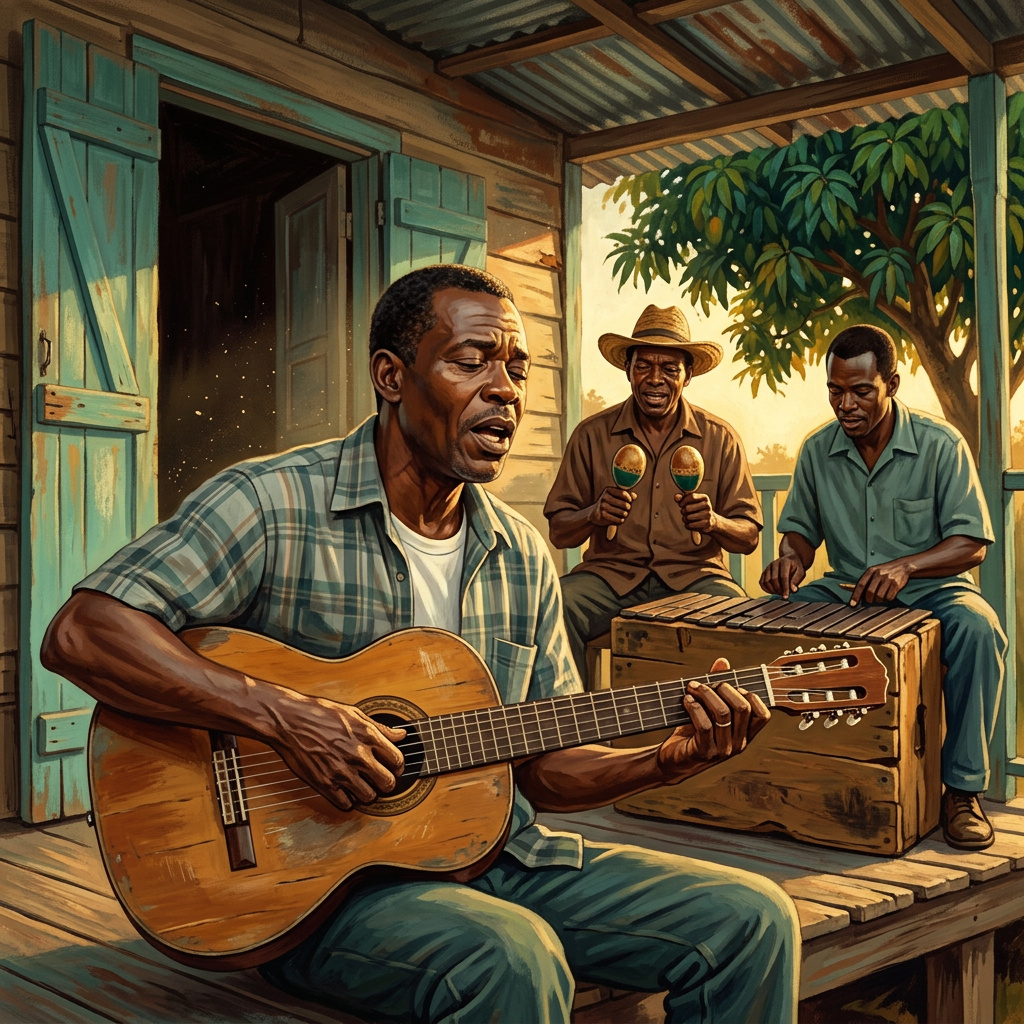
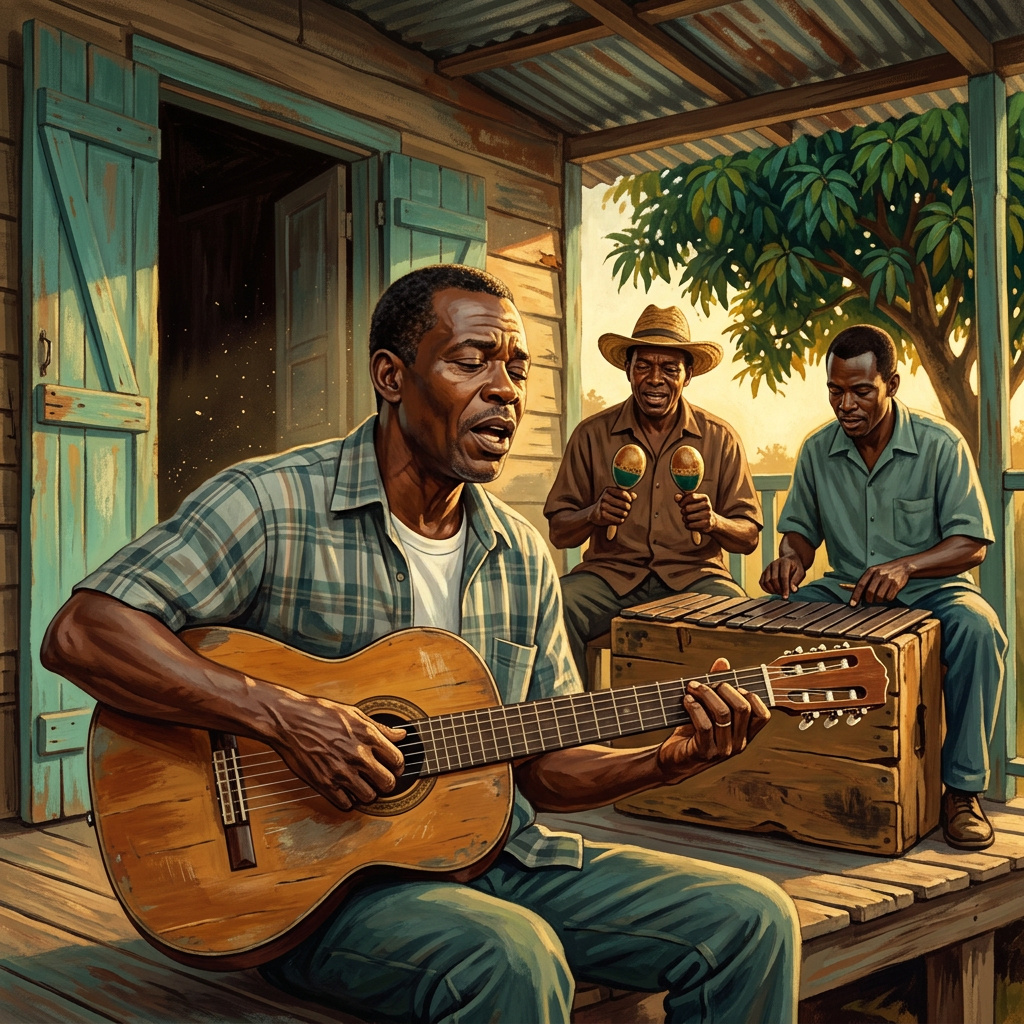
The sound arrives before the musicians do. Somewhere past the last streetlight in Léogâne, a guitar starts up in a yard — nylon strings, slightly out of tune, played with a thumb that has been keeping this same pattern for forty years. A pair of maracas answers. Then a low, woody thump, felt more than heard, as a man seated on a wooden box plucks metal tongues bent over a soundhole. By the time the singer opens his mouth, half the street has drifted toward the gate. Nobody bought a ticket. Nobody will. This is twoubadou, and in Haiti it has never really needed a stage.
The Cane Fields That Taught Haiti a New Chord
Twoubadou did not begin in Haiti. It began in a sugarcane field in Cuba, in the hands of men who were desperately homesick.
In the early 1900s, tens of thousands of Haitian laborers boarded boats each season for the Cuban harvest, cutting cane for wages that Haiti’s own faltering economy could not offer. They lived hard: long days under the machete, crowded barracks, contempt from the growers. What they found in the evenings, in the shared dark of the workers’ quarters, was Cuban guajiro music — the rural string tradition that would flower into son. Guitars, and the small bright-voiced tres. Songs about land, longing, and women, sung by ordinary men who had taught themselves to play.
Haitian cutters learned the chords. Then they did something more interesting than imitate: they folded the Cuban string style into mereng, the Haitian méringue that had been the country’s national dance since the middle of the nineteenth century — itself a fusion, born when the African rhythms of the chica and calenda met the ballroom posture of the French contredanse. Cuban strings, Haitian hips. When the men came home at the end of the season, the guitars came with them.

The name they gave it looked backward across an ocean and several centuries: troubadour, the wandering poet-singer of medieval France who moved from court to court trading songs about love. The Haitian version kept the wandering and kept the love songs, and traded the courts for backyards, market days, and hotel verandas.
An Orchestra You Can Carry on Foot
Part of what has kept twoubadou alive for more than a century is that it costs almost nothing to make. The genre’s instrumentation is a masterclass in resourcefulness.
At the center is the acoustic guitar — sometimes the Cuban tres, sometimes a banjo, an instrument Haitian players adopted and made unmistakably their own. Around it: the tanbou, a barrel drum played with bare hands; tcha-tcha, a pair of maracas; the graj, a metal scraper that supplies the shuffle. And holding down the bottom end, the manouba or marimbula — a wooden box with metal tongues fixed over a soundhole, large enough that the player sits on it and plucks between his knees. It is a bass, a stool, and a piece of luggage at the same time. An accordion turns up when someone has one.
Then there are the words, which are the whole point. A twoubadou is a singer-composer first and a guitarist second, and the songs are narrative — closer to American blues or Cuban son than to anything in a concert hall. They tell you about a landlord, a faithless girlfriend, a neighbor’s scandal, a bad year for the harvest. They are frequently funny and frequently filthy, working through layers of double meaning that let a performer say something outrageous in a churchyard and get away with it. And they slide between languages mid-verse — Kreyòl into French into scraps of Spanish left over from Cuba — the way Haitians actually speak when they are relaxed.
Ti Paris and the Age of the Serenade
If twoubadou has a patron saint, it is Ti Paris.
Born in 1933, Ti Paris became the most widely loved guitarist in Haiti’s provincial towns, a man whose recordings circulated on cassette long after his death in 1979 and whose phrasing every subsequent troubadour has had to reckon with. His music was small-scale and devastatingly precise: a voice, a guitar, and an eye for the street life and romantic disasters of Port-au-Prince. Groups that came decades later — Haïti Troubadour, Black Parents — were building on foundations he laid.
He worked in an era when the serenade was still a functioning social institution. A young man who wanted to be noticed hired musicians and stood under a window at an indecent hour. A family celebrating a saint’s day paid a trio to play in the yard until the rum was gone. Alongside Ti Paris came players like Althiery Dorival, singing in a raspy tenor over Haitian banjo, whose album Natif Natal and songs such as “Ti Joseph” made him a voice for Haiti’s poor majority — not pitying them, but describing their lives with humor and an unsinkable dignity.
Coupé Cloué: The Footballer Who Built an Empire on Innuendo
Jean Gesner Henry was born in Fondwa in 1925, trained as a cabinetmaker, studied a little classical music, and then became a professional footballer. Playing defense for the Port-au-Prince club Aigles Noirs, he tackled with such finality that the crowd gave him a nickname: Coupé Cloué — “cut and nailed.” He carried it into music, and it became one of the most famous names in the Caribbean.
Coupé Cloué started out in serenades, then founded Trio Select in 1957, which grew into the full Ensemble Select. What he built there was a hybrid he named konpa manba — “peanut-butter konpa” — taking the intimacy and storytelling of the twoubadou guitar and welding it onto the dance engine of konpa. The lyrics were his signature: bawdy, sly, endlessly suggestive, delivered deadpan in a voice like gravel in a bucket. Haitian audiences adored him for saying out loud, in code, what everyone was already thinking.
His reach ran far beyond Haiti. Coupé Cloué became a genuine star in West Africa, where audiences heard something familiar in his guitars and filled halls for him. When he died in January 1998 he was mourned as royalty, and his centenary in 2025 was marked across Haiti and the diaspora — proof that a man who sang dirty jokes over a guitar can end up a national institution.
Manno Charlemagne and the Guitar as a Weapon
The twoubadou tradition contains an argument as well as a party, and nobody made that argument as dangerously as Joseph Emmanuel “Manno” Charlemagne.
Born in 1948, armed with a deep voice, an acoustic Takamine, and a talent for lyrics that named names, Manno turned the troubadour’s intimacy into open political resistance. He recorded his first album in 1978, during the reign of Jean-Claude Duvalier, and was driven into exile from 1980 to 1986 — his songs building popular opposition to the dictatorship from outside the country. He came home when the Duvaliers fell, then was exiled a second time from 1991 to 1994 under the military junta of Raoul Cédras. Foreign journalists sometimes called him Haiti’s Bob Marley, which undersells how specific and local his targets were.
Then came the twist his own lyrics might have mocked: in July 1995 he was elected mayor of Port-au-Prince, and served until 1999. The man who had spent two decades singing about power now had to exercise it — a Haitian story if there ever was one. He died in 2017, still the reference point for anyone who picks up a guitar in Haiti with something to say.
Where the Twoubadou Plays Now
Twoubadou never had a revival, because it never stopped. It simply moved into whatever rooms were available.
You still find trios working restaurant floors in Pétionville and Cap-Haïtien, taking requests for a few gourdes. You find them at patron saint festivals, at countryside weddings, at Carnival, and on street corners in Port-au-Prince. In December the tradition surges: Haitian Christmas and New Year run on live guitars, and a troubadour who is quiet in October is booked solid through Jou Lendepandans. In Brooklyn, Miami, and Montreal the same thing happens in basements and church halls, the songs pulling a room of exiles back to a yard they left thirty years ago.
Some of it has traveled a long way. Ti-Coca, one of the few Haitians who makes his living purely as a twoubadou, tours internationally with Wanga-Nègès — the band founded by David Mettelus in 1976 and named for the hummingbird, which is roughly how the group plays. They have carried a form invented by cane cutters onto the stage of the Kennedy Center. A different lineage runs through Beethova Obas, born in 1964 to the painter Charles Obas and named for a German composer, who emerged in the early 1990s writing songs that carry the troubadour’s conscience into jazz-inflected territory.
What binds all of them is the original economics. Twoubadou requires no venue, no electricity, and no permission. In a country that has lost power grids, governments, and whole neighborhoods within living memory, a music that runs on a guitar and a wooden box is not a quaint survival. It is a design that refuses to fail.
Haiti’s great cultural inventions almost always begin with people who had nothing and improvised anyway — a fortress on a mountaintop, a language built out of resistance, a nation declared against every empire that mattered. Twoubadou belongs on that list. It was assembled in exile by workers nobody was writing songs about, carried home in the hands of men returning from the cane, and kept alive for a century by musicians who never expected to be famous and mostly weren’t. At HaitiPAM, we tell these stories because Haiti’s history does not live only in its battles and its presidents; it lives in a thumb on a nylon string in a dark yard, turning an ordinary evening into something worth remembering.
Leave a Reply