
Every 20 September, Haiti closes its offices, its schools and its shops to mark the birthday of Jean-Jacques Dessalines. It is a strange and beautiful thing to do, because nobody wrote that birthday down. No priest entered it in a parish register. No clerk recorded it in a colonial ledger. In Saint-Domingue in 1758, the birth of an enslaved child created no paperwork at all — a child born into slavery was an addition to an inventory, not a person with a date. And yet a nation that had to invent itself out of nothing has fixed a day, and keeps it.

The Record That Was Never Kept
Writing the life of a man who was born property means working against the grain of the archive. The colony of Saint-Domingue produced mountains of documents — shipping manifests, sugar yields, court proceedings, the meticulous accounting of an economy built on human beings — and almost none of it was interested in who those human beings were. Historians have never reached consensus on exactly when or where Dessalines was born. The date of 20 September 1758 is a reconstruction, assembled from fragments, held in place by a century of Haitian scholarship and, since 2020, by law.
What the archive does hold is scattered and hard-won. The French historian Jacques de Cauna was among the first to surface documentary evidence placing Dessalines’ birth in the region of Grande-Rivière-du-Nord, in the mountainous north of the colony, not far from Cap-Français. The evidence also suggests something that rarely survives about an enslaved person: a father’s name. He appears to have been born Jean-Jacques Duclos, carrying the surname his father had taken from the plantation’s owner — a name that was never really a name, only a mark of who held the title.
The historian Julia Gaffield, whose recent work has done more than anyone’s to reconstruct the man, puts the difficulty plainly: Dessalines’ early life is obscure, and he himself almost never spoke about his years in slavery. The silence was his own. He did not narrate it, did not build a public story out of it, and left his biographers with a gap that no amount of archival patience can entirely close.
Cormier, and the Name He Chose to Keep
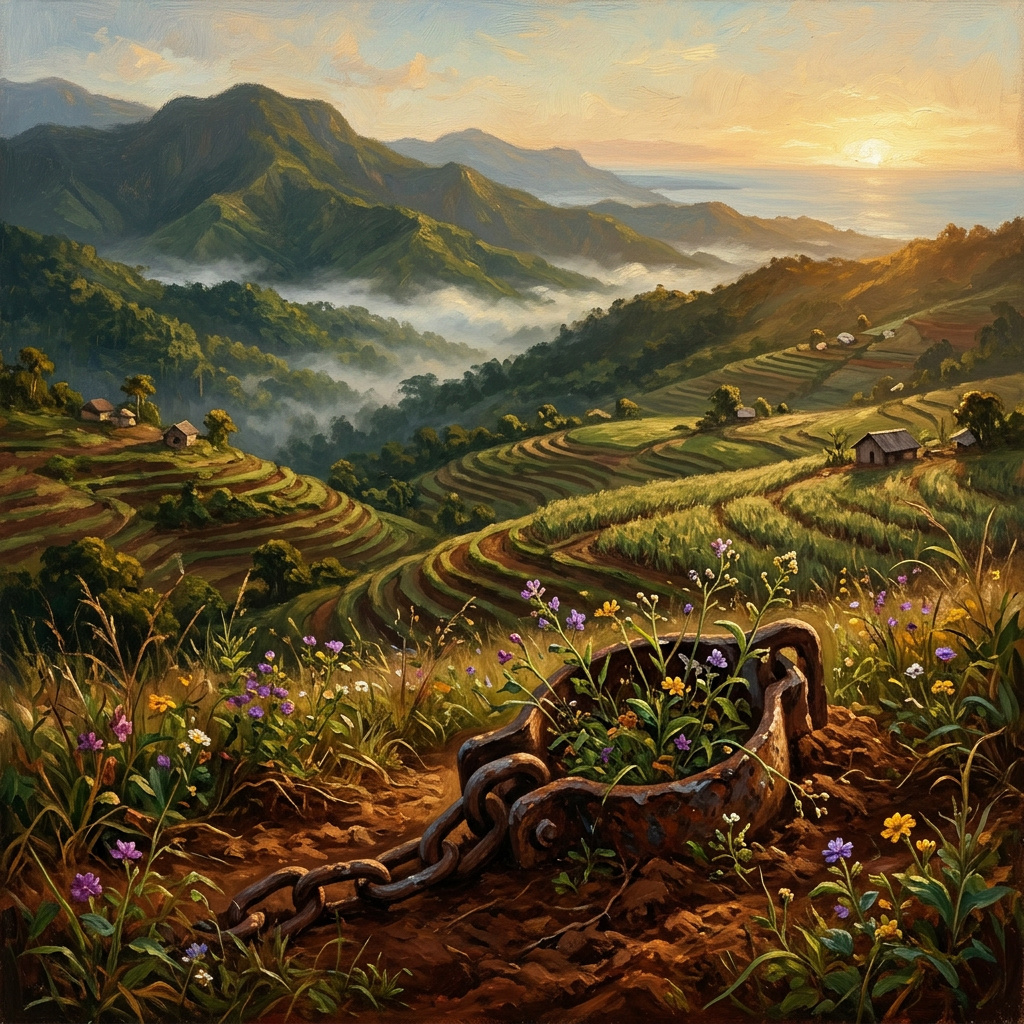
For most of his enslaved life he worked the Duclos sugar plantation at Cormier. Sugar was the most lethal work in the Americas — cane fields in the punishing heat, then the boiling house, where the mills took fingers and arms and the vats took skin. His master there was, by every surviving account, exceptionally cruel even by the standards of a system engineered for cruelty. Dessalines carried the scars of that plantation on his body for the rest of his life. Men who fought beside him decades later, when he was a general and then an emperor, could still read what had been done to him.
Around the age of thirty he was sold again, this time to a free Black master builder named Dessalines. It is one of the more revealing details of his early biography, and it turns on a choice he made later. When slavery was abolished and he was free to be called whatever he wished — when he could have discarded every name that had ever been imposed on him — he kept this one. Not Duclos, the name of the plantation that scarred him. Dessalines. Historians read that decision as evidence that the second household treated him as something closer to a man than the first had.
It is worth sitting with the arithmetic. Roughly thirty years enslaved. Then the uprising of 1791, the long war, the rise through Toussaint Louverture’s officer corps, the campaigns against the French and the Spanish and the British. Then 1802, Napoleon’s expedition sent to restore slavery, and Dessalines emerging as the revolution’s decisive commander. Then 1 January 1804, and independence, and the restoration of the Indigenous name Ayiti to the land. The founder of the first Black republic had spent the first half of his life as someone else’s property.

The Africa Question
For two centuries a rival story circulated: that Dessalines was born not in Saint-Domingue but in Africa, and carried across the Atlantic in the hold of a slave ship. It has been repeated in encyclopedias, in textbooks, in a great many well-meaning tributes. The trouble is where it came from. Several early nineteenth-century writers — overwhelmingly European, overwhelmingly hostile — reached for African birth precisely because it let them paint him as foreign, unassimilated and barbaric. The claim was never neutral. It was a character description dressed as a fact, and it was doing exactly the work its authors intended.
Haitian scholars pushed back on it from the beginning, arguing from the early 1800s onward that he was born in the colony. The archival record has since come down on their side. The episode is a small lesson in how the history of Haiti has been written: a detail repeated confidently abroad for two hundred years, contested by Haitians the entire time, and only lately confirmed in the direction Haitians had always said.
That pattern shapes his reputation more broadly. Gaffield notes the split cleanly — a hero to Haitians for centuries, and abroad a byword for barbarism and violence. Even admiring accounts, she observes, have a way of dwelling on the bloodshed. What gets lost in both versions is the thing she identifies as his actual achievement and his real legacy: securing the first permanent, universal and immediate abolition of slavery anywhere in the world. Not gradual. Not compensated. Not conditional on anyone’s approval. Immediate.
A Holiday Two Centuries Late
Here is the part that surprises most people, Haitians included: 20 September is a very young holiday. Dessalines was born in 1758 and killed in 1806, and for most of the time since, his birthday was not a national observance at all. It became one by an arrêté of 17 September 2020, which declared the date a public holiday across the entire national territory, dedicated to the memory of the founding father. Public administration closes. Schools close. Commerce and industry close. The 2026 observance marked the 268th anniversary of his birth — and only the sixth time the country had stopped work to mark it.
The lateness is not an oversight so much as a history in itself. Through the nineteenth century Dessalines was a contested and often unwelcome figure in Haiti’s official memory — remembered by the governing class as a tyrant, his killing treated as something between a necessity and an embarrassment. His rehabilitation was a twentieth-century project, driven from below as much as from above, by people for whom Papa Desalin had never stopped being the one who broke the chain. The holiday is the end of a long argument, not the beginning of one.
Two Dates, One Month
Haiti now holds two Dessalines days, and the distance between them is the whole story. 20 September is the birth. 17 October is the assassination at Pont-Rouge, just outside Port-au-Prince, where men who had fought beside him cut him down in 1806. Twenty-seven days separate them on the calendar.
In the commune of Marchand-Dessalines, in the Artibonite — the town he made his imperial capital, ringed by the forts he built against a French return that never came — those twenty-seven days are not two separate observances but one continuous season. The life of the emperor is commemorated there from 20 September through 17 October: ceremonies, processions, speeches, a month that opens with a birth nobody recorded and closes with a murder everybody did. Most nations mark a founder’s birthday and quietly decline to mark his end. Haiti insists on both, and on the ground in between.
There is something unflinching in that. It refuses the sanitized founder. It holds together the man born on a sugar plantation in the north and the man shot on a road outside the capital, and it does not pretend the second was deserved or that the first was inevitable. A country that was told for two hundred years that it should not exist has decided to remember its founder whole — scars, empire, contradictions and all.
That Haiti fixed a birthday for a man whose birth the colonial world refused to record is not a footnote — it is the founding gesture repeated in miniature. A people who were denied a place in the register wrote themselves one anyway, first with a declaration of independence and now with a date on the calendar. At HaitiPAM, we tell these stories because the archive was never built to hold them, and because remembering is its own kind of sovereignty. Haiti, peyi an mwen.
Leave a Reply