

Somewhere in the hills above Saint-Michel-de-l’Attalaye, before the sun has cleared the ridgeline, a donkey is picking its way down a footpath with a load of cut sugarcane lashed across its back. The cane was standing in a field yesterday. By tonight it will be juice, and within a week it will be kleren — the clear, fierce, unaged cane spirit that Haitians pour for their dead, drink at their weddings, rub on aching joints, and sell by the cupful out of plastic jugs in every market in the country. There is no marketing department behind it. There is no aging warehouse. There is only cane, wild yeast, fire, and copper, arranged in more or less the same order they have been arranged in Haiti for over three hundred years.
A Spirit Older Than the Republic
Kleren did not begin as a Haitian drink. It began as a colonial byproduct. In seventeenth- and eighteenth-century Saint-Domingue, the most profitable colony on earth, French planters ran sugar estates on the labor of enslaved Africans, and from the fresh juice of that cane they distilled a raw, cheap spirit called tafia. Tafia was not for the planters’ tables. It was currency in the coastal trade, ration and anesthetic on the plantations, and — quietly, in the provision grounds and at night — an offering in the ceremonies the enslaved carried with them from West and Central Africa.
Then the revolution came, and the plantation system that produced tafia was burned to the ground along with everything else. What is remarkable is what happened next. Across the rest of the Caribbean, sugar consolidated: estates merged, distilleries industrialized, and the number of producers collapsed. In Haiti it went the other way. Land was broken up among smallholders, and the knowledge of how to press cane and run a still went with it — into thousands of small hands, on thousands of small plots. The colonial spirit survived by becoming a peasant one. That inversion is the whole story of kleren, and arguably a good deal of the story of Haiti itself.
Five Hundred Distilleries, No Two Alike
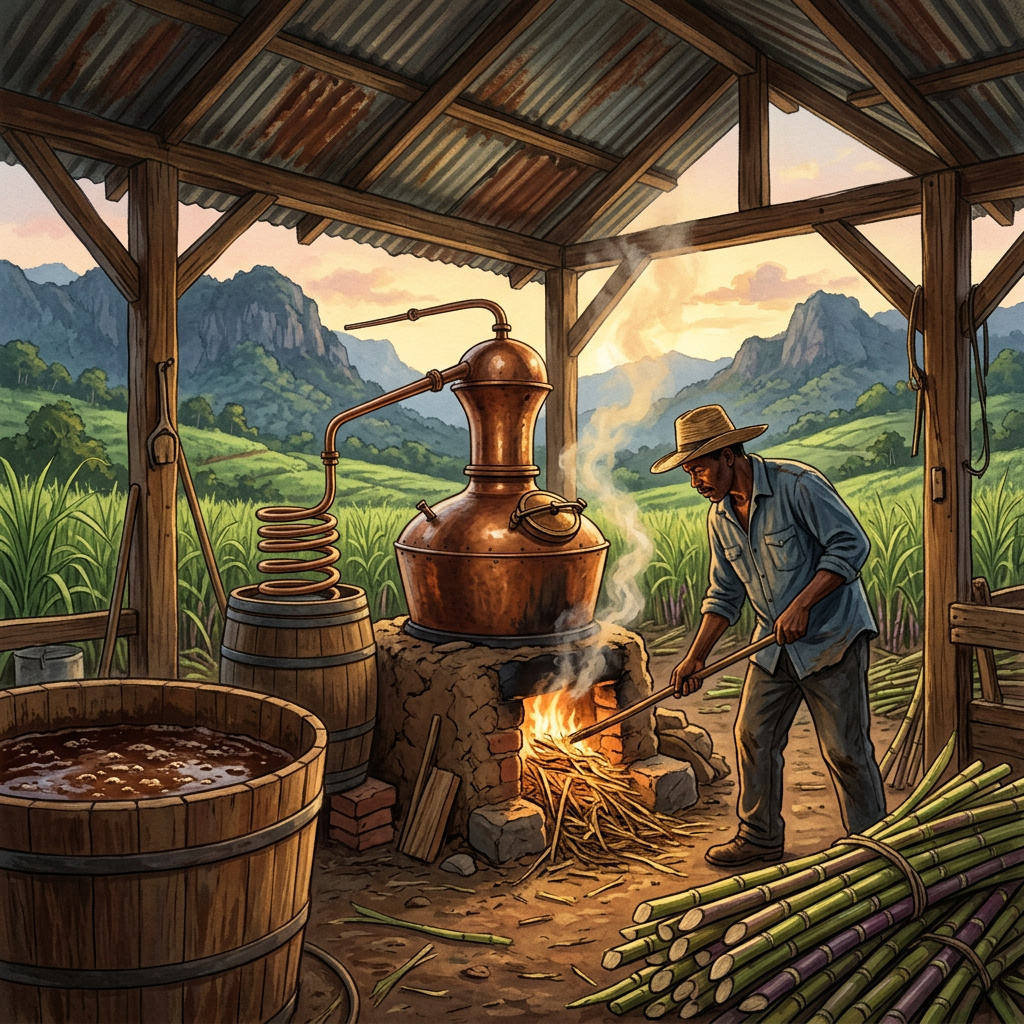
Here is the statistic that stops people who know the spirits world: fewer than fifty distilleries are still operating across the entire rest of the Caribbean. In Haiti alone there are more than five hundred. They are not distilleries in the sense of gleaming stainless steel and stainless-steel accountants. They are open-sided sheds set down in the middle of the cane, roofed with tin, with a mill out front and an alembic out back.
The method is unhurried and almost entirely pre-industrial. Cane is cut by hand and brought in by ox cart or on the back of a mule, and it has to be pressed the same day or by the following morning, because fresh cane juice begins to turn almost immediately. The juice goes into vats of wood or metal, and then — this is the part that makes the spirits world sit up — nothing is added to it. No cultured yeast, no starter, no temperature control. Fermentation is left to the wild yeasts already living on the cane skins, in the vat staves, in the air of that particular valley. It runs for at least five days, sometimes considerably longer. Then it is distilled in a copper alembic fired by burning bagasse, the dried cane fiber left over from pressing, so that the plant fuels its own transformation and almost nothing is wasted.
The cane itself is not the modern high-yield hybrid grown everywhere else. Haitian producers still work heritage varieties with names that sound like a folk song — Cristalline, the most prized; alongside Farine France, Hasco, Petekoka, Madame Meuze, Créole. It grows on an eighteen-month cycle, generally without synthetic chemicals, intercropped with corn, manioc, bananas, and mango, because a family that plants only cane cannot eat. What all of this produces is a spirit with a fingerprint. Kleren from Pignon does not taste like kleren from Cavaillon or Barradères. It cannot. Different cane, different yeast, different water, different hands.

The Drink the Lwa Ask For
To understand why kleren has never gone away, you have to understand that in Haiti it is not only a beverage. It is a ritual substance. In Vodou ceremony, kleren is poured onto the ground in libation for the ancestors and for the lwa, tracing the boundary between the living and the dead. It is sprinkled to consecrate ground, used in cleansings meant to strip away misfortune, and taken in small sips by the houngan or manbo as part of the work of drawing the spirits near. Certain lwa are known to want it, and to want it unsoftened by age or sugar. Gede, the raucous spirits of death and fertility who take over the cemeteries at the start of November, are famous for demanding kleren steeped with chile peppers so fierce no ordinary person could swallow it — proof, when a possessed body drinks it without flinching, that the spirit and not the person is present.
Outside the peristil, it does the ordinary work of a national drink. It is at weddings and at wakes, at cockfights and at the end of a long day cutting cane. Infused in jars with roots, bark, and spices, it becomes tranpe, the household medicine cabinet of rural Haiti — for chills, for stomach trouble, for whatever is wrong. It is the spirit of a country where a bottle of imported liquor is a luxury and a cup of kleren costs a few gourdes. Haitians call it, with affection and without apology, the rum of the people.
Kleren and Barbancourt: Two Haitian Rums
Haiti’s other cane spirit is world-famous, and the contrast is instructive. Rhum Barbancourt, founded in 1862, is a single large distillery whose method was consciously modeled on Cognac: fresh cane juice, double distillation, long aging in oak. It is polished, exported, and stocked in good bars from Paris to Tokyo, and its supply chain reaches more than three thousand small and medium sugarcane farmers across the country — one of the few Haitian agricultural value chains that genuinely functions at scale.
Kleren is the opposite arrangement, and both are authentically Haitian. Where Barbancourt is one house making a consistent product, kleren is five hundred houses making five hundred products, none of them consistent and none of them trying to be. Barbancourt is aged; kleren goes from cane to cup in a matter of days. Barbancourt is bottled and labeled; kleren is more often ladled from a jerrican into whatever container you brought. One is Haiti’s ambassador. The other is Haiti’s household.
The World Comes Looking
For most of its history, kleren stayed home. That changed in 2012, when the Italian importer Luca Gargano of Velier — a man with a long record of finding spirits before the rest of the industry does — went into the Haitian countryside and started tasting what the small distillers were making. He found Michel Sajous at Chelo. A remark from someone a few days later sent him toward Vaval; a chance meeting on the road led him to the Casimir family’s still. In 2014 the first three clairins — Sajous, Vaval, and Casimir, each named for the person who made it rather than a brand invented by a marketing team — went abroad. Le Rocher joined the range in 2017, and in 2018 a fifth arrived from a small distillery at Cabaret called Sonson.
Bartenders reacted the way people do when they encounter something with no smoothing applied to it. Here was a cane spirit that tasted violently of place, with none of the sanding-down that industrial production performs. In 2018 the Slow Food Foundation established a Presidium for traditional Haitian clairin, working with twelve artisanal producers across Saint-Michel-de-l’Attalaye, Pignon, Cabaret, Barradères, and Cavaillon, with a protocol that simply writes down what these families were already doing: native cane, no synthetic chemicals, wild-yeast fermentation, copper pot distillation. The Presidium’s language is worth noting — it treats the distillers not as quaint survivors but as defenders of the territory, people whose farming practices are a live argument about what Haitian agriculture could be.
There is a real tension in this, and it should not be smoothed over either. Export markets pay far better than a market stall in Pignon, but they also reward standardization, and standardization is the one thing that would kill what makes kleren worth exporting. So far the Haitian producers have mostly held the line. The bottles that reach New York and Milan are still made the way the ones sold down the road are made — which is to say, by a family, from their own cane, with fire and copper and time.
Kleren is one of those Haitian things that looks, from outside, like poverty — cane cut by hand, a still in a shed, liquor sold from a jug — and turns out on closer inspection to be an inheritance the rest of the world spent a century throwing away and is now trying to buy back. The colonizers brought the still. Haitians kept it, scattered it across five hundred hillsides, and made it theirs. That pattern repeats everywhere you look in this country, and at HaitiPAM it is the pattern we keep returning to: the story of what Haiti built out of what it was handed.
Leave a Reply