
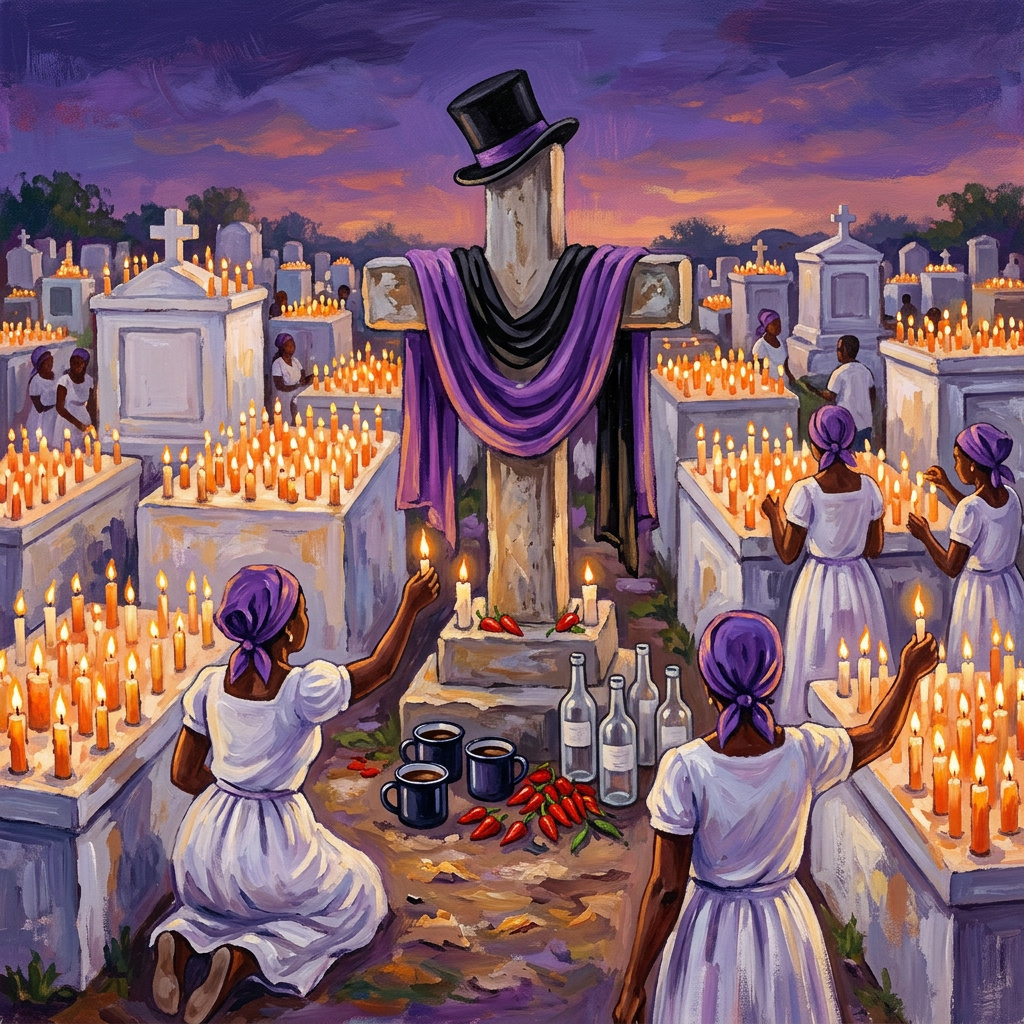
Before sunrise on the first of November, the women are already at the cemetery gates with buckets of whitewash and armfuls of candles. By mid-morning the tombs have been scrubbed and repainted, coffee has been poured onto the ground in three careful splashes, and somewhere among the crowded graves a drum has started. Then a man in a battered top hat and dark glasses with one lens punched out comes swaggering down the alley between the tombs, hips rolling, cane twirling, telling a joke so filthy that the grandmothers shriek with laughter. Nobody is scandalized. The dead have arrived, and in Haiti the dead are very good company.
This is Fèt Gede, the festival of the ancestors, and although its great days are November 1 and 2, the whole month belongs to it. All through November, in temple courtyards and family yards from Port-au-Prince to Brooklyn, Haitians keep feeding, teasing, and dancing with the spirits who stand between the living and those who came before.

Two Holidays, One Cemetery
On the Haitian calendar, November 1 is Fèt Tousen, All Saints’ Day, and November 2 is Fèt dè Mò, the Day of the Dead. Both are public holidays. The Catholic Church gave the dates; Haiti gave them their character. Families go to Mass in the morning and to the graveyard in the afternoon, and many see no contradiction in lighting a candle in the cathedral and then pouring rum at the foot of a cemetery cross.
That layering is as old as the country. Enslaved Africans in Saint-Domingue were baptized by law and forbidden their own rites, so they learned to honor their ancestors under cover of the saints’ days. The feast for all the faithful departed became the natural home for the spirits of the dead. Two centuries after independence, the arrangement still stands: the same family that pays for a requiem Mass will set out a plate of food at home for a great-grandmother who, as everyone knows, never stopped being hungry.
The Baron, the Grandmother, and Their Unruly Children
Every Haitian cemetery has a master. Tradition holds that the first man buried in a graveyard becomes its Bawon, and the first woman its Grann Brijit. His sign is the kwa Bawon, the large cross that stands near the entrance or at the central crossing of paths. Hers is often a tree or a pile of stones. Nothing happens among the tombs without their permission, which is why visitors greet the cross before they greet their own dead.
Bawon Samdi is stern, formal, dressed like an undertaker of another century in a black frock coat and tall hat. The Gede are his family and his opposite. They are the spirits of the forgotten dead, the ones with no one left to remember their names, gathered up and given new life as a rowdy clan: Gede Nibo, Brav Gede, Gede Ti Malis, and countless others, each with a nickname and a personality. Their colors are black, purple, and white. Their humor is merciless.
Because they have already died, the Gede have nothing left to fear and nothing left to hide. They say what the living only think. They mock the powerful, expose hypocrites, flirt with everyone, and speak about sex with a frankness that would empty a church. It is all deliberate. The Gede rule the two doors of existence, the grave and the cradle, and their bawdiness is a reminder that life comes from exactly the place polite people refuse to mention. Mothers bring sick children to them. No spirit is thought to love children more.
Pepper, Rum, and the Banda
You know a Gede by the costume: the hat, the cane, the cigar, a face powdered white as bone, sometimes cotton tucked into the nostrils the way a corpse is prepared. The broken sunglasses matter most. One eye looks on the world of the living and the other on the world of the dead, and the Gede sees both at once.
You know a real one by the pepper. The drink of the Gede is kleren, raw cane spirit, steeped with a fistful of the hottest piman bouk until it could strip paint. A person truly mounted by the spirit drinks it like water and rubs it on the face and in the eyes without flinching. Anyone only pretending is found out quickly, to the delight of the crowd.
Then comes the banda, the Gede’s own dance, a fast, grinding roll of the hips set to a driving drum. It is comic and it is serious, a dance of death that is unmistakably about making life. The offerings match the mood. The Gede like the food of poor people: black coffee, roasted peanuts and corn, cassava bread, smoked herring, boiled plantain, all of it generously peppered. Writing in the 1930s, the American author Zora Neale Hurston called Gede the one spirit that belonged wholly to Haiti’s common people, a god who preferred their plain table to anyone’s banquet.

The Day the Dead Called on the President
The Gede’s talent for cutting the mighty down to size has its own legend. The filmmaker Maya Deren, who studied Vodou in Haiti in the late 1940s, recorded a story still told about the presidency of Louis Borno in the 1920s, during the American occupation. A band of Gede, the story goes, dressed in their finest funeral clothes, marched through the streets of Port-au-Prince to the gates of the National Palace, singing and gathering a crowd as they went. They wanted money, and they would not leave without it.
The guards hesitated. Borno was a polished member of the elite and no friend of Vodou, but he understood what it would mean to turn away the dead in front of half the city. He paid. The song said to commemorate the visit is still sung every November: Papa Gede bèl gason, Papa Gede is a handsome fellow, dressed all in white to go up to the palace. Whether or not every detail happened as told, Haitians have kept the story for a century because of what it says. Presidents come and go. Death outranks them all, and death has a sense of humor.
A Festival Under Pressure
For generations the heart of Fèt Gede has been the Grand Cimetière of Port-au-Prince, the vast national cemetery near the city center. On a normal November 2 its lanes were packed with pilgrims pressing toward the Bawon’s cross, vendors selling candles and kleren, and Gede holding court on the tombs. The earthquake of 2010 broke many of those tombs open and filled the ground with new dead. Mourners came back anyway.
The past few years have been harder. Armed gangs now control most of the capital, and the cemetery sits in contested ground. In 2024 its director told reporters that the pilgrims and the merchants who used to come simply had not come. In 2025, days after Hurricane Melissa battered the south, a few hundred worshipers still made their way in, dressed in white and purple, to ask the Bawon for health, work, and safer days. The crowds are smaller. The observance has not stopped. It has moved into neighborhood cemeteries, provincial towns like Gonaïves and Jacmel, and private temples where the drums can sound behind a wall.
Gede Crosses the Water
The dead also travel. In the basements and storefront temples of Brooklyn, Miami, Boston, and Montreal, November is the busiest month of the ritual year. The anthropologist Karen McCarthy Brown, in her classic portrait of the Brooklyn priestess known as Mama Lola, described how Gede arrived at nearly every ceremony there, joking in a mix of Kreyòl and English and handing out advice on immigration papers, rent, and wayward husbands. A spirit of the poor adapts easily to new kinds of trouble.
For Haitians abroad, whose parents and grandparents lie in cemeteries they may not be able to visit, the festival carries extra weight. A candle, a cup of black coffee, and a small glass of pepper rum on a windowsill in Flatbush do the work that a trip to the family tomb once did. The Gede, after all, are the dead who refuse to be forgotten, and they are remarkably good at finding their people.
Fèt Gede holds one of Haiti’s oldest convictions: that the dead are not gone, that laughter belongs at the graveside, and that a people who remember their ancestors cannot be erased. Through revolution, occupation, earthquake, and exile, every November the candles are lit again. At HaitiPAM, we tell these stories for the same reason the Gede dance: so that no one who made this country is ever left without a name.
Leave a Reply