

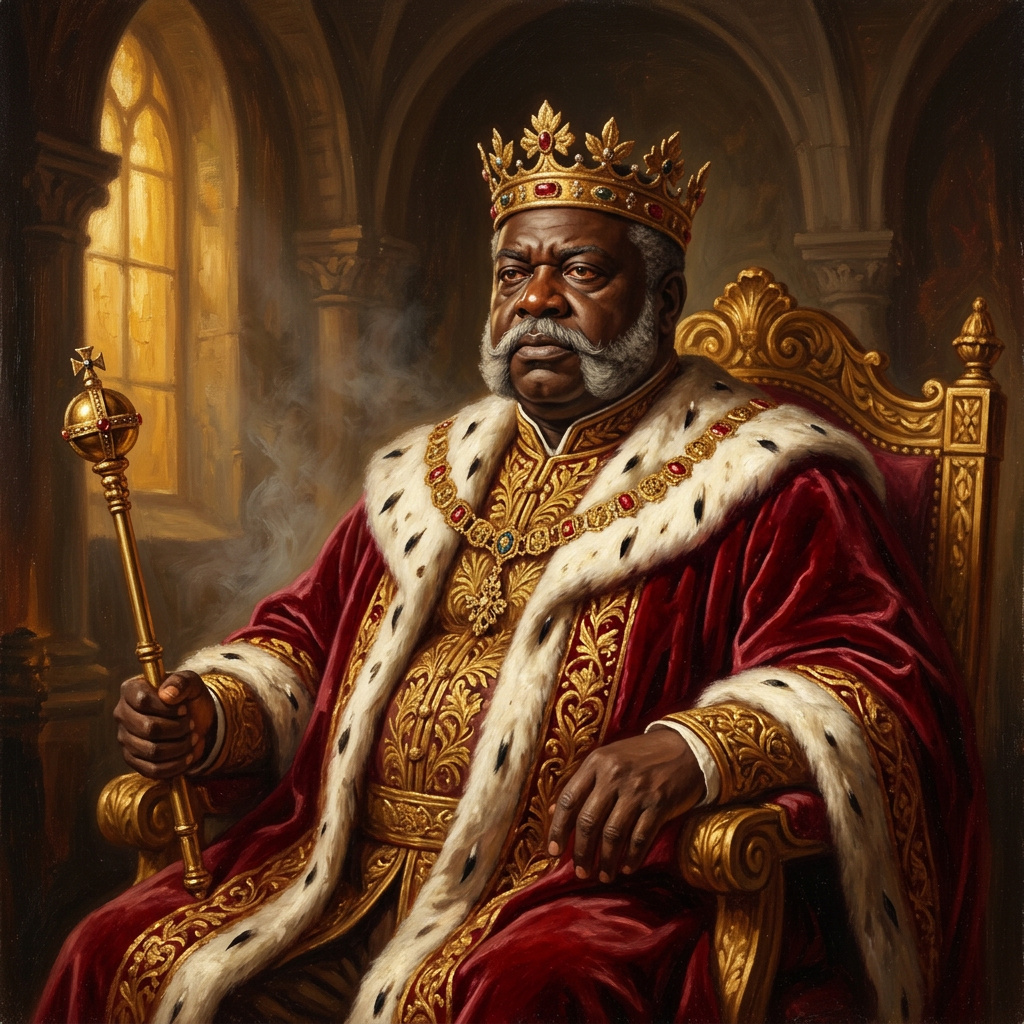
On the morning of 18 April 1852, the cathedral in Port-au-Prince filled with incense, brass bands and the rustle of brand-new velvet. At the altar stood a man nearly seventy years old, born enslaved on a plantation near Petit-Goâve, about to put a crown on his own head. The crown had cost two thousand pounds sterling. The robes, the scepter, the throne and the rest of the regalia had cost fifteen times as much, and they had been copied, stitch for stitch, from the coronation of Napoléon Bonaparte. The man was Faustin-Élie Soulouque. Payments on the country’s foreign debt would be interrupted to pay for it, but on this day Haiti had an emperor.
Soulouque is one of the most mocked rulers in Haitian history, and one of the most misunderstood. Foreign writers turned him into a cartoon. Haitian historians remember a decade of fear, failed wars and an empty treasury. Underneath both versions is a stranger and more revealing story about colour, power and who Haiti’s independence actually belonged to.
A Soldier from Petit-Goâve
Faustin Soulouque was born on 15 August 1782 in Petit-Goâve, in the French colony of Saint-Domingue, to an enslaved mother named Marie-Catherine. He was freed as a boy by the emancipation decree of the French commissioner Léger-Félicité Sonthonax in 1793, and by 1803 he was carrying a musket in the revolutionary army that drove the French out for good. He fought as a private in the final campaign of the war of independence and stayed in uniform for the next four decades.
His career was steady rather than spectacular. He became a lieutenant in 1806 and an aide-de-camp to General Lamarre. Under President Alexandre Pétion he joined the Horse Guards. He rose to colonel under Philippe Guerrier and, under President Jean-Baptiste Riché, to lieutenant general and commander of the Presidential Guard. Contemporaries described him as quiet, devout, barely literate and loyal. To the men who ran Haiti in the 1840s, those were exactly the right qualities.
The Puppet Who Cut His Strings
Haitian politics after the fall of Jean-Pierre Boyer in 1843 ran on a system historians call la politique de doublure, the politics of the understudy. A small, mostly light-skinned elite in Port-au-Prince controlled commerce, the Senate and the civil service. To keep the black majority quiet, it placed elderly black generals in the presidency and governed through them. When President Riché died suddenly in February 1847, the elite went looking for another understudy, and they chose the commander of the palace guard.
Soulouque was sworn in on 2 March 1847. The senators who elected him expected a figurehead. Within a year they found they had misjudged him. He built a militia loyal only to himself, a feared irregular force known as the zinglins, and he began replacing the elite’s men in the army and the administration with black officers from the provinces. On 16 April 1848, rumours of a plot against him exploded into violence in Port-au-Prince. The guard and the zinglins turned on mulatto politicians and merchants in the streets, and many were killed or forced into exile. The understudy system died that day, and fear became the instrument of government.
Faustin I and His Imperial Court
On 26 August 1849, the Senate and Chamber of Deputies proclaimed him Emperor Faustin I. A new constitution that September gave him the right to create hereditary titles, and he used it generously. By one 1859 count the empire had 4 princes, 59 dukes, 90 counts and 250 barons, along with knights, marchionesses and two new chivalric orders. Most of the titles were named after Haitian towns and districts, and nearly all went to black generals and loyalists who, a few years earlier, could never have expected a seat at the table of power.
He married his longtime companion, Adélina Lévêque, in December 1849, and she became Empress. He founded an Imperial Academy of Arts in 1856. He also did something no Haitian head of state had done openly: he gave Vodou semi-official standing, kept manbos and oungans close to the court, and refused to pretend that the faith of most Haitians was something to be ashamed of. For the rural majority, this was not a joke. A black emperor who honoured the lwa and pushed the old elite aside looked like independence finally reaching them.

Three Marches East
The emperor’s great obsession was the eastern half of the island. Haiti had governed it from 1822 until the Dominican uprising of 1844. Soulouque believed, as many Haitians did, that an independent Dominican Republic would become a foothold for France, Spain or slaving powers, and that the island could only be safe united under Port-au-Prince.
He tried to retake it three times. In 1849 his army advanced deep into Dominican territory before collapsing near Ocoa, where a few hundred determined defenders and a lack of food and supplies broke it. In 1850 a second invasion was halted before it began, when Britain, France and the United States jointly warned him off. In late 1855 he marched again with an army often put at around 30,000 men, and it was routed at Santomé and Cambronal and again at Sabana Larga in January 1856. Thousands of Haitian conscripts never came home. Each defeat cost money the treasury did not have and drained the loyalty of the army that kept him in power.
Laughter in Paris
Abroad, Soulouque became a punchline. The Paris press filled with caricatures of the Haitian emperor and his dukes, many by the cartoonist Cham. The jokes were openly racist, mocking the very idea of a black man in a crown. They were also, very often, not really about Haiti at all. In December 1851, Louis-Napoléon Bonaparte seized power in France by coup and a year later declared himself Emperor Napoléon III. Attacking him directly could land a French writer in prison. Mocking a Haitian emperor who copied the first Napoléon’s coronation was safe. Soulouque became a mask for satirizing a European dictator, and the cruelty of the jokes was aimed at both men at once.
The caricature outlived its purpose. For more than a century, foreign accounts of Haiti used Soulouque as proof that Haitians could not govern themselves, ignoring that the coronation he was mocked for was a copy of a European one, staged in the same decade Europe crowned its own imitation Bonaparte.
The Fall and the Long Way Home
By 1858 the empire was exhausted. The army was demoralised, the currency was weak and the elite had never forgiven 1848. In December, General Fabre Geffrard, one of the emperor’s own dukes, raised a revolt in Gonaïves and defeated the imperial forces. Soulouque fled the capital, was deposed within days and formally abdicated on 15 January 1859. A week later a British warship carried him into exile in Jamaica. Geffrard became president and restored the republic.
Soulouque was eventually allowed to come home under the government of Sylvain Salnave. He died in August 1867 at Petit-Goâve, the town where he had been born enslaved some eighty-five years earlier, and was buried at Fort Soulouque.
His legacy is hard to settle. He governed through terror, wasted lives and money on impossible wars and left Haiti poorer than he found it. He also broke, for a time, the elite’s habit of ruling through borrowed black faces, gave official dignity to the religion of the people and showed how quickly a “safe” president could become the most dangerous man in the country. The pattern of a ruler chosen to be controlled, who instead turns a private militia on his makers, would return in Haitian history, most darkly a century later under François Duvalier.
Faustin Soulouque’s empire lasted only a decade, but the questions it raised about colour and class, about who controls the palace and who merely sits in it, and about how the world chooses to laugh at Haiti, are still alive. Understanding them is part of understanding the country itself. At HaitiPAM, we keep telling these stories in full: the glory, the folly and the hard lessons of a nation that has always insisted on writing its own history. Haiti, peyi an mwen.
Leave a Reply