
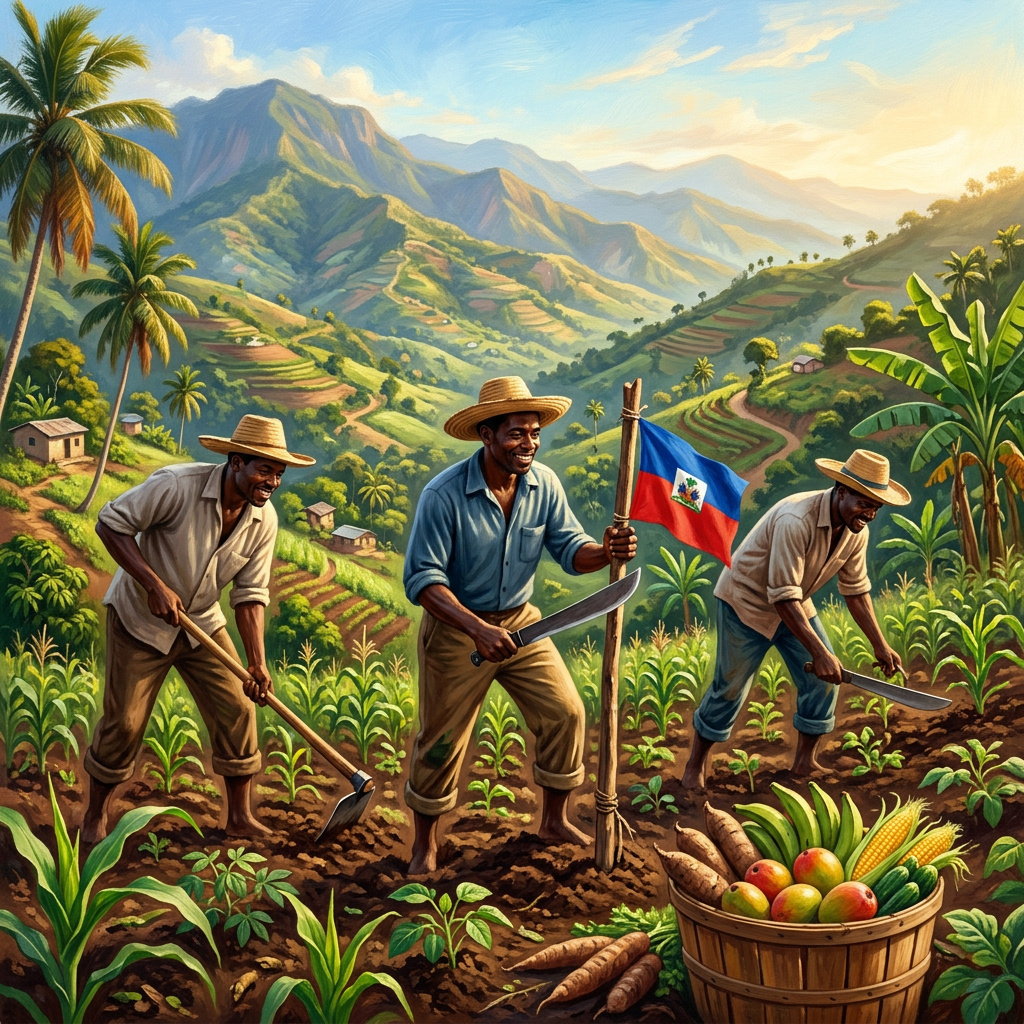
On the first morning of May, before the heat settles over the hills, you can hear them: drums, a horn, a chorus of voices rising in unison from a Haitian field. A line of farmers moves across the land in rhythm, machetes flashing, hoes biting into the soil. Someone at the back is singing a call, and twenty voices answer it. This is a konbit — a collective workday — and it is the oldest possible way to celebrate what May 1 means in Haiti. While much of the world marks the day as Labor Day, Haiti alone calls it the Fête du Travail et de l’Agriculture — the Festival of Labor and Agriculture — and that single conjunction carries the weight of two centuries of national history.

The Holiday That Honors Two Things at Once
Most countries that observe May 1 do so as a workers’ holiday — an inheritance from the international labor movement, the Chicago strikes of 1886, and the socialist congresses of late nineteenth-century Europe. Haiti adopted that international tradition, but it did something no other country did. It fused the day with another celebration entirely: a celebration of agriculture, of the soil, of the men and women who feed the nation. The official name of the holiday — Fête du Travail et de l’Agriculture — refuses to separate them. Every Haitian schoolchild learns that work and the land are one inheritance, that the man who breaks rocks in a quarry and the woman who weeds a row of djondjon mushrooms are honored on the same day, by the same flag.
The legal frame for the modern holiday came together in the late 1940s, during one of the most intellectually ambitious presidencies in Haitian history. Article 139 of the Constitution of 1946 listed three national holidays — Independence on January 1, Agriculture and Labor on May 1, and the Flag on May 18 — and a law dated April 29, 1948 turned May 1 into a paid public holiday. President Dumarsais Estimé signed it, and the timing was no accident. Estimé was preparing to celebrate the Bicentennial of Port-au-Prince in 1949, transforming the capital with new monuments, a world’s fair, and a confident new vocabulary of national pride. He wanted a calendar that told a story: the country was born in liberation, raised in agriculture, and crowned in its own flag. May 1, sandwiched between those two anchors, made the fields and the factories part of the founding itself.
An Older Memory: Dessalines and the Land
Estimé did not invent the link between Haitian sovereignty and Haitian soil. He was completing a thread that ran back to the founding generation. In the 1805 Constitution — the first written by a free Black republic — Jean-Jacques Dessalines made agriculture a constitutional concern, not a footnote. Articles 21 and 27 spoke of farming as a duty and a virtue. It was the practical translation of an idea Dessalines had been articulating since the war: a country that could not feed itself could not stay free. Independence had been won by men who carried machetes as well as muskets, and most of them, when the fighting was done, went back to the only inheritance they had — the land.
The decisive break with the colonial past came not under Dessalines but under the man who succeeded him in the south: Alexandre Pétion. Beginning in 1809, Pétion launched what historians now call the first land reform in Latin American history. He took plantations that had once belonged to French planters — the great sugar estates of Léogâne, Jacmel, the southern plain — and broke them apart. He gave land to his soldiers first, then extended the program: any Haitian who could afford a few gourdes could buy a parcel from the state, and Pétion kept lowering the price until almost no one was excluded. By the 1840s, no plantation was its original size. Haiti had become, in the words of one historian, “a society of peasant proprietors.” Today, more than ninety percent of Haitian farms are still under four hectares. That tiny family plot — the jaden — is Pétion’s legacy, and it is the foundation on which May 1 rests.
Konbit: The Real Engine of Haitian Agriculture
If the law was written in 1948, the spirit of the holiday was written in the eighteenth century. The word that captures it is konbit — Haitian Kreyòl for “work together.” A konbit is a collective workday in the fields. A farmer who needs his cane cut, his beans planted, or his hillside terraced sends word to neighbors and kin. They come at dawn carrying their tools, organize themselves into rows, and move across the land as one body. There is a song-leader at the head of the line — the simidor — and he calls out a verse; the others answer, the rhythm sets the pace of the hoes, and a job that would have taken one man a week is finished by sundown. In return, the host’s family feeds everyone: pots of rice, beans, fried plantains, bread, sometimes a sacrificed goat, always coffee.
Konbit was not invented for May 1. It was invented in slavery. On the colonial plantations, enslaved Africans built secret economies of mutual aid — gardening their own provision plots at night, harvesting one another’s crops in turn, hiding the runaways, sharing what little could be shared. After independence, that habit of cooperation moved into the open and became the basic technology of Haitian smallholder farming. It is what makes a country of tiny plots into something like a community. On May 1, communities still organize konbits as a kind of public theater of who they are: the drums come out, the simidor sings, the rum and the kremas are poured, and the day’s harvest is shared on long tables under tarpaulins. The festival is the daily life made visible.

How Haiti Celebrates the Day
The modern observance has two faces. In the cities — Port-au-Prince, Cap-Haïtien, Les Cayes, Jacmel — May 1 looks like Labor Day everywhere else. Trade unions and worker associations march down the main avenues. Red flags snap in the morning air. Speeches at the Champ-de-Mars or at municipal squares invoke the dignity of the working class, denounce wage stagnation, and remember the struggle that built every right Haitian workers have. Street vendors set up along the parade routes selling griot, fritay, akra; the smell of frying pork fat hangs over the crowd. The day belongs, for a few hours, to the welder and the sewing-machine operator and the longshoreman.
In the countryside — and in much of the smaller-town life that is closer to the countryside than to Port-au-Prince — the day is agriculture’s. Farming families gather at konbits organized by community associations, churches, and schools. Konbits are held at agricultural schools, at parish halls, at the rural teaching institutes that have always doubled as community centers. The Institut Sacré-Cœur in Cap-Haïtien, for instance, hosts a yearly konbit in which farmers scrape manioc together while drums and horns play; the morning’s manioc becomes the afternoon’s kasav, the flat bread that has fed Haitians since the Taíno. Food fairs spring up in market squares, with farmers showing off their best yams, plantains, mangoes, and bottles of cane syrup. Children parade in straw hats with miniature hoes. The point is to make agriculture visible — to remind a nation that has been pulled toward the city for a century that the country is, at root, a republic of farmers.
The Diaspora Adds Its Own Layer
For Haitians outside Haiti, May 1 has taken on a slightly different shape. In Brooklyn, Miami, Montreal, and Boston, May 1 is the unofficial opening of Haitian Heritage Month — a thirty-day stretch that runs through Flag Day on May 18 and on into the end of the month. Cultural centers host panels on Haitian agriculture; restaurants put a special on griot or soup joumou; community gardens — there are several in Brooklyn alone, planted and tended by Haitian families who never lost the habit of the jaden — hold open days. The agricultural side of the holiday is, in some ways, more visible in the diaspora than the labor side, because the urgency of remembering the soil is more vivid for people who left it. A Haitian farmer in the Artibonite Valley does not need to be reminded what the land is. A Haitian taxi driver in Flatbush does, and the holiday gives him a way to bring his children back to it.
Why the Day Still Matters
Haitian agriculture has been under pressure for a long time — soil erosion, deforestation, cheap imported rice, a generation of young people leaving the land for the cities or for abroad. Every May 1, the speeches are full of it. Politicians promise irrigation projects; ministries announce subsidies that may or may not arrive; farmers’ associations issue manifestos. It would be easy to be cynical about the holiday, to file it under the long list of national rituals whose words outrun their deeds. But that would miss the point. May 1 is not, in Haiti, primarily a political holiday. It is a memory exercise. It is the country reminding itself, once a year, that its founders gave land to its soldiers, that its peasants invented mutual aid before any government did, that no constitution and no flag and no anthem mean anything if the soil does not feed the people who stand for them. The drums on May 1 are saying what Dessalines, Pétion, and Estimé all knew: the republic is the field.
From the konbits of the 1800s to the parades of today, the Fête du Travail et de l’Agriculture stands as one of Haiti’s most distinctive national celebrations — a day where the song of farmers and the march of workers belong to the same anthem. At HaitiPAM, we keep telling the stories that make a holiday more than a date on a calendar — the people, the land, and the long work of being free.
Leave a Reply