
Every July, when the Centre department’s hillsides shimmer with heat and the rains of summer begin to swell the rivers, a great human current starts moving toward a single point on the map. Tens of thousands of Haitians — peasants, schoolteachers, taxi drivers, returning members of the diaspora — leave their homes and converge on a small valley near Mirebalais. They come on foot, by motorcycle, in tap-taps so loaded that knees press against strangers’ knees. They come singing, praying, and carrying offerings. They come because somewhere in that valley, a hundred-foot wall of water tumbles down a limestone cliff, and that water, every Haitian knows, is holy.

The Day the Earth Made a Sanctuary
The story of Saut-d’Eau — Sodo, as Haitians call it in Kreyòl — begins not with a prayer but with a tremor. On May 7, 1842, a massive earthquake split the northern half of Hispaniola. The same convulsion that flattened Cap-Haïtien also tore open a new fold in the cliffs of the Central Plateau, and from that fold, water began to fall. The cascade that emerged is still the tallest in Haiti, a roaring white drop framed by figs and bamboo. The land had remade itself, and seven years later, it would deliver a vision that remade the country’s spiritual geography.
On July 16, 1849 — the Feast of Our Lady of Mount Carmel — a peasant named Fortuné Morose was working near a palm tree at the edge of the new falls when, he said, the Virgin Mary appeared in the leaves above him. Word spread the way it spreads in a country where every grandmother is also a theologian. Pilgrims arrived. A small chapel was raised in a nearby clearing. The village around it took on a hopeful new name: Ville-Bonheur, “Happy Town.” Within a generation, July 16 would belong to Sodo, and Sodo would belong to all of Haiti.
Two Faiths, One Pool
To understand Saut-d’Eau, you have to understand that the Virgin who appeared to Fortuné Morose did not arrive alone. In the spiritual cosmology that enslaved Africans had carried across the Middle Passage and woven into the cracks of Catholicism, every saint had a counterpart, every chapel a hidden hounfò. The Vierge du Mont Carmel, with her dark hair and her grief-darkened gaze, became inseparable from Erzulie Dantor, the fierce mother-spirit who weeps for her children and whose face is marked by parallel scars on her right cheek. Where Catholics saw the mother of Christ, Vodouisants saw the lwa of motherhood, of single women, of the wronged who refuse to forget. The waters themselves were said to belong to Damballah, the rainbow serpent of creation, and his consort Ayida Wèdo, whose twin coils were mirrored in the twin cascades.
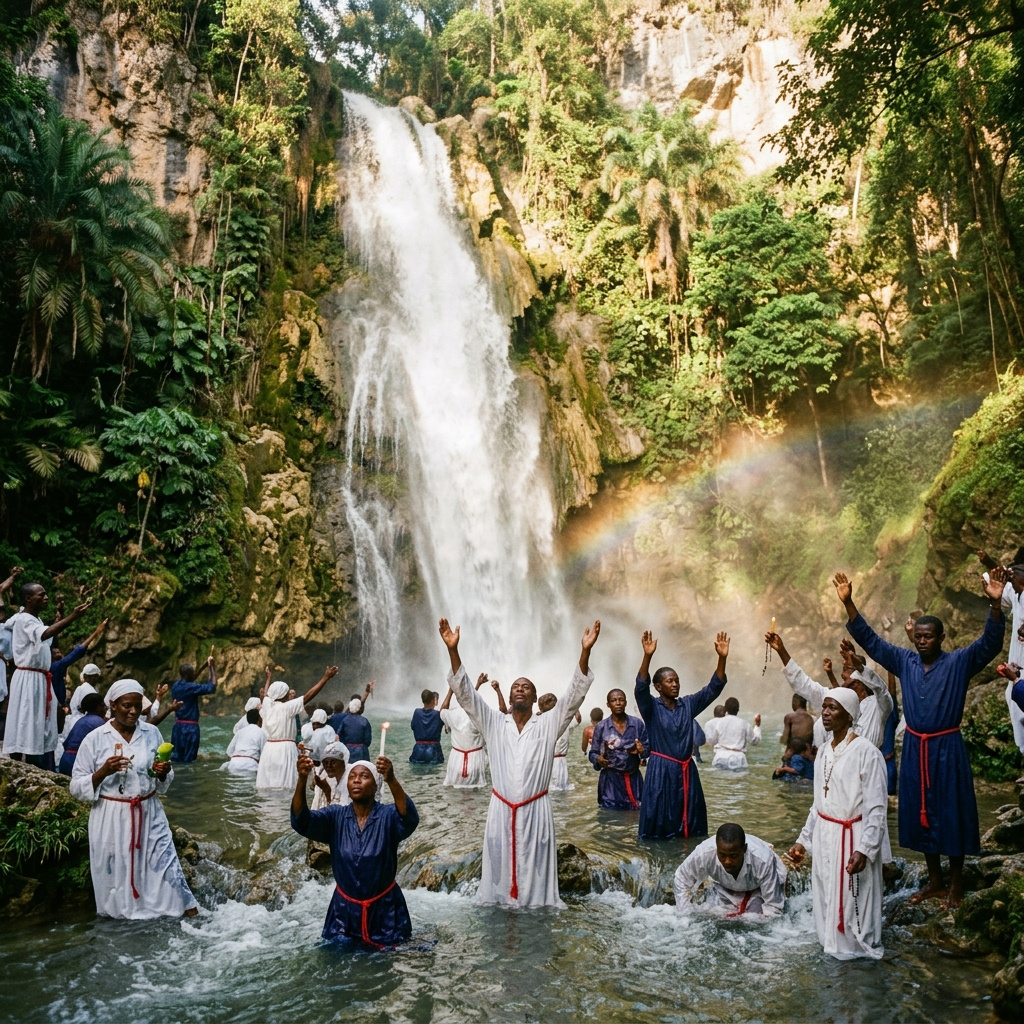
This is the doubled architecture of Haitian faith — what the anthropologists call syncretism and what ordinary Haitians simply call the truth. At Saut-d’Eau, the two halves do not so much blend as stand shoulder to shoulder. A priest in vestments leads a Eucharistic procession through the streets of Ville-Bonheur, carrying the icon of the Virgin while a brass band plays. A few hundred meters away, in the spray of the falls, a houngan in a red headscarf shakes his asson and a woman trembles into the body of Erzulie. No one asks the participants to choose. Most would not understand the question.
The Priests Who Cut the Tree
Not everyone, of course, accepted this arrangement. In the late nineteenth century, the French Catholic clergy who staffed Haiti’s parishes looked at Saut-d’Eau and saw a problem. They saw drumming. They saw possession. They saw, in their telling, the devil thinly disguised as the Mother of God. In 1891, a French priest named Father Lenouvel rode out to the falls determined to settle the matter. He ordered the original palm tree — the tree where Morose had seen the Virgin — chopped down. According to oral history collected for generations afterward, Father Lenouvel returned to his church that same day, collapsed at the altar, and died before nightfall. A second priest, Father Cessens, repeated the experiment some years later by felling another sacred tree. He, too, did not live to see another season.
Whether or not the deaths were historical, the lesson was metaphysical. After Cessens, the Church largely stopped trying to wrest Saut-d’Eau from its dual congregation. Officially, Rome celebrated the Feast of Mount Carmel and turned a blind eye to what happened in the spray. Unofficially, Haitians had won. The pilgrimage to Sodo would belong to its people, in all of their layered, stubborn, beautiful inconsistency.

The Long Walk to the Water
To make the pilgrimage properly is to begin long before you arrive. Some Haitians will visit every Catholic church along their route, lighting a candle at each, the way an earlier generation walked the Camino. Others sit with a houngan or mambo a week ahead, receiving a list of items to bring: white candles, blue soap, a bottle of cane syrup, a chicken if the lwa demand one. The most committed don the rad penitans — the penitential garment, sewn from indigo denim or stitched in panels of red and white — and tie a colorful rope around the waist. The rope marks them as pèlerins. It also marks them as people in conversation with something larger than themselves.
The road to Ville-Bonheur is gravel and dust, a switchbacking ribbon through the Central Plateau where mango trees lean over the asphalt and children wave from doorways. Tap-taps blast Kompa from cracked speakers. Vendors line the verges selling fried plantains, sweet bread, and small bundles of fey — sacred leaves, gathered that morning, each species tuned to a different ailment. By the eve of July 16, Ville-Bonheur has become a temporary city of forty or fifty thousand souls. The air smells of wood smoke, kleren, sweat, and the sweet damp of approaching rain.
Beneath the Cascade
The falls themselves are reached by a steep, slippery descent through a grove of trees from which countless ropes hang, knotted there by previous pilgrims as offerings. Pilgrims untie the cords from their own waists and add them to the canopy. Then they strip to their underclothes and walk, slowly, into the pool beneath the cascade. The water is cold and powerful and shocks the breath out of the body. Medsin fey — leaf doctors who have practiced their craft for generations — wade through the crowd offering preparations of crushed herbs mixed with the sacred water, pressed against backs and bellies and foreheads to draw out illness, jealousy, the slow rot of bad luck.
Around the pool, drums beat. Voices rise in chante lwa — songs to the spirits — and in old Catholic hymns, sometimes layered into the same breath. A woman begins to shake. Her eyes roll back. The crowd parts gently around her: Erzulie has come. She speaks in a voice not her own, blesses a child, accepts a cigar, and is gone. The waters keep falling. Nobody is in a hurry. The point of the pilgrimage is not to finish but to be inside it, to let the water and the song and the trembling body of the country wash over you for one weekend out of the year.
A Sanctuary Under Strain
Saut-d’Eau today carries the weight of a country that needs it more than ever. After the catastrophe of January 12, 2010, when the earthquake reduced Port-au-Prince to rubble, the pilgrimage swelled. People came not only for healing but for accounting, to ask Erzulie why a mother had let so many children die. They came again after the assassinations, the gang violence, the displacement crises that have ground at Haiti through the 2020s. The waters answer the way they have always answered: by falling, by being cold, by being there.
The site is not invulnerable. Deforestation has eaten away at the surrounding hillsides, and the flow of the falls is thinner now than the elders remember. A growing wave of evangelical Protestantism, much of it imported, condemns the Vodou half of the pilgrimage and, in some sermons, the entire site. And yet every July, the buses fill, the ropes are tied, and the pilgrims descend toward the spray. Sodo, like Haiti itself, has been told for centuries that it should not exist. It exists anyway.
Saut-d’Eau is the place where the two great rivers of Haitian belief — the African and the European, the ancestral and the imposed — pour into the same pool and emerge as one current. To stand beneath that water is to feel a country that has refused, again and again, to choose between halves of itself. At HaitiPAM, we believe that this refusal is one of Haiti’s deepest gifts to the world: the insistence that what was meant to divide us can, with enough faith and enough water, become the very thing that holds us together.
Leave a Reply