
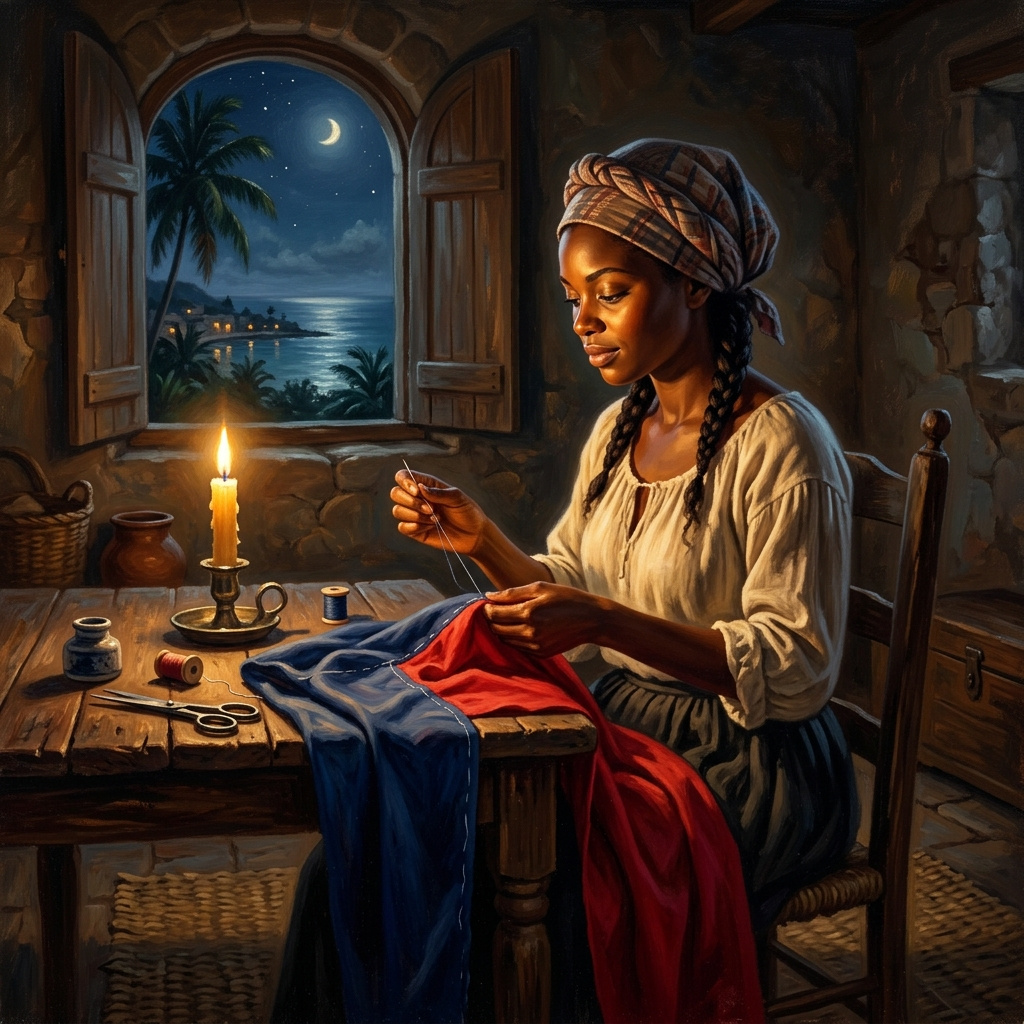
On the morning of May 18, 1803, in the coastal town of Arcahaie, a woman sat down with a needle and thread and, with a few careful stitches, helped birth a nation. Her name was Catherine Flon, and the cloth she sewed together — two strips of blue and red torn from the flag of a colonial empire — would fly over the first free Black republic in the history of the world. She did not fire a rifle. She did not lead a charge. But in that single act of creation, she gave the Haitian Revolution something no army could manufacture: a symbol.

A Life Shaped by Thread and Revolution
Catherine Flon was born on December 2, 1772, in Arcahaie — a quiet town pressed between the Haitian mountains and the blue expanse of the Golfe de la Gonâve. Her parents were textile traders who dealt in cloth imported from France, which meant that from her earliest years, Flon’s hands knew the weight and weave of fabric. She grew into an exceptional seamstress, eventually opening her own workshop where she trained young women in needlework, giving them a craft that could sustain them financially long after the upheavals of revolution reshaped their world.
But Flon was far more than a craftsperson. When the Haitian Revolution erupted in 1791 with the slave uprising in the north, she chose her side without hesitation. She worked as a nurse, tending to wounded revolutionary soldiers, cleaning injuries, and keeping fighters alive long enough to return to battle. When her parents, unsettled by the war, left for France, Catherine stayed. That decision — to remain in a country tearing itself apart rather than retreat to comfort and safety — tells us everything about who she was.
She was also the goddaughter of Jean-Jacques Dessalines, the most formidable military mind of the Revolution. In Afro-Creole culture, this relationship — known as marennaj, or baptismal kinship — carried almost familial weight. It was a bond of loyalty, protection, and deep mutual obligation. That bond would define the most important moment of Flon’s life.
The Congress of Arcahaie
By the spring of 1803, the Haitian Revolution was entering its decisive phase. Twelve years of brutal conflict had turned Saint-Domingue into a graveyard for European ambitions. Napoleon Bonaparte had sent his brother-in-law General Leclerc with tens of thousands of soldiers to crush the revolution and restore slavery — but yellow fever had decimated the French forces, killing Leclerc himself in November 1802. His successor, General Rochambeau, was crueler and more desperate, resorting to atrocities that only hardened Haitian resolve.
Toussaint L’Ouverture, the towering leader of the first phase of the revolution, had been captured through treachery and deported to France, where he died in prison in April 1803. But his death did not end the struggle — it inflamed it. Dessalines, Henri Christophe, and Alexandre Pétion stepped into the vacuum, and in May 1803, the leaders of the revolutionary forces gathered in Arcahaie to unify their command and coordinate the final campaign for independence.
This assembly — the Congress of Arcahaie — was as much a declaration of intent as it was a military council. On May 18, 1803, its final day, Dessalines performed one of the most resonant acts of political theater in the history of any revolution.

The Tearing of the White
He took a French tricolor — blue, white, and red — and tore the white stripe from it. Some accounts say he used his sword; others say he tore it with his bare hands. He cast the white strip to the ground and trampled it beneath his boot. Then he handed the remaining blue and red strips to Catherine Flon.
She threaded her needle and sewed them together.
The act was not random. Every person present understood exactly what the colors meant. Blue represented the Black Haitian population — those of African descent who had borne the full weight of slavery and who formed the overwhelming fighting force of the Revolution. Red represented the mixed-race affranchi population — free people of color who had fought French attempts to strip away their rights. Together, the colors declared what the Revolution was actually about: not just freedom from France, but the unity of all Haitians, regardless of shade or background, bound by a common will to be free.
The white that Dessalines tore away was the white of the French flag, the white of the colonial planter class, the white of the system that had turned human beings into property. There would be no place for it in what came next.
Flon stitched the two strips together, and the first Haitian flag was born. It bore the motto Liberté ou la Mort — Liberty or Death.
The Road to January 1, 1804
The flag created at Arcahaie flew over the final campaigns of the Revolution. On the very same day as the Congress — May 18, 1803 — Britain and France resumed open warfare, meaning Napoleon could no longer reinforce his crumbling position in Saint-Domingue. He had already sold Louisiana to the United States in April, abandoning his dreams of an American empire. The end was in sight.
At the Battle of Vertières on November 18, 1803, Dessalines’ Indigenous Army delivered the final blow, decisively defeating Rochambeau’s forces. On January 1, 1804, at the town of Gonaïves, Haiti declared independence — becoming the first free Black republic in history, and the only nation ever born from a successful slave revolution. The name they chose — Ayiti, the indigenous Taíno word for “land of high mountains” — was a deliberate erasure of everything colonial.
The flag Catherine Flon had sewn was there for all of it.
A Legacy Stitched into Haiti’s Soul
Flon lived another 27 years after independence, dying in 1831. The historical record of her later life is sparse — as it is for most non-elite women of her era — but her legacy was being woven into Haitian national identity long before her death.
Today, her presence is everywhere in Haiti. A public square on the Champ de Mars in Port-au-Prince — the central civic heart of the capital — bears her name. A girls’ secondary school carries her name. Since 2000, her face has appeared on the Haitian 10-gourde banknote, depicted in Madsen Mompremier’s painting of the Arcahaie ceremony. She is the only woman to have appeared on Haitian currency. In 2022, UNESCO added her birthday to its heritage calendar, recognizing her as a figure of global historical importance.
And every year on May 18, Arcahaie — known across Haiti as vil drapo, “flag town” — becomes a national pilgrimage site. Since Flag Day was formally established in 1926, the day has grown into one of Haiti’s most joyful celebrations: parades, music, the sea of blue and red that floods the streets, children reciting the story of Catherine Flon and the needle that stitched a nation together. In Miami, New York, Montreal, and Paris, the Haitian diaspora holds its own celebrations, carrying the flag across the world.
The Women Who Made Haiti Free
Catherine Flon is one of three women who are remembered as the heroines of the Haitian Revolution, each one present at a defining moment:
Cécile Fatiman was there at the beginning. A Vodou mambo, she co-led the Bois Caïman ceremony in August 1791 — the sacred ritual that ignited the mass uprising and bound the revolutionary fighters with an oath before their ancestors and their gods.
Catherine Flon was there in the middle — at the moment when scattered resistance crystallized into a unified nation with a name, a flag, and a cause.
Dédée Bazile was there at the end — or rather, at the tragedy that followed independence. When Dessalines was assassinated in 1806 and his body mutilated and abandoned in the streets of Port-au-Prince, it was Dédée who came to gather his remains and restore his dignity. She honored the man who had trusted Catherine Flon with the needle.
Together, these three women trace an arc across the Revolution: the spiritual fire that started it, the symbolic act that gave it identity, and the act of grief and memory that preserved it. None of them commanded armies or signed treaties. All of them were essential.
Catherine Flon’s needle was small. What it produced was not. In a single act of craft, she transformed the most visible symbol of colonial oppression into the founding banner of a free people — and in doing so, she gave the Haitian Revolution something that outlasted every battle: an image of what it meant to be Haitian. That image still flies today, from the mountains of Arcahaie to the streets of Brooklyn, a blue and red reminder that nations are not only made by soldiers and politicians, but by the people who understand, deep in their hands and their hearts, what a people are capable of becoming. At HaitiPAM, we tell these stories because they belong to everyone — and because Haiti’s past is one of the great untold epics of human freedom.
Leave a Reply