
Before Haiti existed, before the name had been spoken, before the first flag was sewn — there was a language. It had no name yet, no grammar books, no national anthem to carry it forward. It was born in the dark, stitched together from broken French and the deep rhythms of Fon, Yoruba, Igbo, and Ewe, spoken in whispers between people who shared nothing except chains and the urgent need to understand each other. That language became Haitian Kreyòl. And in the centuries since, it has proved as indestructible as the people who created it.
Born in the Cane Fields
The story of Kreyòl begins in the late seventeenth century, when the French colony of Saint-Domingue began its brutal transformation into the sugar capital of the world. Between 1690 and 1790, approximately 800,000 West and Central Africans were forcibly transported to the island — peoples who spoke dozens of mutually incomprehensible languages: Fongbe, Ewe, Yoruba, Igbo, Wolof, Kikongo. Thrown together in the sugarcane fields, they needed to communicate, to plan, to survive. They reached for French — the only language their captors shared — but they bent it to the structures and cadences of their native tongues.
What emerged between roughly 1680 and 1740 was not broken French and not simply a dialect. It was an entirely new language. Haitian Kreyòl kept about 90 percent of its vocabulary from 18th-century French, but its grammar followed an unmistakably African architecture. Verbs carry no inflection for tense or person. There is no grammatical gender — adjectives do not shift to match nouns. The word yo signals plurality; context does the work that conjugation does in French. Of all French-based creoles in the Western Hemisphere, linguists note that Haitian Kreyòl bears the strongest imprint of African linguistic structures. It was a language built by Africans, using European raw material, to serve African purposes.
The Language of Revolution
On the night of August 14, 1791, representatives of enslaved workers from plantations across the northern colony gathered in a clearing called Bwa Kayiman — Alligator Wood. The ceremony was led by Dutty Boukman, an enslaved Houngan who was also one of the most influential organizers of the coming uprising, and by Cécile Fatiman, a mambo whose ritual presence consecrated the gathering. What happened there was simultaneously a Vodou ceremony and a war council — both conducted in Kreyòl. Eight days later, on August 22, the rebellion erupted across the northern plain. Thirteen years of warfare followed, and on January 1, 1804, Jean-Jacques Dessalines proclaimed the independent Republic of Haiti: the first Black republic in history, the first nation born of a successful slave revolt.
Kreyòl was the tongue of that revolution. It let people from dozens of African nations speak to one another, organize in secret, pray together, and dream in a common register. The enslaved had turned the colonizer’s language into a weapon the colonizer could not fully understand or control. Kreyol pale, kreyol komprann — “Creole spoken, Creole understood” — is a proverb that captures this intimacy perfectly: when Haitians speak Kreyòl to each other, something essential passes between them that no other language can carry.

Two Centuries of Silence
Independence should have been Kreyòl’s triumphant moment. Instead, the language that won Haiti’s freedom was almost immediately relegated to the shadows. The Haitian elite — educated in French, shaped by French colonial culture, conscious of their precarious position in a world hostile to Black sovereignty — made French the sole official language of the new nation. Over 95 percent of Haitians spoke only Kreyòl, but the state conducted all its business in a language the vast majority of citizens could not access. Presidents addressed the nation in French. Courts operated in French. Schools taught in French. A child born in the mountains of Artibonite or the plains of Léogâne arrived on her first day of class to discover that the language in which she thought, prayed, and laughed was not the language in which she would be required to learn.
This was not merely a cultural exclusion. It was a structural one. Linguists call the situation “diglossia”: two languages coexisting in the same society, assigned to different social functions, with one elevated and one suppressed. In Haiti, French was the language of power, prestige, and upward mobility. Kreyòl was the language of the street, the market, the fields, the home — of life as it was actually lived. The effect on literacy was devastating. Research found that 49 percent of Haitian students entering third grade could not read a single word, not because they lacked intelligence, but because they were being taught to read in a foreign language rather than their own.
The Living Heart of Culture
Through all those centuries of official silence, Kreyòl survived where it always had: in the spaces the state could not reach. In Vodou ceremonies, where it is the sacred tongue of the lwa and their human intermediaries — as central to Haitian spirituality as Arabic to Islam or Hebrew to Judaism. In the proverbs that encode a philosophy of life: Piti piti, zwazo fè nich — “Little by little, the bird builds its nest” — teaching patience without a single wasted syllable. In the kont, the traditional folktales told at wakes and vigils, where trickster animals outwitted powerful enemies in stories that were never only about animals.
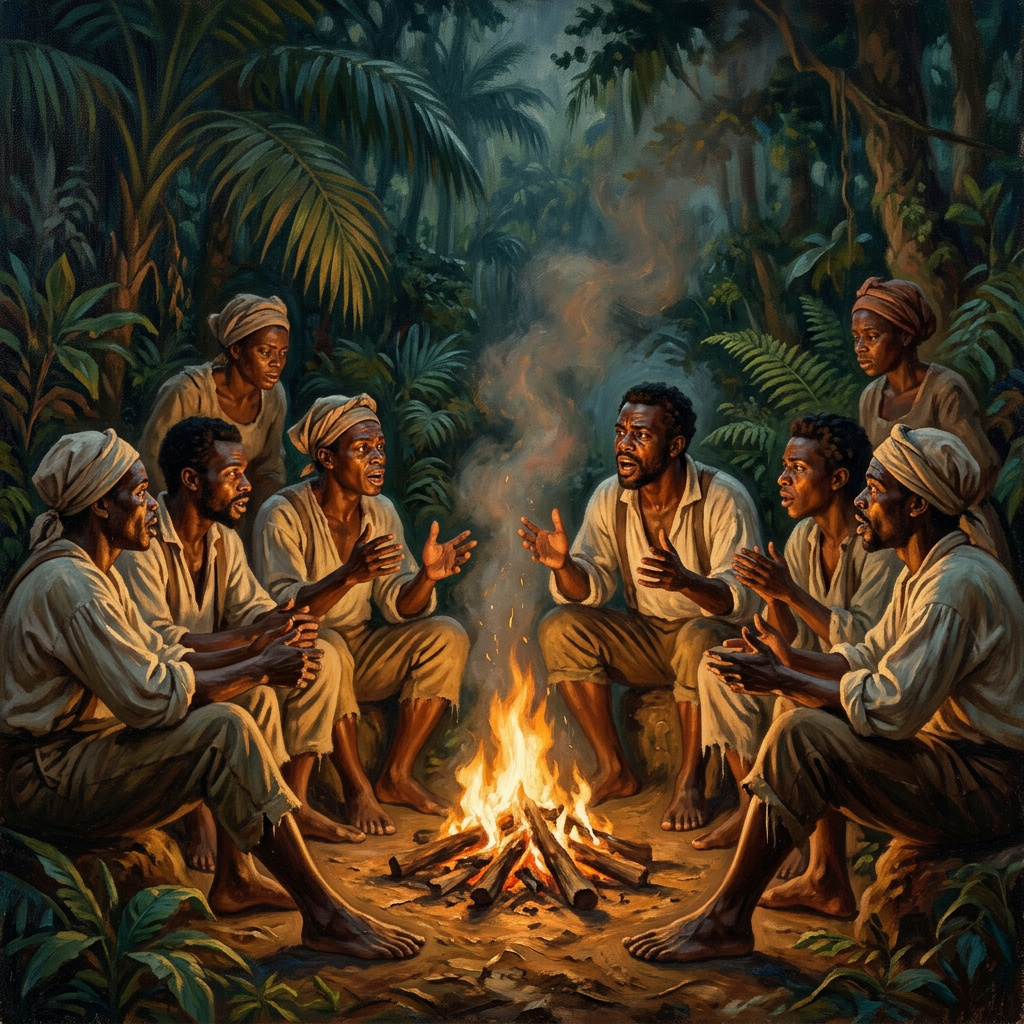
Under slavery, historians note, these nighttime storytelling sessions served as what one scholar calls a “symbolic weapon to preserve the dignity of the oppressed.” The stories were told in a language the slaveholders could not follow. The cunning of the small creature who defeats the powerful one was understood by everyone gathered around the fire. The language and the stories it carried were the same act of resistance: proof that the inner life of the enslaved could not be confiscated, however thoroughly everything else was taken.
Recognition and Reclamation
The 1987 Haitian Constitution finally granted Kreyòl what it had always deserved: official status. For the first time in nearly two centuries of independence, the language spoken by every Haitian was formally recognized alongside French as a co-official language of the state. The constitution acknowledged what no one could honestly deny — that Kreyòl is “the only language that all Haitians hold in common.” It was a legal milestone, even if implementation was slow and the structural privileging of French persisted in practice.
In recent decades, the effort to reclaim Kreyòl for education has gathered real momentum. USAID and Haiti’s Ministry of Education developed scripted curricula — M ap li nèt ale — that teach Haitian children to read in their mother tongue first. International organizations including UNESCO have worked with the Haitian government to overhaul teacher training and school curricula, centering Kreyòl as a genuine language of instruction rather than an obstacle to overcome. In Boston in 2017, the Toussaint L’Ouverture Academy launched the first Two-Way Immersion Haitian Creole Dual-Language program in the United States, teaching American and Haitian-American children together in both English and Kreyòl.
Today approximately 12 million people speak Haitian Kreyòl in Haiti, with another 3 million in the diaspora — in Miami and Brooklyn, in Montreal and Paris, in the Bahamas and the Dominican Republic. Across all those latitudes, the language that enslaved Africans built from necessity carries the same weight it always has: not merely a means of communication, but a declaration of existence. To speak Kreyòl is to claim a history, an identity, a continuity with every generation that survived what should not have been survivable.
A language forged in suffering and sharpened by revolution, Haitian Kreyòl is one of the most extraordinary stories in the history of human expression — proof that even the most brutal systems of control cannot silence the human need to speak, to name the world, and to be understood. At HaitiPAM, we believe that knowing Haiti means listening to it in the language it chose for itself.
 HAITI PAM
Leave a comment