
Long before the sun fully crests the mountains behind Port-au-Prince, the Marché en Fer is already alive. Vendors arrive in the blue-grey dark, hauling bundles on their heads, arranging bolts of fabric, stacking towers of plastic bowls and hand-carved wooden saints. By the time the Caribbean light turns gold and horizontal, the Iron Market is roaring—a thousand voices haggling, laughing, praying, arguing, singing—and the great Victorian clock tower presiding over it all, keeping time for a city that has never stopped moving.

A Building That Was Never Meant for Haiti
The story of the Iron Market begins not in Haiti at all, but in a Parisian workshop in the late nineteenth century. The firm of Baudet, Donon & Cie—celebrated engineers who supplied prefabricated iron structures across the globe—fabricated an elaborate set of cast iron halls destined for Cairo, Egypt, where they were to serve as a grand railway terminal. But the Cairo plans collapsed, and the market stood, undelivered, waiting for a buyer.
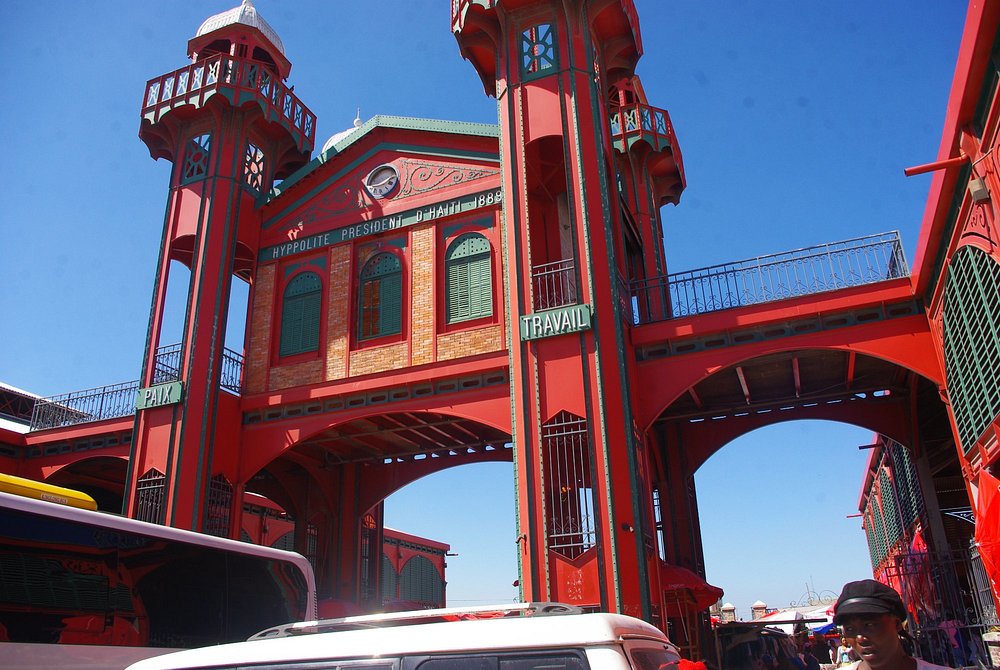
Enter Florvil Hyppolite, President of Haiti from 1889 to 1896, a man who understood the power of grand gestures. He purchased the entire structure—towers, minarets, clock, and all—had it crated and loaded onto ships, and brought it across the Atlantic to his capital. On November 22, 1891, the Marché en Fer was inaugurated in Port-au-Prince. A building conceived for Egypt, crafted in France, now stood at the heart of the Caribbean’s first Black republic, its ornate Moorish minarets gleaming in the tropical sun.
That backstory—of a structure meant for elsewhere, redirected and reimagined by Haitian ambition—feels almost like a parable for Haiti itself: a nation forever navigating circumstances not of its choosing, forever finding a way to make something magnificent out of what the world leaves behind.
The Architecture of a City’s Soul
The Marché en Fer occupies an entire city block just west of the Bel Air district, roughly half a mile north of the Champ de Mars. The structure comprises two soaring iron halls—each reaching thirty-five feet high and covering twenty thousand square feet—connected by a central tower capped with that famous Victorian railway clock. Four minarets punctuate the roofline, their Moroccan-style ironwork a visual riddle: why does this market, in a Caribbean capital, look like a mosque in North Africa? The answer is simply that it was built from what was available, adapted with Haitian ingenuity, and became something entirely its own.
Architectural historians classify it as a masterwork of late-nineteenth-century “flat-pack” construction—European engineering designed for export, shipped in components and assembled on-site. But no architectural category captures what the Iron Market actually is. It is not a monument in the way that a palace or a cathedral is a monument. It is alive. Its beauty is inseparable from the noise, the color, the smell of cloves and charcoal and roasting corn that fill it every single day.
The Madan Sara: Women Who Hold the Market Together
To understand the Iron Market is to understand the madan sara. The name—borrowed from a small migratory bird known for its energy and its constant motion—belongs to the women traders who form the spine of Haiti’s informal economy. They travel deep into the countryside, buying produce, spices, and goods from farmers who cannot easily reach the city. Then they return, sometimes overnight, sometimes across days of brutal travel, to sell at markets like Marché en Fer.
A madan sara carries her change tucked into her bra and her reserve capital in a cloth knotted beneath her dress. She haggles with a speed and precision that would make a Wall Street trader blink. She gives a little to the beggar children who crowd the market’s edges, and she takes nothing from anyone trying to shortchange her. She is, in almost every practical sense, the link between rural Haiti and urban Haiti—and without her, the Iron Market would not function.
Roughly nine hundred vendors work within the market itself, with hundreds more spilling onto the surrounding streets. They sell everything: Haitian hardwood sculptures, bright oil paintings in the naive style that Port-au-Prince made famous, bolts of cotton in purples and yellows, handwoven baskets, medicinal herbs, street food, beauty products, clothing, religious icons—both the Catholic saints and the Vodou lwas who share so much iconography. You can get your hair done and your fortune told and a bag of star anise all within the same fifty-foot stretch. The Iron Market is not a place you go to buy a specific thing. It is a place you go to be inside Haiti.

Fire, Earthquake, and the Will to Endure
In 2008, a catastrophic fire swept through the market’s northern hall, reducing it to a blackened skeleton. Vendors who had worked their stalls for decades lost everything overnight. Many moved to the streets around the building, continuing their trade in makeshift arrangements. The market grieved, but it did not stop.
Then came January 12, 2010. The earthquake that tore through Port-au-Prince in thirty-five seconds of terror killed more than two hundred thousand people and left the capital in ruins. The Iron Market’s southern hall and central tower, already patched and scarred from years of hard use, were severely damaged. The clock stopped. For a city in shock, the sight of those bent minarets felt like a wound beyond wounds.
But Haiti, as it has done again and again across its history, chose to rebuild. Denis O’Brien, the Irish businessman who built Digicel into one of Haiti’s largest employers, personally funded a twelve-million-dollar restoration project. The British firm John McAslan + Partners led the architectural work, but the labor came from Port-au-Prince itself—more than a hundred local craftsmen, carpenters, and ironworkers employed in the reconstruction. The rebuilt market opened in January 2011, almost exactly one year after the earthquake, in time to mark the anniversary not with mourning alone but with the sound of commerce resuming.
The restored market is faithful to the original: the minarets upright again, the clock ticking, the two great halls filled with morning light. New touches—vendor ID cards, organized stall numbers, mobile money payment systems—brought the nineteenth-century structure into the twenty-first century without stealing its soul.
More Than a Market
There is a particular moment in the early afternoon, when the heat presses down and the market finds a temporary slower rhythm, that you can stand in the central hall and feel the full weight of what this building has witnessed. Generations of Port-au-Prince families have passed through here. Political upheavals, American occupations, dictatorships, democratic experiments, natural disasters—all of it has washed over and around the Iron Market, and the market has absorbed it, adapted, and kept going.
Travelers who visit often describe a kind of overwhelm—sensory, emotional—that turns into something else once they surrender to the rhythm of the place. The Iron Market rewards patience and curiosity. Slow down, make eye contact, try to bargain (badly, probably, but try), and you will find yourself in conversation with people whose families have worked these stalls for three or four generations, who can tell you stories about the market before the earthquake, before the fire, before the millennium. The market is a living archive of Port-au-Prince itself.
A Symbol That Refuses to Fall
Port-au-Prince has faced extraordinary pressures in recent years—political instability, gang violence, the 2021 earthquake that devastated the southern peninsula, the ongoing struggles of a population defined by the world primarily through its suffering. The Iron Market, like Haiti itself, is not untouched by these pressures. But it continues to open its doors.
There is something quietly radical about that persistence. The market does not exist to make a political statement. It exists because people need to eat, to sell, to buy, to connect, to earn a living. In doing those ordinary things every day, in a building that was never supposed to be there in the first place—shipped from France, meant for Egypt, claimed by Haiti—the Iron Market makes one of the oldest arguments Haiti has always made to the world: we are still here, and we are not done.
The Marché en Fer is far more than a tourist attraction or a commercial hub—it is the visible pulse of Port-au-Prince, a 130-year-old testament to Haitian resilience, creativity, and the stubborn refusal to disappear. Stories like this one are why HaitiPAM exists: to hold up the richness of Haitian culture, history, and everyday life, and to share it with a world that deserves to know Haiti beyond the headlines.
Leave a Reply