
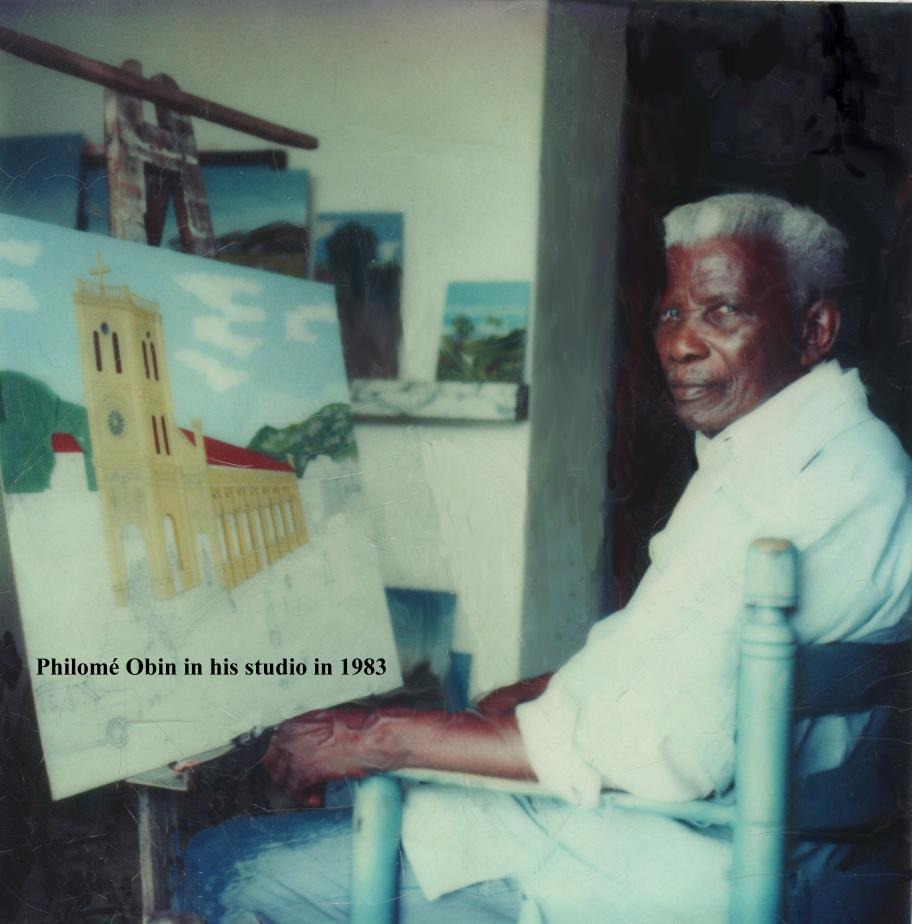
In a modest barbershop in Cap-Haïtien, a man with steady hands and a patient eye spent decades cutting hair, selling coffee, and painting the world around him. He had no gallery, no patron, no formal training — only a hunger to set down what he saw, what he remembered, and what he refused to let his country forget. His name was Philomé Obin, and by the time the world finally noticed him in his fifties, he had already been quietly building a visual archive of Haiti for nearly forty years. From his quiet discipline would grow an entire movement: the Cap-Haïtien School, a tradition that treats painting not as decoration, but as national memory.

The Barber of Cap-Haïtien
Philomé Obin was born on July 20, 1892, in Bas-Limbé, near the historic northern city of Cap-Haïtien. He was a young man of precocious talent in a country that, at the time, offered almost no formal avenue for an aspiring painter. He produced his first known work — a delicate watercolor of a young man hunting — at the age of seventeen. Then, for the next four decades, he painted in near-total obscurity. He worked as a barber, a coffee buyer, an occasional sign painter, and a Freemason, always returning in his spare hours to oil and Masonite. His subjects were the things he knew: the peaked-roof colonial houses of his city, the iron-hooked shutters, the processions, the funerals, the weddings, the small daily rituals of a town whose walls remembered two revolutions.
What makes Obin astonishing is not just the length of his career — he painted actively for roughly seventy-five years — but the seriousness of his vision. He was never a Sunday painter, never a hobbyist. He was an archivist with a brush. Every window and balcony in his compositions is rendered with an architect’s patience; every figure, though small and simplified, is placed with the gravity of a witness. For Obin, to paint was to remember, and to remember was a civic duty.
1944: The Year Haiti Was Discovered by Itself
Obin’s transformation from unknown provincial painter to internationally celebrated master began in 1944, when an American watercolorist named DeWitt Peters, working in Port-au-Prince, founded the Centre d’Art. Peters had come to Haiti as an English teacher during World War II and quickly recognized that a country with no galleries, no art schools, and no public market for painting was nevertheless teeming with artists. Alongside Haitian intellectuals such as the writer Philippe Thoby-Marcelin and the architect Albert Mangonès, Peters opened a space where self-taught painters could exhibit, sell, and be seen.
One day, a letter arrived at the Centre from a fifty-two-year-old barber in Cap-Haïtien, enclosing a small painting of a country wedding. Peters was stunned. He wrote back inviting Obin to send more work — and then, after more astonishing canvases arrived, invited the painter to Port-au-Prince. Obin’s arrival at the Centre d’Art is one of the quietly seismic moments in twentieth-century Caribbean art. What Peters had expected was a folk curiosity. What he found was a fully formed visual philosophy, already decades in the making, ready to reshape the entire national conversation about what Haitian painting could be.

What the Cap-Haïtien School Sees
Almost immediately, a second school of Haitian painting began to cohere around Obin, distinct from the vibrant, dreamlike canvases being produced in Port-au-Prince. If the southern school, led by painters like Hector Hyppolite, leaned into vodou spirit, ecstatic color, and mystical invention, the Cap-Haïtien School looked outward and backward — toward streets, buildings, and history. Critics have described Obin’s manner as “magical pseudo-realism,” a phrase that captures the curious tension in his work: the scenes appear documentary, almost architectural, yet there is something solemn and dreamlike in the geometry, a stillness that lifts the ordinary into the mythic.
The visual vocabulary Obin forged became the school’s signature. Rows of colonial townhouses with steeply peaked roofs and deep protective overhangs. Tall shuttered doors fastened with long iron hooks. Figures in the foreground small, simplified, almost emblematic — less individuals than representatives of the Haitian people as a whole. A palette of dusky blues, ochres, terracottas, and muted greens, as though the entire north of Haiti had been filtered through the light of late afternoon. His younger brother Sénèque Obin (1896–1972) took up the same manner. So did his sons — Antoine and Télémaque — and later his grandchildren, including Claude Obin. Cap-Haïtien painting became, in the most literal sense, a family trade and a lineage.
History on a Square of Masonite
What sets Obin apart from almost every other Caribbean painter of his era is that he treated history itself as a subject worthy of the brush. He painted Toussaint Louverture receiving French emissaries. He painted the funeral processions of northern priests and the liturgical pageantry of provincial churches. Most famously, he painted the 1919 assassination of Charlemagne Péralte — the Haitian patriot killed by U.S. Marines during the American Occupation, whose body was photographed strapped to a door in a grim propaganda display. Obin saw that infamous photograph as a young man and never forgot it. Decades later, in works like “The Crucifixion of Charlemagne Péralte for Freedom” (1970), he transformed the image into an icon of martyrdom, rendering Péralte in the composition of Christ on the cross — a silent, searing indictment that turned a humiliation into a national altarpiece.
This is why the Cap-Haïtien School matters far beyond the walls of any gallery. In a country whose official archives have been burned, flooded, looted, and lost more than once, painters like Obin built a parallel archive — a visual record of what happened here, who mattered here, what it felt like to live in this city on this day. The school’s commitment to documentary realism, to named events and named people, made Haitian art a form of historical record-keeping. The canvas became, in effect, a second constitution: a place where the nation could remember itself.
Recognition, Late but Complete
Recognition, once it arrived, was generous. Obin’s paintings entered the Museum of Modern Art in New York, the Milwaukee Art Museum, the Figge Art Museum in Iowa, and the Waterloo Center for the Arts, which holds one of the largest public collections of Haitian art in the world. In 1976, the Haitian government awarded him its highest honor for a lifetime of service to the country’s arts. He continued painting almost until his death in August 1986, at ninety-four — a barber who had become, without ever raising his voice, the visual conscience of a nation.
Today, a walk through any serious exhibition of twentieth-century Haitian painting is, in one way or another, a walk through Obin’s legacy. The peaked roofs and small dignified figures have passed into a regional visual dialect. Younger painters from the north still inherit the Cap-Haïtien discipline of looking, remembering, and setting down — of treating each canvas as a small, stubborn act of preservation. Obin’s great insight was that a country without monuments can still build a memory. You only need a scrap of Masonite, a little oil paint, and the patience of a barber who has all day.
At HaitiPAM, we believe that a country is remembered in the works of its artists as much as in the pages of its history books. Philomé Obin’s life reminds us that genius can live, for decades, behind a barber’s chair in a small northern city — and that when it is finally seen, it can rewrite the visual identity of an entire nation. The Cap-Haïtien School is not only a chapter in art history; it is an instruction in how a people choose to remember themselves.
Leave a Reply