

In 1965, in a middle-class neighborhood of Port-au-Prince, a man was dragged from his family and taken to one of the most feared prisons on earth. His crime? Dissent against the regime of François “Papa Doc” Duvalier, whose Tonton Macoutes had turned Haiti into a kingdom of terror. The man was Roger Jean, a philosopher and school principal. He was tortured. He survived. And when he finally walked free and made his way to a cold, foreign land called Canada, he carried with him a daughter who would one day stand before the world as one of the most powerful Black women the Americas had ever seen.
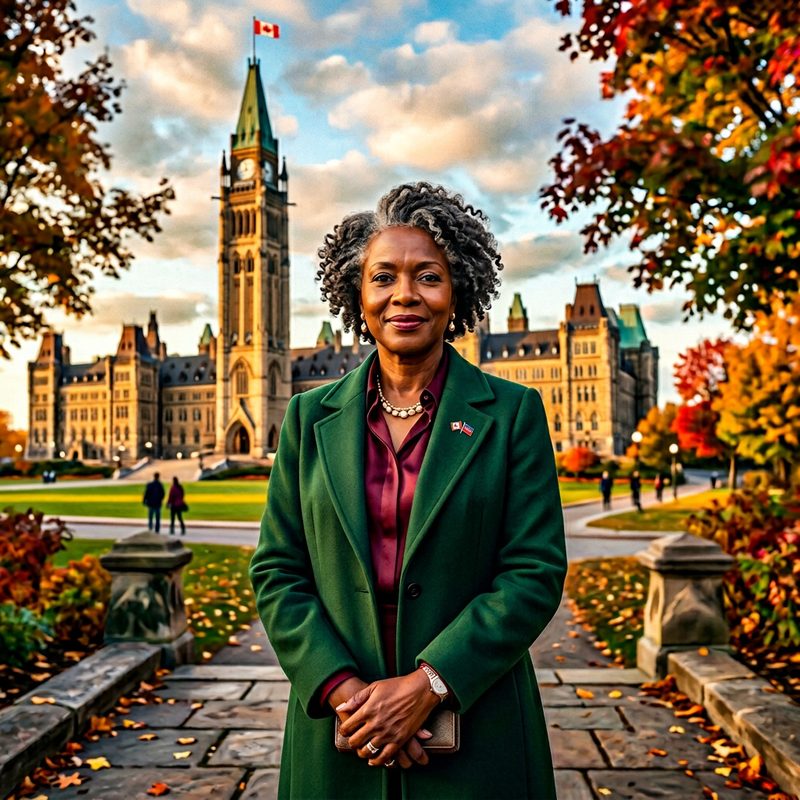
That daughter was Michaëlle Jean. Born on September 6, 1957, in Port-au-Prince, she arrived in Canada as a refugee child and climbed — through intellect, grace, and sheer force of purpose — to become the 27th Governor General of Canada. She was the first Haitian Canadian, and the first Black person, ever to hold that office. Her story is not merely a story of personal triumph. It is Haiti’s story: the story of a people shaped by fire, scattered across the world, and refusing — always refusing — to disappear.
Growing Up in the Shadow of Duvalier
Michaëlle Jean’s early years were lived in the anxious quietude that defined middle-class Haitian life under dictatorship. Her father, Roger Jean, was principal and philosophy teacher at an elite Protestant preparatory school — a man of ideas in a country that had made ideas dangerous. To protect their daughter from the regime’s demand that schoolchildren swear personal allegiance to Papa Doc, her parents educated her at home. It was an act of defiance dressed as caution, the kind of quiet resistance that Haitian families practiced daily just to stay whole.
When Roger Jean was arrested and tortured in 1965, the family’s world shattered. He was released, but Haiti was no longer safe. He left for Canada in 1967; Michaëlle, her mother Luce, and her sister followed in 1968. The family settled in Thetford Mines, a working-class mining town in Quebec — as far from the Caribbean sun as one could imagine. The girl who had grown up hearing Haitian Creole and French in Port-au-Prince now navigated snowdrifts and a new language with the resilience that Haiti had forged into her bones.
The Making of a Voice
Michaëlle Jean did not merely adapt to Canada — she conquered it academically. She studied languages and literature at the Université de Montréal, earning a master’s degree in comparative literature. She speaks five languages fluently — French, Haitian Creole, English, Italian, and Spanish — and can read Portuguese. In a country built on linguistic politics, her command of language was both armor and instrument.
She entered journalism at a time when Black faces were essentially absent from French-language Canadian television. When Radio-Canada hired her, she became the first Black person on French television news in Canada. She worked as reporter and host on programs including Actuel, Montréal ce soir, and Virages, before moving to RDI, Radio-Canada’s all-news network. Her on-screen presence was warm yet serious, a combination that earned her trust from viewers across Quebec. But she was never content to merely report the world — she wanted to understand it, and to make others understand it too.
Together with her husband, filmmaker Jean-Daniel Lafond, she made documentary films that brought Haiti’s complexity to Canadian audiences. Among them was Haïti dans tous nos rêves — “Haiti in All Our Dreams” — a work that announced clearly: the island she had left was never far from her heart.

From Rideau Hall to the World Stage
In August 2005, Prime Minister Paul Martin announced that Queen Elizabeth II had approved his recommendation of Michaëlle Jean as Canada’s next Governor General. The appointment sent shockwaves through the country — not in opposition, but in wonder. Here was a Haitian-born Black woman, a child who had fled a dictatorship, who would now represent the Canadian Crown and serve as Commander-in-Chief of the Canadian Armed Forces.
She was installed on September 27, 2005, at a ceremony in which she wore an elegant ivory gown and delivered a bilingual speech that electrified the chamber. “I come from a land of wounds and a land of wonders,” her presence seemed to declare. “And I come to serve.”
As Governor General from 2005 to 2010, Jean used the platform with intention. She advanced human rights, championed the arts, drew attention to poverty in Canada’s North, and traveled widely to promote Canadian interests in Africa and the Caribbean. She visited Haiti — her Haiti — as a head of state, and the emotion of those visits was palpable. She was the official embodiment of a country that had once taken her in as a refugee. The circle of that journey moved many Canadians to tears.
When the Earth Shook
On January 12, 2010, a 7.0 magnitude earthquake struck Haiti. In seconds, Port-au-Prince — the city of her birth — was in ruins. More than 200,000 people were killed. Michaëlle Jean learned of the disaster almost immediately. Though she was still serving as Governor General of Canada, in that moment she was also simply a daughter of Haiti, and the anguish was personal and immense.
Canada mobilized quickly under her moral leadership, with Jean making urgent, impassioned public pleas for aid. When her term as Governor General ended later that year in October 2010, it was clear she would not be stepping back from Haiti. UNESCO called on her to become its Special Envoy to Haiti — a role she accepted and held until 2014. She also co-founded the Michaëlle Jean Foundation, dedicated to supporting vulnerable young people through art and culture across Canada and in Haiti. Art, she had always believed, was not decoration. It was survival.
La Francophonie and a Legacy in Motion
In November 2014, Michaëlle Jean was elected Secretary General of the Organisation internationale de la Francophonie — the body representing 88 countries and governments that share the French language. She was the third person, and first woman, to hold the role, which she filled from January 2015 to January 2019. In that position she served as a global diplomat for the French-speaking world, speaking for nations from Senegal to Vietnam to Quebec, always with Haiti’s voice woven into her own.
She has received honorary degrees from universities across the world and continues her work in advocacy, education, and human rights. The girl from Port-au-Prince, educated at home to protect her from a dictator’s oath, grew up to represent a nation of 38 million, and then to speak for hundreds of millions more.
Michaëlle Jean’s life is one of the most extraordinary arcs in the Haitian diaspora’s long story — a story of exile turned into purpose, of wounds carried quietly into the world’s grandest halls. She reminds us that Haiti does not only endure; Haiti transforms, and in doing so, it transforms the world. At HaitiPAM, we believe these stories deserve to be told, celebrated, and shared. Haiti’s sons and daughters are everywhere — and their light belongs to everyone.
Leave a Reply