

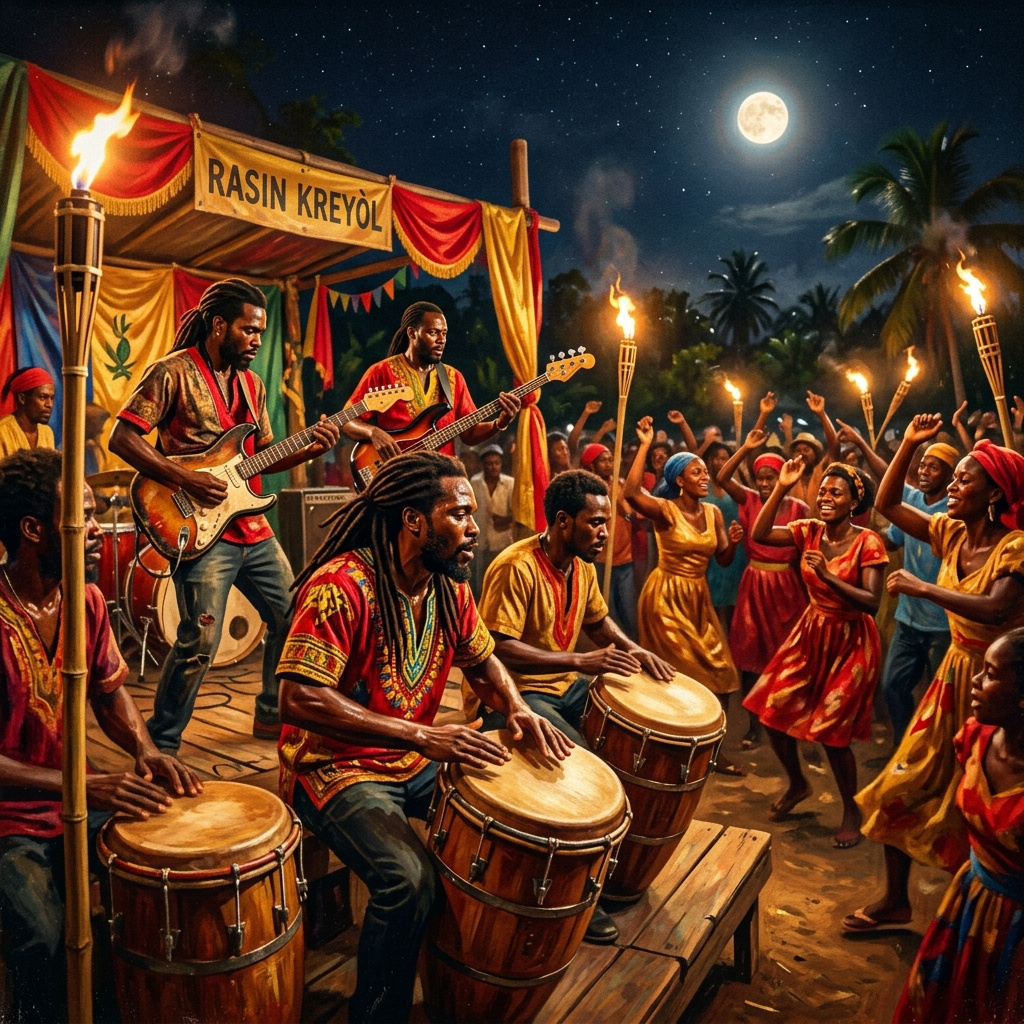
On a sweltering February night in 1990, the streets of Port-au-Prince crackled with something more than Carnival heat. Soldiers pushed through the crowds, weapons in hand, sent by the military government to silence a band before it could play. But Boukman Eksperyans had already taken the stage. When the opening tanbou drums rang out and the crowd roared back the chorus of “Ké-M Pa Sote” — “My Heart Doesn’t Leap in Fear” — no amount of armed intimidation could stop what was happening. Haiti’s roots music revolution was alive, and neither soldiers nor censors could contain it.
The Ceremony That Started Everything
To understand mizik rasin — Haitian Creole for “roots music” — you have to go back further than 1990. You have to go back to 1791, to a dark, rain-soaked night in the forest of Bois Caïman, where a Vodou priest named Dutty Boukman led a ceremony that set a revolution in motion. The drums spoke. The spirits answered. And the enslaved people of Saint-Domingue rose up to fight for freedom that would eventually, in 1804, produce the world’s first Black republic.
That moment — Boukman’s ceremony, the drums, the covenant between the living and the divine — never left Haitian memory. It embedded itself in the nation’s spiritual and musical DNA. Two centuries later, when a group of musicians wanted to name their band and announce their purpose to the world, they looked back to that night in the forest. Boukman Eksperyans. The Boukman Experience. The past speaking through the present.
From the Duvalier Shadow to the Stage
Mizik rasin didn’t emerge from a vacuum. Its roots stretch into the 1970s, when a handful of musicians began doing something quietly radical: mixing the sacred rhythmic language of Vodou — the “cool” Rada rhythms evoking Africa, the fiercer “hot” Petwo rhythms forged in the New World — with electric guitars, bass lines, and the structures of rock and roll.
For decades under the Duvalier dictatorship, Vodou had been a tool of political manipulation. Papa Doc François Duvalier, who came to power in 1957, had cynically co-opted Vodou imagery to project fear and supernatural authority. The religion that had helped Haiti win its freedom was twisted into a prop for tyranny. When Jean-Claude “Baby Doc” Duvalier finally fled the country in 1986, something was released — a long-held breath, a suppressed song.
Into that opening stepped the rasin bands. Their project was cultural reclamation: to take back Vodou, take back the drums, take back the ancestral rhythms that belonged to the Haitian people — not to any government, not to any dictator. And to do it with the amplified thunder of rock and roll.
Boukman Eksperyans: Reclaiming the Revolution
Founded in Port-au-Prince in the late 1980s by the couple Lòlò and Mimerose “Manzè” Beaubrun along with a constellation of family and friends, Boukman Eksperyans was from the start an act of radical homecoming. The “Eksperyans” in the name was a nod to Jimi Hendrix’s Experience — a declaration that this music would be electric, visionary, and unbounded. But the Boukman half grounded it unmistakably in Haitian soil.
Their 1990 Carnival performance was the moment they became legends. “Ké-M Pa Sote” — written as a direct challenge to the military government of General Prosper Avril — used the oblique poetic language of Vodou tradition to deliver a message sharp enough to get the song banned from Haitian radio. Soldiers showed up at the festival to stop them. The band played anyway. The crowd sang every word back at the stage. The song, and the band, became a symbol of unbreakable Haitian defiance.
When their debut album Vodou Adjae earned a Grammy nomination, it announced to the world that something extraordinary was happening in Haitian music. The album drew on traditional Vodou ceremonial songs and prayers, recontextualizing them in an arrangement that was simultaneously ancient and unmistakably contemporary. Critics scrambled to describe it: world music, roots rock, sacred fusion. Haitians simply called it theirs.
The political story grew darker. In September 1991, a military coup overthrew the democratically elected President Jean-Bertrand Aristide. Like many artists and intellectuals, Boukman Eksperyans went into exile. But from abroad they kept playing, kept speaking, using their music as testimony against the Cédras military dictatorship. When Aristide was eventually restored to power in 1994, they came home.

RAM and the Hotel at the Heart of Haiti
If Boukman Eksperyans represented the spiritual heart of mizik rasin, RAM — led by the Princeton-educated Richard Auguste Morse — embodied its strange, cosmopolitan soul. Morse was born in Puerto Rico to an American father and a Haitian mother, and grew up between cultures, always feeling the pull of the island his mother came from. In 1985, he moved to Port-au-Prince and began immersing himself in Haitian life.
Two years later, he signed a lease on the Hotel Oloffson — a magnificent, crumbling Victorian “gingerbread” mansion in the hills above the city that had once inspired Graham Greene’s 1966 novel The Comedians. While restoring the hotel, Morse hired a local folkloric dance troupe. He fell in love with one of the performers, Lunise, and married her. The troupe slowly transformed into a band. He named it RAM — his own initials.
RAM’s music was rawer, stranger, and more experimental than Boukman’s polished sound. Morse wrote songs rooted in the Petwo drumming tradition, incorporating rara horns and the dense rhythmic language of Vodou ceremony. For years, RAM performed every Thursday night at the Oloffson, playing to a mixed crowd of Haitian intellectuals, diplomats, tourists, and neighbors who gathered on the old wooden verandah to drink rum and feel the drums in their chests.
Morse’s immersion in Haitian culture went deeper than music. In 2002, after years of participation in Vodou communities and ceremony, he was initiated as a houngan — a Vodou priest. For him, the music was never separate from the religion; they were one continuous act of devotion and communication.
The Sound of Resistance
What made mizik rasin so powerful as a tool of political resistance was precisely what made it spiritually effective: indirection. In Vodou tradition, the most potent speech often comes coded — in parables, in the languages of the lwa, in metaphors that the initiated understand and the uninitiated cannot easily prosecute. Rasin bands learned to write songs that said everything by appearing to say nothing. Government censors heard Vodou prayers; the people heard rallying cries.
Other bands joined the movement. Boukan Ginen wove reggae influences through their ceremonial structures. Racine Mapou de Azor kept closer to traditional folkloric forms. Together, these artists constituted something that scholars of Haitian culture recognized as a profound shift: what one commentator called a “re-Africanization,” a generation of young Haitians reaching through modernity to reclaim the African heritage that centuries of colonialism, slavery, and authoritarian rule had tried to sever.
The rasin movement said: we are not ashamed of Vodou. We are not ashamed of our drums, our ancestors, our spirits, our Creole tongue. This music belongs to us, and it speaks for us.
The Roots Run Deep
Mizik rasin’s commercial peak was the 1990s, but its influence never faded. Today, a new generation of Haitian artists continues to draw on the tradition — groups like Rasin Okan, whose 2025 debut album Jou Ma Lonje carries the ancestral sound forward with fresh energy. The diaspora has become a crucial audience and amplifier: Haitian communities in Miami, New York, Montreal, and Paris kept the rasin flame burning through decades of instability on the island.
Richard Morse, now in his sixties, ran the Hotel Oloffson for nearly four decades, playing those Thursday night concerts through coups, earthquakes, protests, and pandemics — a remarkable testimony to music’s stubborn resilience. Boukman Eksperyans continues to perform, still honoring the vision of the original ceremony, still insisting that the heart doesn’t leap in fear.
The tanbou drums that accompanied Dutty Boukman in 1791 never really stopped. They evolved, electrified, and found new voices. They became mizik rasin — Haiti’s way of saying, through music, what has always been true: the ancestors are still here, the spirits are still listening, and the people are still free.
Mizik rasin is more than a musical genre — it is a living archive of Haitian memory and resistance, a place where the spiritual and the political, the ancient and the electric, have always spoken the same language. HaitiPAM is proud to share these stories of the culture, art, and indomitable spirit that define Haiti’s extraordinary legacy.
Leave a Reply