
In December of 1815, a defeated man stepped ashore at Les Cayes on Haiti’s southern coast. Simón Bolívar had lost almost everything — his army scattered, his homeland of Venezuela back under Spanish rule, his name a byword for failure among the very people he had hoped to free. He arrived not as a liberator but as a refugee, one more exile washing up on an island that had made a habit of welcoming the desperate. The man who received him was Alexandre Pétion, president of the young Republic of Haiti. What passed between them in the months that followed would help shake an empire loose from half a continent — and Pétion would ask for nothing in return. Not gold, not territory, not even credit.

A Son of Two Worlds
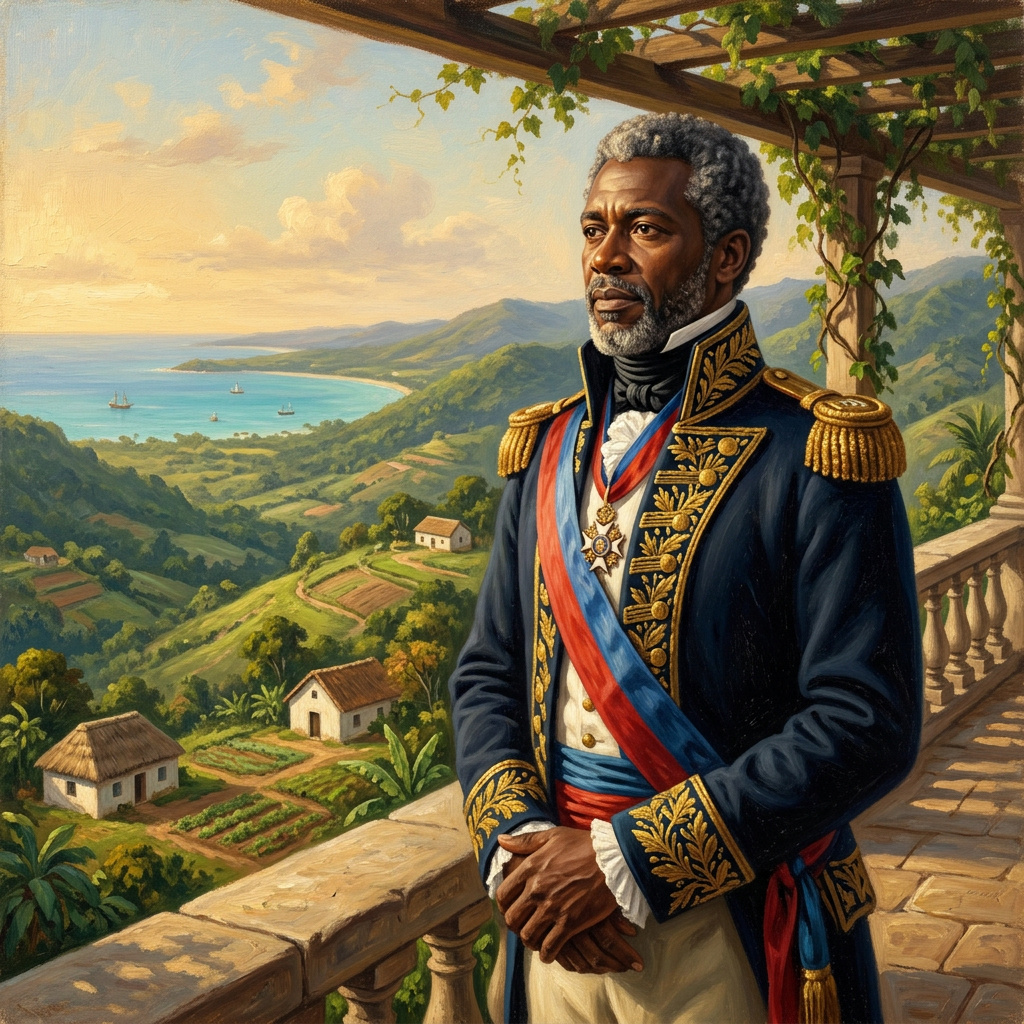
Alexandre Sabès Pétion was born in Port-au-Prince on April 2, 1770, into the complicated middle of colonial Saint-Domingue’s racial order. His father was a wealthy French colonist; his mother was a free woman of color. That made the boy one of the gens de couleur — the free people of mixed African and European descent who occupied an uneasy rung between the white planter class and the enslaved masses who outnumbered everyone many times over. They could own property, even own people, yet were barred from public office and treated as social inferiors by the whites whose blood many of them carried.
Pétion’s family had means, and means meant education. In 1788 he was sent across the Atlantic to study at the Military Academy in Paris, returning to the Caribbean as a trained soldier just as the world he knew began to come apart. When revolution swept Saint-Domingue, he fought first in the French colonial army, then threw in his lot with the revolutionary forces — serving under Toussaint Louverture and, later, under the general André Rigaud. He was a gifted artilleryman and an even better strategist: quiet where other commanders were loud, patient where they were rash. Those qualities would define everything that came after.
The Republic of the South
By 1804 Haiti was free — the first nation born of a successful slave revolution, the first Black republic in the world. But freedom did not mean unity. Jean-Jacques Dessalines, the iron general who had declared independence, was assassinated at Pont-Rouge on October 17, 1806, and the nation he left behind split along a fault line that had been forming for years.
In the north, Henri Christophe built a kingdom — crowning himself king, raising palaces and the great fortress of the Citadelle, ruling with the absolute authority he believed a fragile new state required. In the south and west, Pétion took a different road. He championed a republic: an elected presidency, a senate, a constitution — the machinery of representative government, however imperfect its first turning. In 1807 he was chosen as the first president of the Republic of Haiti, with Port-au-Prince as its capital.
The two Haitis eyed each other warily for more than a decade — monarchy against republic, north against south. Pétion has been criticized, then and since, for a presidency that drifted toward personal rule. But he planted an idea that outlived him: that a Haitian government should answer, at least in principle, to the Haitian people. It is an idea the country has been arguing over ever since.
Papa Bon Cœur and the Gift of Land
If Pétion is remembered with affection rather than awe, it is because of what he did with land. The plantations of Saint-Domingue had been engines of unimaginable cruelty — sugar and coffee estates worked by enslaved people until they died. After independence, the question of what to do with that land became the central question of Haitian life. Christophe, in the north, tried to keep the great estates intact and productive, binding laborers to them under a system of compulsory work. Exports stayed high; so did resentment.
Pétion chose the opposite. Beginning in 1807 and continuing for a decade, his government broke the plantations into small parcels and handed them out — first to the soldiers who had won the revolution, then to landless peasants who had never owned anything at all. By the time the program wound down, roughly 150,000 hectares had passed to something like ten thousand new smallholders. A people who had once been property became, in a single generation, a people who owned property.
Haitians called him Papa Bon Cœur — “good-hearted father.” He believed in schooling, too, founding the Lycée Pétion in Port-au-Prince, an institution that would educate generations of Haitian thinkers. The economic verdict on his land reform is genuinely mixed: dividing the estates traded plantation exports for subsistence farming, and the country’s cash economy never fully recovered. But Pétion had made a choice about what a nation was for. A field you farmed for yourself, he seemed to say, was worth more than a number in someone else’s ledger.

The Stranger at Les Cayes
This was the Haiti — proud, poor, and barely a decade old — that Simón Bolívar reached at the end of 1815. His revolution in Venezuela had collapsed. He had been driven out, beaten, and forced to flee by way of Jamaica, where an assassin had narrowly missed him. Les Cayes, under Pétion’s republic, had become a port of asylum: for South American patriots, for freedom-seekers from across the Caribbean, for anyone the Atlantic’s slave empires wanted dead.
Pétion welcomed Bolívar and listened. Then he did something remarkable for the leader of a small, embattled nation with enemies of its own: he gave the Venezuelan the means to fight. Roughly four thousand muskets, fifteen thousand pounds of gunpowder, flints and lead, ships, food, and — perhaps most consequential of all — a printing press, the instrument that would let a revolution explain itself. When Bolívar’s first expedition failed, he returned to Haiti, and Pétion supplied him again, this time adding trained men.
Pétion attached one condition, and it had nothing to do with money or land. He asked that Bolívar abolish slavery in every territory he liberated. The president of the world’s first Black republic would arm a continental revolution only if that revolution carried emancipation with it. And when Bolívar, overwhelmed, asked whether he might tell posterity that Alexandre Pétion was the true liberator of his homeland, Pétion refused the honor. His answer, by tradition, was simple: name no one — just free the enslaved wherever you go. He wanted the deed, not the glory.
The Cost of Generosity
Bolívar kept his word. He proclaimed the abolition of slavery, and over the following decade his armies broke Spanish power across Venezuela, Colombia, Panama, Ecuador, Peru, and the nation that would take his name, Bolivia. A meaningful share of that liberation was loaded onto ships at a Haitian dock and paid for by a Haitian treasury that could scarcely afford it.
Pétion did not live to see most of it. In 1816 he had modified the constitution to make himself president for life — a decision that sits uneasily beside his republican reputation — and named the young general Jean-Pierre Boyer as his successor. By early 1818 he was a tired and disillusioned man. He died in Port-au-Prince on March 29, 1818, not yet forty-eight, generally said to have been carried off by yellow fever, though contemporaries also spoke of a leader simply worn down by the weight of his office. Boyer took power and, two years later, reunited the country after Christophe’s death.
Pétion left Haiti poorer in exports and richer in something harder to measure — a countryside of people who owned the ground they stood on, and a place in the long story of human freedom that reached far beyond his own shoreline.
Alexandre Pétion never sought a monument, and for a long time history obliged him by half-forgetting his name. But the small farms still terrace the hills of southern Haiti, and the independence of much of South America still traces back, in part, to a quiet man at Les Cayes who armed a stranger and asked only that freedom travel with the guns. At HaitiPAM, we tell these stories because Haiti’s gift to the world has always been larger than the world has cared to admit — and because a nation that did so much for the freedom of others deserves to have its own heroes remembered out loud.
Leave a Reply