
On the morning of October 8, 1820, in the polished marble corridors of Sans-Souci, a king who could barely sign his own name dictated his last orders. His left side was paralyzed. His army had melted away in the night. His ministers had crossed over to the rebels. And somewhere in his bedroom — between 7:30 and 10:30 that evening, no one is quite sure — Henri Christophe lifted a pistol to his chest and ended the only monarchy ever declared in the Caribbean. The bullet, legend insists, was made of silver. Whether the silver was real or merely the kind of myth that great men attract in death, the kingdom died with him. So did the dream of a Black empire built on the ruins of slavery, modeled on the courts of Europe, and crowned with a fortress so vast that two centuries later it still drops the jaw of every visitor who climbs the mountain to see it.

From a Slave Boy on Grenada to a General in the North
Henri Christophe was born on October 6, 1767, almost certainly on the British island of Grenada, to an enslaved mother and a free Black man whose surname his son would carry into history. As a child he was probably brought to Saint-Domingue as a captive, and tradition holds that as a twelve-year-old he served — possibly as a drummer boy — in the Battle of Savannah during the American Revolutionary War, where he watched Black soldiers stand against white ones in open combat. The image stayed with him.
By the eve of the Haitian Revolution he was working in Cap-Français at an inn called, with strange foreshadowing, La Couronne — The Crown. He was a free man by then, sharp, ambitious, fluent in French and English, well known in the city. When the slave uprising of August 1791 detonated across the northern plain, Christophe joined the insurgent ranks early, and there he found Toussaint Louverture. The man who could barely read attached himself to the man who could read everything, and for the better part of a decade he served as one of Toussaint’s most trusted generals — disciplined, fearless, politically shrewd. By 1801 he was a brigadier-general. By 1802 he commanded Cap-Français itself.
“You Will Enter Only on Ashes”
His defining moment came in February 1802, when General Charles Leclerc — Napoleon’s brother-in-law — appeared off the coast with a French armada sent to crush the colony’s Black government and restore slavery. Leclerc demanded entry into the city. Christophe answered with one of the great refusals in revolutionary history: If you persist in these threats, you will only enter this city once it has been reduced to ashes. And even on those ashes I will fight you.
Leclerc persisted. Christophe set the torch to his own city — burning his own house first, so no soldier could accuse him of sparing his own. Cap-Français went up in flames, and the war that followed cost the French an empire. Twenty months later, after Toussaint had been kidnapped and Christophe and Dessalines had taken back command, the colony declared independence on January 1, 1804. Haiti was born. But the men who had won the war were already eyeing each other across the smoke.
The Crown of the North
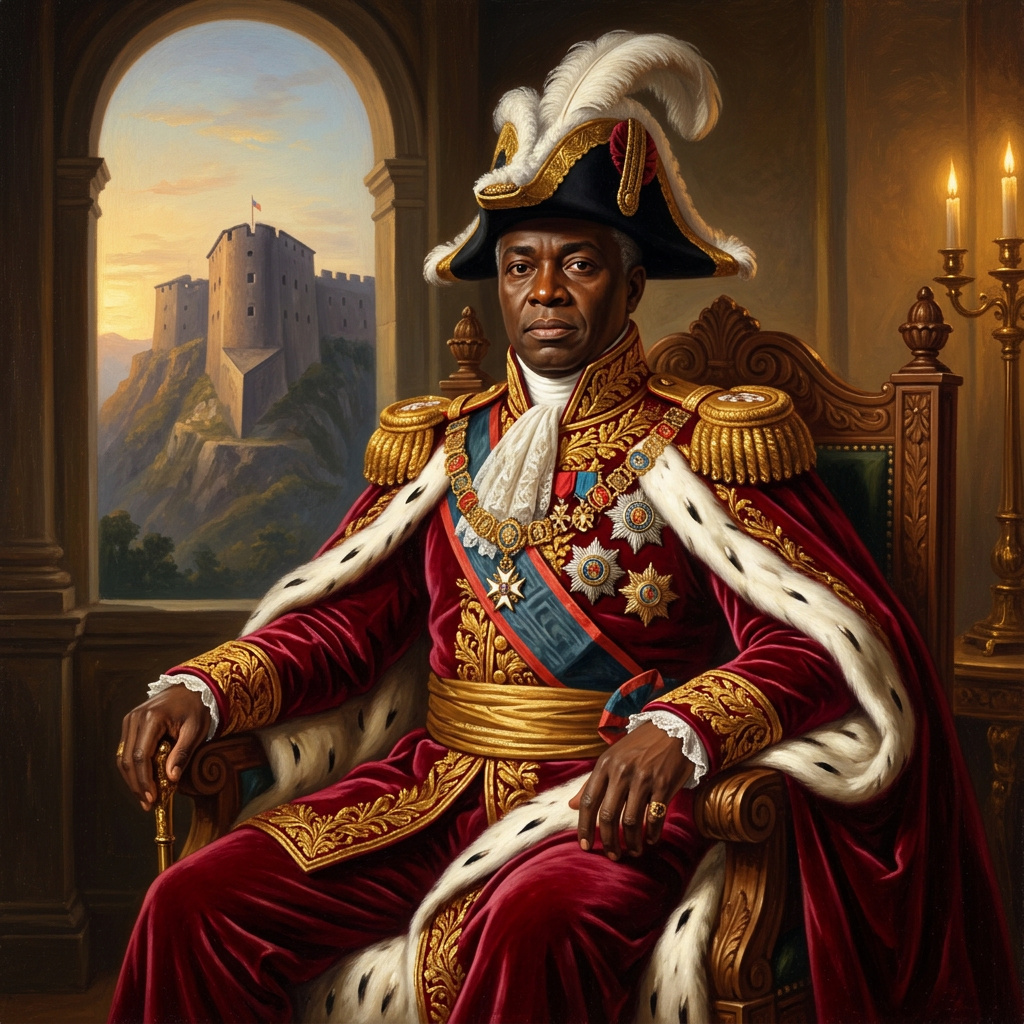
When Dessalines was assassinated at Pont-Rouge in October 1806, the young republic split in two. In the south, the elegant mulatto general Alexandre Pétion built a parliamentary republic. In the north, Henri Christophe withdrew to the Plaine-du-Nord and built something altogether stranger. On February 17, 1807, he was elected President of the State of Haiti. Four years later, on March 26, 1811, he abolished the title and proclaimed himself Henry I, King of Haïti.
It was an audacious gesture. He created a hereditary nobility — four princes, eight dukes, twenty-two counts, thirty-seven barons, fourteen knights — and a College of Arms to design their coats of arms. There was a Duc de la Marmelade, a Comte de Limonade, a Baron de Dondon. To European observers it sounded like opera. To Christophe it was deadly serious: titles, etiquette, ceremony, and crowns were the language of legitimacy in 1811, and he intended his Black kingdom to speak that language fluently. He admired George II of England, brought English tutors across the Atlantic to staff his schools, declared Catholicism the state religion, founded a school of medicine, and minted his own gourde currency.

Sans-Souci and the Mountain Fortress
Of all the things Henri Christophe built, two refuse to be forgotten. The first is the Sans-Souci Palace at Milot, raised between 1810 and 1813 as a deliberate answer to the European powers — proof, in marble and gilt and water gardens, that a Black man could build a Versailles of his own. Visiting diplomats described its grand staircases, its mirrored ballrooms, its mahogany floors and the artificial stream that ran beneath them to cool the rooms. An 1842 earthquake reduced most of it to elegant ruins, but even the bones of Sans-Souci still command awe.
The second is the Citadelle Laferrière. Begun in 1805 and completed only in the year of his death, it sits 900 meters above the plain on the Bonnet à l’Évêque, the largest fortress in the Western Hemisphere. Its walls are four meters thick. Its 365 cannons could rake any approach. It was designed for a single, terrifying purpose: when Napoleon — or any French successor — sent another fleet to re-enslave Haiti, the entire population of the north would retreat into the mountains, slip behind those walls, and outlast a siege of years. The French never came. But the Citadelle remained, and remains, a stone declaration that freedom would never again be negotiated. The cost was staggering: contemporary accounts speak of as many as 20,000 lives lost in its construction, men driven by the king’s brutal fermage labor system to haul stone up the mountainside under tropical sun.
The Stroke, the Silver Bullet, and the End of a Dream
On August 15, 1820, the Feast of the Assumption, Henri attended Mass at the church in Limonade with his queen, Marie-Louise Coidavid, and his court. Mid-service, he collapsed. A massive stroke had taken his left side. His Scottish physician, Duncan Stewart, revived him, but the king who returned to Sans-Souci that September was not the man who had ridden out. He was paranoid, mistrustful, certain that his rival Boyer in the south was already moving against him. The fermage system — which kept former slaves bound to the plantations of his nobles — had been resented for years. Word of the stroke broke the spell. Garrisons mutinied. Generals defected. By the morning of October 8, the kingdom was disintegrating around him.
He sent out one last brigade. When word came back that those troops, too, had crossed over to the republic, the king turned to Dr. Stewart and said quietly: For my part, I know what I must do. Sometime that night the shot was fired. The bullet — silver, by tradition; ordinary lead, by some accounts — struck him in the heart. His sixteen-year-old son and heir, Victor-Henry, was hanged ten days later. His widow and daughters slipped into exile. Loyal soldiers carried the king’s body up the mountain and buried him inside the walls of his Citadelle, where a simple plaque marks the spot today. The kingdom of the north was over. The republic absorbed it. There would never be another Haitian king.
Henri Christophe was a contradiction his country has never quite resolved — the illiterate king who imported English schoolmasters, the liberator who chained his own people to the soil, the visionary who could imagine a Black Versailles and the tyrant who built it on broken backs. UNESCO declared his Citadelle and Sans-Souci a World Heritage Site in 1982, and Haitian schoolchildren still know his face from postage stamps and history books. Climb the long mountain trail to the Citadelle on a clear day and the Atlantic stretches out blue forever, and you understand what he was trying to say to history: that freedom won by fire would be defended in stone, and that no empire on earth would ever dare to take it back. At HaitiPAM we tell these stories — the proud ones and the painful ones — because the country that produced King Henry I is still writing the next chapter.
Leave a Reply