
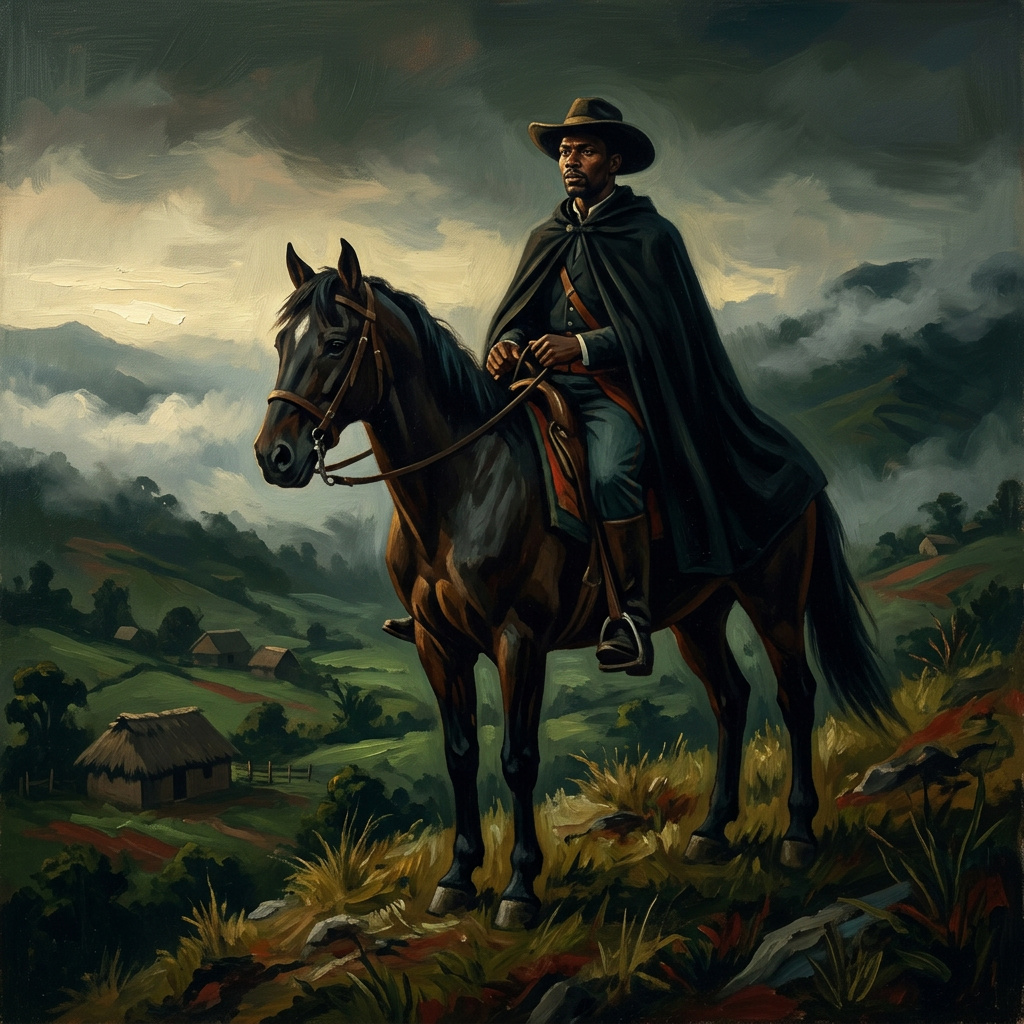
On a humid October night in 1919, in the green hills above the Central Plateau, a tall man in a black cape rode through the camp of five thousand fighters who called him their general. They called him by his given name too — Charlemagne — as if he were one of those medieval emperors whose name his mother had borrowed at his birth thirty-three years earlier. Two weeks later, the same man would be dead, his body stripped and tied upright to a wooden door, photographed by United States Marines who believed the image would end the rebellion. Instead, it would canonize him.
This is the story of Charlemagne Péralte — the son of a Haitian army general who became the most famous guerrilla leader in the country’s history, and whose corpse, against every intention of the men who killed him, became one of the most powerful images of resistance the Caribbean has ever produced.

The Son of a General, the Boy of Hinche
Charlemagne Masséna Péralte was born in 1885 in Hinche, a town tucked into the savannas of the Central Plateau where the Artibonite River begins its long roll west toward the sea. His father, Remi Masséna Péralte, was a Haitian army general; his parents had roots across the border in the Dominican Republic. The family was what Haitians sometimes call the bourgeoisie rurale — landed, literate, comfortable enough to send their son away to school in the capital.
That school was Saint-Louis de Gonzague, the same Jesuit institution that has educated generations of Haitian writers, presidents, and revolutionaries. Péralte studied his Latin, his French, his catechism. He learned the disciplines that prepared the children of his class for officer’s commissions or government posts. By his thirtieth year, he was a military commander in Léogâne, then in Port-de-Paix on the north coast — the kind of competent, well-bred officer the Haitian state had been producing since the days of Pétion.
Then, in the summer of 1915, the United States Marines came ashore at Port-au-Prince, and the world Péralte had been trained to serve ceased to exist.
The Occupation That Sparked a Country
The American occupation of Haiti, which would last from 1915 to 1934, was justified in Washington as a stabilization mission. In practice it was something cruder: the dissolution of the Haitian army, the rewriting of the constitution to permit foreign land ownership, and — most explosively — the reintroduction of corvée, an old French forced-labor system that the Marines and the new American-run Gendarmerie used to build roads. Peasants were rounded up at gunpoint, tied together by rope, and marched into the hills to break stone for wages that often never came.
For a country whose entire founding identity was built on the abolition of slavery, the spectacle was unbearable. The word kakos — or in French spelling, Cacos — had long described the irregular peasant fighters of the northern hills, men who had played a role in nearly every Haitian uprising since independence. Now, with the corvée gangs trudging past their villages, the Cacos took up the cause again. What they needed was a commander.
They got one in October 1917, when a band of Cacos staged a raid on a Gendarmerie payroll in the town of Hinche. The raid failed. One of its organizers, a thirty-two-year-old former officer named Charlemagne Péralte, was arrested and sentenced to five years of hard labor — and, as a final insult, paraded through the streets of his own hometown with a broom in his hands, sweeping the road like one of the corvée peasants. It was the humiliation that broke him, and broke open the country.
A General in the Hills
In September 1918, after a year of forced labor, Péralte escaped. He vanished into the hills above Hinche and began to gather an army. Within months, he had something no Haitian leader had assembled since the wars of independence: a coordinated guerrilla force operating across the Central Plateau and the Northern Department, with sympathizers in nearly every village. By the summer of 1919, his Caco forces numbered roughly five thousand men. He had issued proclamations. He had created a parallel government with himself as chef suprême de la révolution. He had vowed, in a phrase that would echo through the century, “to drive the invaders into the sea and free Haiti.”
The Marines, who had been treating the Caco resistance as bandit suppression, suddenly realized they were facing something much larger. On October 7, 1919, Péralte’s forces attacked Port-au-Prince itself. The raid was beaten back at the city limits — the Cacos were poorly armed, and the Marines had machine guns and air support — but the audacity of the assault terrified the occupation command. A Haitian peasant army was now marching on the capital. The story was being picked up by American newspapers. The occupation, sold to the public as a benevolent caretaking, looked like exactly what it was.

Betrayal at Grande-Rivière-du-Nord
Washington decided Péralte had to be killed. The man who volunteered was a young Marine sergeant named Herman Henry Hanneken, who proposed something audacious: infiltrate the Caco camp in blackface and kill the general from arm’s length. To make the plan work, Hanneken bribed one of Péralte’s officers, Jean-Baptiste Conzé, into staging a fake defection — Conzé would set up a counter-camp, draw Péralte’s attention with a series of “rebel raids,” and eventually invite the general himself for an inspection. Hanneken and Corporal William Button, their skin darkened with cork and burnt cane, would be waiting.
On the night of November 1, 1919, the trap closed. Péralte rode into a hillside camp near Grande-Rivière-du-Nord, surrounded by his bodyguards. Hanneken stepped out of the shadows, recognized the tall figure in the cape, and fired twice with a .45 caliber pistol into Péralte’s chest at close range. Button opened up with a Browning Automatic Rifle on the bodyguards. The general of the Cacos died on the dirt of the camp he had ridden in to bless. He was thirty-three. For their action, both Marines were awarded the Medal of Honor.
The Photograph That Backfired
What the Marines did next is what has haunted them ever since. They stripped Péralte’s body, tied it upright to a wooden door, draped a Haitian flag near his shoulder so its pole rested under his arm, and photographed the result. They thought they were producing a warning. Copies of the photograph were printed by the thousands and distributed all over Haiti — handed out at marketplaces, tacked to trees, dropped from biplanes onto the villages of the Plateau. The intent was psychological warfare in the tradition of the American South: a lynching postcard meant to terrify a population into submission.
It did the opposite. To Haitians looking at the photograph, what they saw was unmistakable: a man bound to a piece of wood, his arms spread, his head fallen forward, a flag at his side. The image was a crucifixion. The man on the door wasn’t a bandit being humiliated. He was a martyr being revealed. Within weeks, the rebellion didn’t collapse — it intensified, picked up by Péralte’s lieutenant Benoît Batraville, and only put down the following year at terrible cost. The occupation would limp on for another fourteen years, but in the country’s imagination it had already lost.
The Long Afterlife of Charlemagne
When the Marines finally withdrew from Haiti in 1934, one of the first acts of President Sténio Vincent was to send a delegation north to recover Péralte’s bones. They were unearthed and reinterred with a state funeral in Cap-Haïtien, attended by the president himself. Slowly, deliberately, the country began to write the rebel back into the official story. In 1988 a postage stamp bore his face. In 1991 a fifty-centime coin was struck with his portrait. After Jean-Bertrand Aristide returned from exile in 1994, the coin was reissued — a small bronze argument that Haiti’s resistance against foreign occupation was a continuous tradition, and Péralte its modern face.
Today, in Hinche, a larger-than-life bust of Charlemagne Péralte stands in the central park that bears his name. On the first of November every year — the same day he died, the same day Haitians honor the dead in the Fèt Gede tradition — families gather around the statue and speak his name. In Port-au-Prince, you can find his portrait painted on tap-tap buses and bar walls. In Brooklyn and Miami, in diaspora homes that have never seen Hinche, the same photograph the Marines hoped would extinguish him hangs in living rooms, retouched and reframed: the man on the door, head bowed, flag in hand, no longer a warning but a benediction.
Charlemagne Péralte’s life lasted thirty-three years. His afterlife has lasted more than a century, and shows no sign of ending. He belongs to that small company of figures — Toussaint, Dessalines, Catherine Flon — whose biographies have been absorbed by the country itself, who became, after their deaths, less men than arguments about what Haiti is. The photograph that was meant to bury him made him eternal, and that is perhaps the most Haitian ending of all: the empire’s instrument turned, in the country’s hands, into a sacrament. At HaitiPAM, we tell these stories because Haiti’s history is not a chronicle of suffering but of the most stubborn dignity the hemisphere has ever known — and because every generation deserves to meet the country’s heroes face-to-face, just as their grandparents did, in the lamplight of a kitchen, listening.
Leave a Reply