
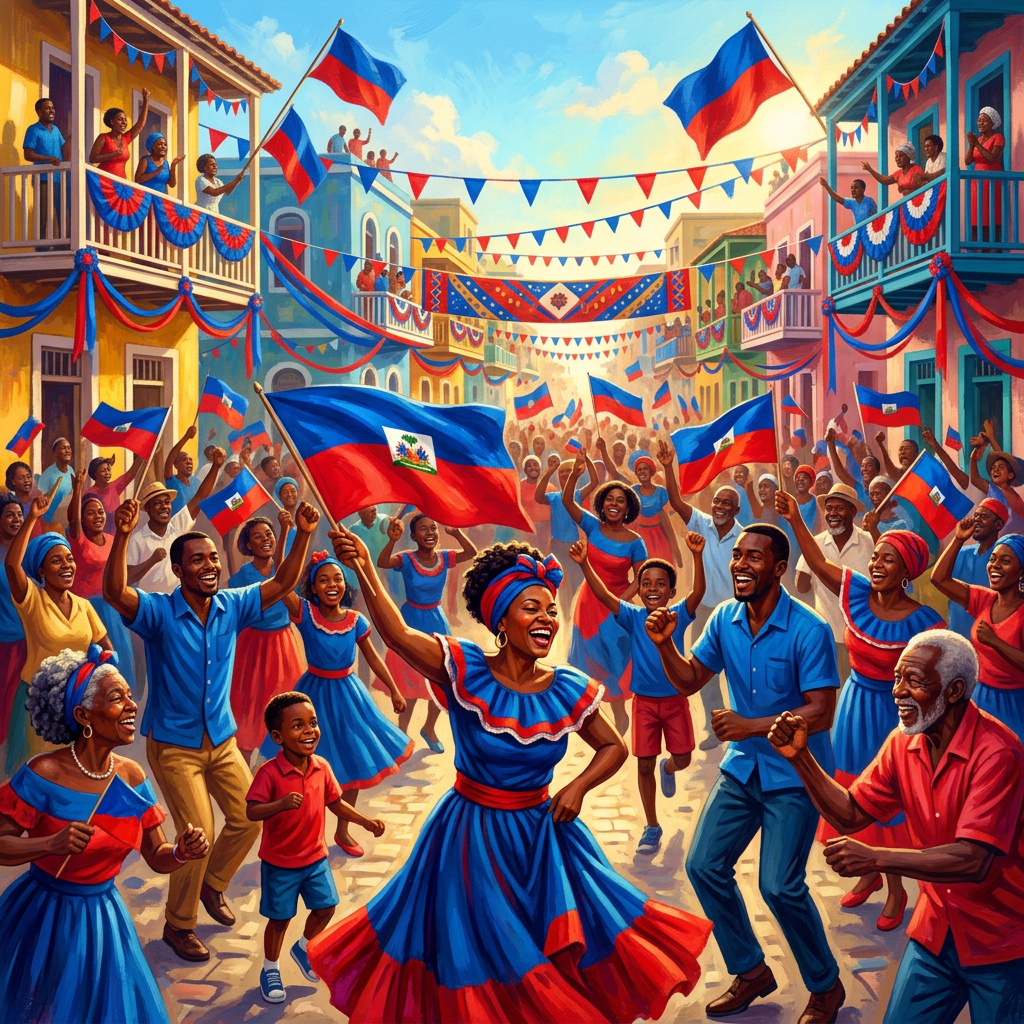
Every year on May 18, Haiti turns blue and red. The colors spill out of windows and across balconies, knot themselves into headscarves and bracelets, and ripple from the antennas of tap-taps inching through Port-au-Prince traffic. Schoolchildren press their hands over their hearts. Somewhere a brass band is already playing. From Cap-Haïtien to Brooklyn to Little Haiti in Miami, millions of people are wearing the same two colors on the same day for the same reason — and that reason is more than two centuries old. This is Drapo Ayisyen, Haitian Flag Day, and it may be the most beloved holiday in the Haitian calendar.

The Congress at Arcahaie
To understand why a flag inspires this much devotion, you have to go back to a town called Arcahaie and a date that has never lost its weight: May 18, 1803. The revolution against French rule was reaching its decisive phase. The enslaved and free people of Saint-Domingue had been fighting for more than a decade, but their leaders were not yet fully united — and disunity was the one luxury a revolution against an empire could not afford.
So the revolutionary commanders gathered for a congress. Over its final days they agreed on a single supreme command under Jean-Jacques Dessalines, and they agreed on a flag. The story, told and retold until it became something close to scripture, runs like this: Dessalines took the French tricolor of blue, white, and red and tore the white band out of its center. What was white — the color the colonizers had claimed as their own — would have no place in the banner of a free people. He handed the remaining blue and red panels to Catherine Flon, who stitched them together into the first Haitian flag, beneath the words “Liberty or Death.”
Eight months later, on January 1, 1804, Haiti declared its independence — the first nation in the world born of a victorious uprising of the enslaved. But the flag came first. It was sewn before the country it would belong to even existed.
Two Colors, One People
The genius of the Haitian flag lies in what it leaves out and what it joins together. Removing the white was a statement of rupture, a clean break from France. But keeping two colors rather than one was a statement of union. By tradition, blue stands for Haiti’s Black citizens and red for those of mixed African and European descent — the two groups whose mistrust of each other had nearly fractured the revolution from within. Sewn side by side, they declared that the new nation would belong to both.
That idea is carved into the country’s motto, which appears on the official state version of the flag beneath a palm tree crowned with a liberty cap, flanked by cannons and trophies of war: L’Union Fait La Force — “Unity Makes Strength.” It is not a decorative phrase. It is the lesson the founders drew from the hardest years of their lives, set permanently into the national emblem so that no generation could forget it. The plain blue-and-red banner without the coat of arms is the civil flag, the one ordinary Haitians wave; the version bearing the arms belongs to the state. Both carry the same message.
A Holiday Takes Shape
Over the generations, the anniversary of that day at Arcahaie grew into a full national holiday — one of the fixed pillars of the Haitian year. In Haiti, the morning of May 18 belongs to ceremony. Flags are raised, officials lay wreaths, and the national anthem, La Dessalinienne, is sung in courtyards and public squares. Schools are central to the day: children dress in blue and red, recite the story of the flag, and learn — often for the first time — that the banner over their classroom was sewn by hand before their country had a name.
By afternoon, the solemnity loosens into celebration. Konpa music carries from sound systems, neighbors share food, and the colors that began the day on flagpoles end it on dancing bodies. It is a holiday that manages to be both a history lesson and a party, and Haitians see no contradiction in that. Remembering the founders and enjoying the freedom they won are, on May 18, simply the same act.

Flag Day and University Day
There is a second meaning folded into May 18 that outsiders often miss. In Haiti, the date is observed not only as Flag Day but as University Day — a celebration of the country’s institutions of higher learning, its students, and its teachers. The pairing is deliberate. The men and women who tore apart a colonial flag were making an argument that a free people could govern, build, and think for themselves. Education is how each new generation makes that argument again.
So on the same day the flag is honored, Haiti also honors the lecture hall and the library. Universities hold ceremonies; students and faculty are recognized for their part in the nation’s intellectual life. It is a quiet but pointed reminder that independence was never only about driving out an army. It was about claiming the right to learning that the colonial system had worked so hard to deny — and trusting the next generation to carry it forward.
The Flag in the Diaspora
For the millions of Haitians who live outside Haiti, May 18 is something even more charged. In the diaspora, the flag is portable homeland — proof of where you come from that fits in a pocket and unfurls from a car window. New York City, home to one of the largest Haitian communities in the United States, fills with blue and red; Brooklyn’s Haitian Flag Day parade has grown from a backyard gathering into a major street celebration. In Miami, Little Haiti becomes the center of the day, with festivities around the Haitian Heritage Museum and its cultural plazas drawing crowds. Boston and Montreal hold their own.
May is Haitian Heritage Month across much of North America, and Flag Day is its beating heart. The celebrations brim with konpa, griot, and pride — but they also carry reflection. For a diaspora shaped by political instability at home, by hard migrations, and by anti-Black discrimination abroad, the flag is both a joy and an act of insistence. To raise it is to say: we are still here, and we are still that people — the ones who sewed a banner before they had a country, and then went out and won the country to match it.
The Haitian flag is older than Haiti itself, and every May 18 the nation and its diaspora gather to remember that a country can be imagined into being before it is fought into existence. Blue and red, stitched together at Arcahaie, still say what they were made to say: that a free people belongs to all of its children, and that unity is strength. At HaitiPAM, we mark Flag Day because few symbols on earth carry as much history in as little cloth — and because the story of those two colors is, in the end, the story of Haiti itself. Bòn Fèt Drapo.
Leave a Reply