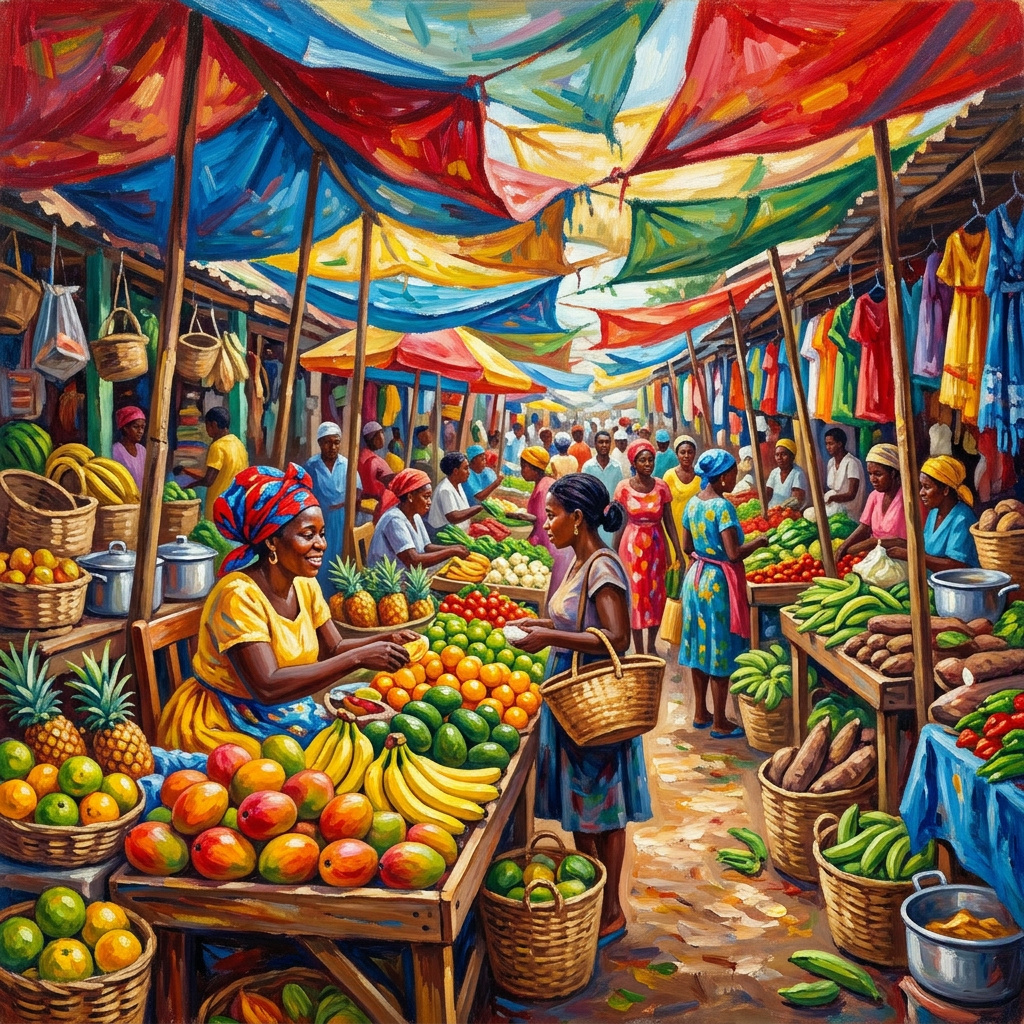
Walk into any Haitian home — from the humblest tin-roofed dwelling in the provinces to a polished apartment in Pétion-Ville — and chances are you will find a painting on the wall. Not a mass-produced print, not a photograph, but a tablo: a hand-painted scene bursting with color, alive with the energy of a market, a Vodou ceremony, a mountainside village at dusk. Haitian painting is not a luxury reserved for museums and collectors. It is a living, breathing part of the national identity — an art form that emerged from the hands of untrained visionaries and captured the attention of the entire world.

The Centre d’Art: Where It All Began
The story of Haitian painting as the world knows it begins in 1944, in a modest building on Rue de la Révolution in Port-au-Prince. That year, an American watercolorist named DeWitt Peters — a conscientious objector who had come to Haiti to teach English during World War II — was astonished to discover that this island teeming with artistic talent had no art gallery, no school, no formal space where artists could gather and create. Together with Haitian intellectuals including the writer Philippe Thoby-Marcelin and the architect Albert Mangonès, Peters founded Le Centre d’Art.
The Centre was never meant to teach artists how to paint in the European tradition. Instead, it became a place of discovery — a magnet for the extraordinary self-taught painters who had been quietly creating masterpieces in their homes, their churches, and their Vodou temples for years. Peters opened the doors, provided materials, and invited people to paint. What poured through those doors would stun the art world. By 1947, the Haitian government recognized the Centre d’Art as an institution of public utility. Visitors from across the globe — including the French Surrealist André Breton and the Cuban painter Wifredo Lam — came to see what was happening in this small Caribbean nation, and they left shaking their heads in wonder.
Hector Hyppolite: The Grand Master
No figure looms larger in the history of Haitian painting than Hector Hyppolite. Born in 1894 in Saint-Marc, Hyppolite was a third-generation Vodou priest — an oungan — who also made shoes and painted houses before he ever touched a canvas. When Peters discovered him in the mid-1940s, Hyppolite was already in his fifties, painting with whatever materials he could find, including chicken feathers instead of brushes. What he created was extraordinary: vivid, dreamlike scenes of Vodou spirits and ceremonies, rendered with an intensity and spiritual depth that transcended anything the European art establishment had seen from the Caribbean.
In the final three years of his life, Hyppolite produced between 250 and 600 paintings — an astonishing outpouring of creative energy. André Breton, the father of Surrealism, encountered Hyppolite’s work and was electrified. He declared it a revelation, and his championing of Hyppolite brought Haitian painting to the attention of galleries and collectors in Paris and New York. When Hyppolite died in 1948 at the age of 54, he left behind a body of work that had single-handedly placed Haiti on the global art map. Today, he is remembered as the Grand Maître — the Grand Master — of Haitian art.
Philomé Obin and the Cap-Haïtien School
While Port-au-Prince had its Centre d’Art, the northern city of Cap-Haïtien was developing its own distinctive artistic tradition under the quiet genius of Philomé Obin. Born in 1892, Obin spent decades painting meticulously detailed scenes of northern Haitian life — street processions, historical events, the everyday rhythms of Cap-Haïtien’s colonial-era streetscapes. His style, sometimes called “magical pseudo-realism,” is instantly recognizable: rows of peak-roofed townhouses with protective overhangs, elongated shuttered doors with long iron hooks, and tiny, carefully placed figures going about their daily business in the foreground.
Obin founded what became known as the Cap-Haïtien School, a northern tradition distinct from the more Vodou-influenced painting of the capital. Where Hyppolite channeled the spirit world, Obin documented the human world — the parades, the politics, the architecture, and the pride of Haiti’s second city. He painted until well into his nineties, dying in 1986 at the age of 94, having trained generations of northern artists and established Cap-Haïtien as a vital center of Haitian art in its own right.
Saint-Soleil: Art from the Mountains
By the 1970s, a radical new chapter was being written in the hills above Port-au-Prince. In 1973, the painter and sculptor Jean-Claude Garoute — known universally as Tiga — and the dancer and cultural activist Maud Robart founded an extraordinary experiment in a rural community called Soisson-la-Montagne. They offered farming families drawing and painting materials, asking nothing except that they create freely, guided by intuition, spirituality, and the rhythms of the land. What emerged was the Saint-Soleil movement — Haiti’s first rural arts community and one of the most remarkable artistic experiments in Caribbean history.
The Saint-Soleil artists — including Louisiane Saint Fleurant, Levoy Exil, Dieuseul Paul, and Prosper Pierre-Louis — created work that was raw, spiritual, and utterly unlike anything that had come before. Their paintings pulsed with the energy of Vodou ceremonies, dreams, and the natural world, rendered in bold colors and abstract forms that felt both ancient and revolutionary. The movement caught the attention of the French author André Malraux, who dedicated an entire chapter to Saint-Soleil in his book L’Intemporel, praising it as one of the most significant artistic phenomena of the twentieth century. Tiga himself went on to develop what he called the Solèy Brile — “burning sun” — technique, a style of abstract spiritual painting that combined raw textures, symbolic forms, and vibrant color.
A Living Tradition
The 2010 earthquake devastated much of Haiti’s artistic infrastructure. The Centre d’Art was destroyed, and countless irreplaceable works were damaged or lost. The Smithsonian Institution and other international organizations joined Haitian efforts to recover and conserve what could be saved. The Centre reopened in temporary premises in 2014, and the work of restoration continues — a testament to the resilience that has always defined Haitian art.
Today, Haitian painting thrives in galleries from Pétion-Ville to Miami’s Little Haiti, from the walls of the Myriam Nader Gallery in Manhattan to the studios of young artists in Jacmel and Gonaïves. The tradition that DeWitt Peters helped bring to the world’s attention eighty years ago has grown into one of the most recognized and collected art forms in the Caribbean. Every brushstroke carries the DNA of Hyppolite’s spiritual visions, Obin’s meticulous chronicles, and Tiga’s burning suns — a lineage of creativity that refuses to be silenced by poverty, natural disaster, or political turmoil.
Haitian painting is more than an art movement — it is a mirror held up to the soul of a nation. In every tablo that hangs on a wall in Port-au-Prince or Cap-Haïtien, in every canvas that crosses the ocean to hang in a collector’s home in Paris or New York, the spirit of Haiti speaks: defiant, joyful, spiritual, and unbreakable. At HaitiPAM, we believe that to understand Haiti, you must see it through the eyes of its painters — the self-taught visionaries who turned color and canvas into a language the whole world could understand.
 HAITI PAM
Leave a comment