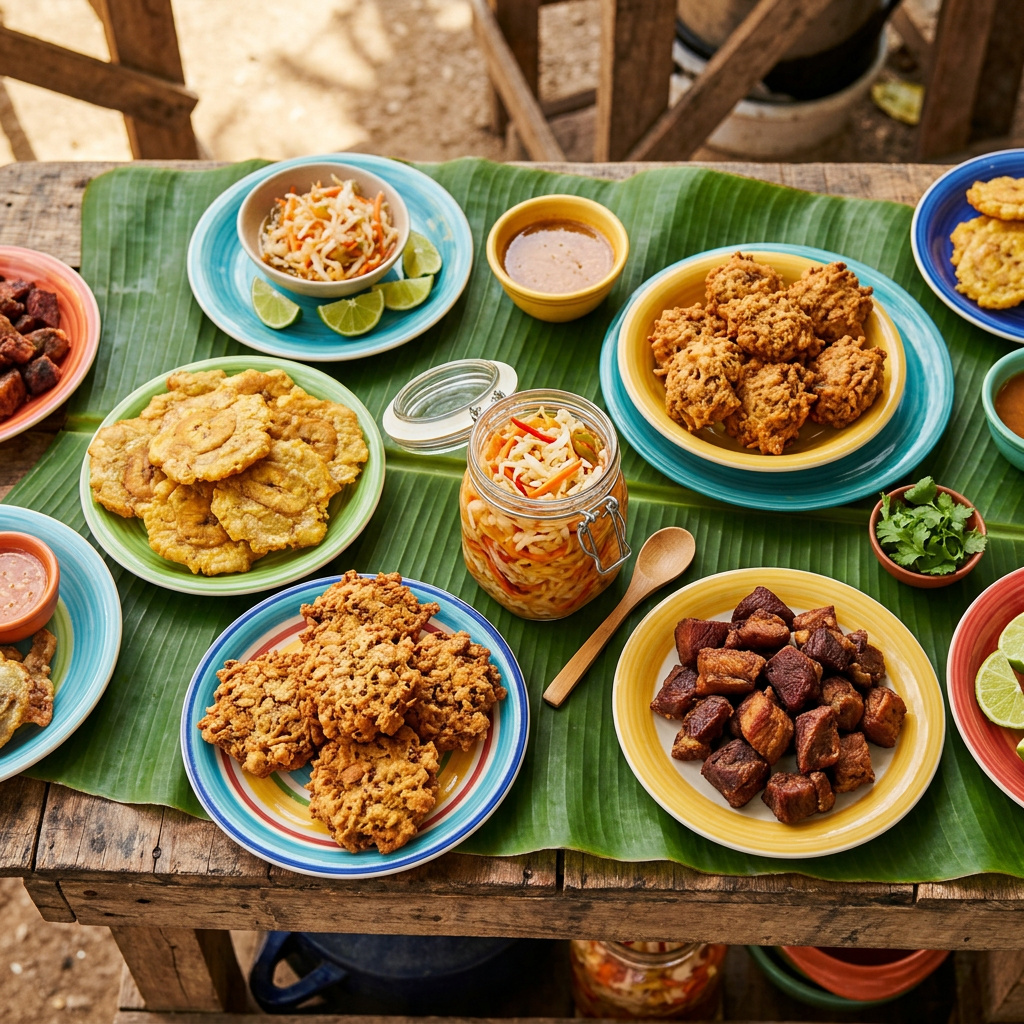
Follow the sound of sizzling oil down any street in Port-au-Prince, Jacmel, or Cap-Haïtien, and you will find her — the fritay vendor. She stands behind a wooden cart or a battered metal table, presiding over a kingdom of golden, bubbling pots. Before her lies a spread that could make a grown man weep with hunger: crispy fried plantains stacked like gold coins, mahogany-dark fritters pulled hot from the oil, a jar of fiery pickled cabbage catching the late afternoon sun. This is fritay — Haiti’s beloved street food tradition — and it is not merely food. It is a ritual, a gathering place, a communion of flavor and community that has sustained Haitians through centuries of triumph and hardship alike.

The Fritay Vendor: Haiti’s Most Important Restaurant
In Haiti, there are restaurants with menus and tablecloths, but the true culinary heart of the nation beats at the fritay stand. The word fritay — from the French friture, meaning fried food — refers not to a single dish but to an entire category of street food: a glorious, communal spread of fried delights served together on sheets of brown paper or shared plates. A typical fritay platter might include griot (fried pork), tassot (fried goat or beef), bannann peze (twice-fried plantains), akra (malanga fritters), marinad (savory batter fritters), and always, always, a generous helping of pikliz — the incendiary pickled relish that ties everything together.
The fritay vendor is almost always a woman — a machann — and her stand is far more than a business. It is a social institution. Neighbors gather around her cart in the late afternoon, catching up on the day’s news while waiting for the next batch to emerge from the oil. Children run errands in exchange for a piece of bannann peze. Young couples share a plate of griot and pikliz under the dimming sky. The fritay stand is where Haiti feeds itself, tells its stories, and holds itself together — one crispy, golden bite at a time.
Pikliz: The Fire That Ties It All Together
No fritay platter is complete without pikliz, and no Haitian meal is truly Haitian without its sharp, vinegary bite. Pikliz is a pickled condiment made from shredded cabbage, carrots, bell peppers, onions, garlic, and — most crucially — Scotch bonnet peppers, all submerged in white vinegar and left to ferment until the flavors meld into something at once tangy, crunchy, and explosively hot. The name itself is a Creole marriage of the English word “pickle” and the French piquer, meaning “to sting” — and sting it does.
Every Haitian household has its own pikliz recipe, passed from grandmother to granddaughter with the solemnity of a sacred text. Some families add cloves for warmth, others toss in lime juice alongside the vinegar, and the ratio of Scotch bonnet to cabbage is a matter of fierce personal pride. The condiment improves with time — a jar of pikliz that has been sitting for a week or two develops a depth of flavor that fresh pikliz cannot match. In the diaspora, pikliz has become one of the most powerful edible connections to home. Haitian-owned brands now sell it commercially in cities from Miami to Montreal, and food writers have begun to recognize it as one of the great condiments of the world — a Caribbean answer to Korean kimchi or Mexican salsa that deserves a place on every table.
Akra: Where Africa Meets the Caribbean
Of all the items on the fritay platter, akra may carry the deepest historical roots. These crispy, golden fritters are made from grated malanga — a starchy root vegetable that the Taíno people cultivated on the island long before European contact — mixed with garlic, scallions, parsley, thyme, and fiery Scotch bonnet peppers, then dropped by spoonfuls into hot oil until they emerge crackling and irresistible.
The name akra traces a direct line back to West Africa, where akara — fritters made from black-eyed bean paste — has been a staple food for centuries among Yoruba and other peoples of present-day Nigeria and Benin. When enslaved Africans were brought to the Caribbean, they carried the technique and the name with them, adapting it to the ingredients they found in their new, brutal home. The black-eyed beans of West Africa gave way to the malanga of the Taíno, creating a dish that is, in its very DNA, a fusion of two ancient food traditions — one African, one Indigenous — forged in the crucible of the plantation.
Today, akra is one of the most beloved street foods in Haiti. Vendors fry them fresh throughout the day, and the sight of a plate of akra — their surfaces craggy and golden, their interiors soft and fragrant with herbs — is enough to stop any Haitian in their tracks. Eaten hot, dipped in pikliz, akra is a small miracle of texture and flavor: the crunch of the exterior yielding to the creamy, earthy center, the heat of the pepper building slowly on the tongue. It is comfort food in its purest form, carrying the memory of two continents in every bite.
Bannann Peze: The Golden Foundation
If fritay has a foundation stone, it is bannann peze — twice-fried green plantains that achieve a state of crispy, salty perfection that no other preparation of the plantain can match. The technique is deceptively simple: thick slices of unripe plantain are fried once at a moderate temperature until soft, then removed, flattened with the bottom of a bottle or a wooden press called a pèz bannann, and plunged back into the oil at high heat until they turn golden and shatteringly crisp.
The result is a disc of pure starchy satisfaction — crunchy on the outside, tender within, and capable of absorbing the flavors of everything it touches. Bannann peze is the plate upon which the rest of the fritay rests, both literally and figuratively. A piece of griot perched atop a bannann peze, crowned with a forkful of pikliz, is one of the most satisfying bites in all of Caribbean cuisine — a single mouthful that contains the sweetness of the plantain, the richness of the pork, and the vinegary fire of the pickled cabbage in perfect harmony.
Plantains themselves arrived in the Caribbean from Africa via the Spanish and Portuguese in the sixteenth century, and they became a cornerstone of Haitian agriculture and diet. Today, bannann peze is as fundamental to Haitian identity as rice and beans. No celebration, no Saturday gathering, no late-night craving is complete without it. In Little Haiti neighborhoods from Miami to Brooklyn, the sound of plantains hitting hot oil is the sound of home being reconstructed, one golden disc at a time.
Fritay in the Diaspora
As Haitians have migrated across the world, fritay has traveled with them. In Miami’s Little Haiti, fritay stands operate on street corners just as they do in Port-au-Prince, serving the same platters of griot, bannann peze, and pikliz to homesick immigrants and curious newcomers alike. In New York, Haitian food trucks and pop-up kitchens have introduced fritay to audiences who had never tasted it before — and who found themselves instantly hooked. Montreal, Boston, Paris — wherever Haitians have settled, the fritay vendor has followed.
A new generation of Haitian-American and Haitian-Canadian chefs is also elevating fritay without losing its soul. Restaurants are serving akra on small plates with artisanal dipping sauces, reimagining bannann peze as a base for creative toppings, and bottling pikliz for a growing audience of spice lovers. Food writers and social media creators are spreading the gospel of Haitian street food to millions who might never visit Haiti but who can now taste its spirit in a fritter, a plantain, or a jar of fire.
Haitian street food is not fast food — it is soul food in the truest sense. Every batch of akra carries the memory of West African grandmothers and Taíno farmers. Every jar of pikliz holds the defiant heat of a people who season their lives with joy even in the hardest times. Every bannann peze, pressed flat and fried to gold, is a small act of transformation — something humble made magnificent by patience, skill, and love. At HaitiPAM, we believe that to know Haiti, you must taste it — and the best place to start is at the fritay stand on the corner, where the oil is hot, the pikliz is fresh, and everyone is welcome.
 HAITI PAM
Leave a comment