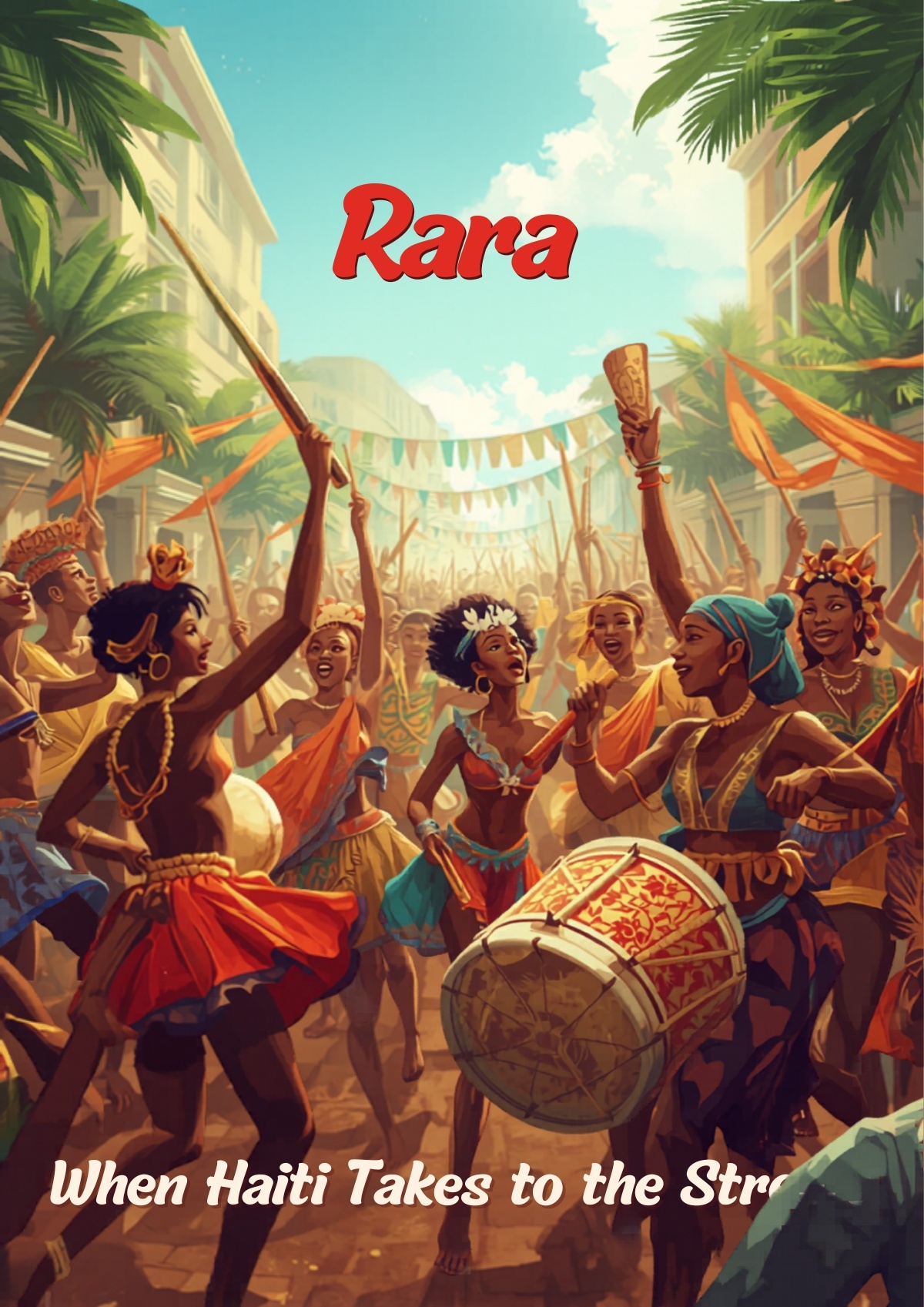
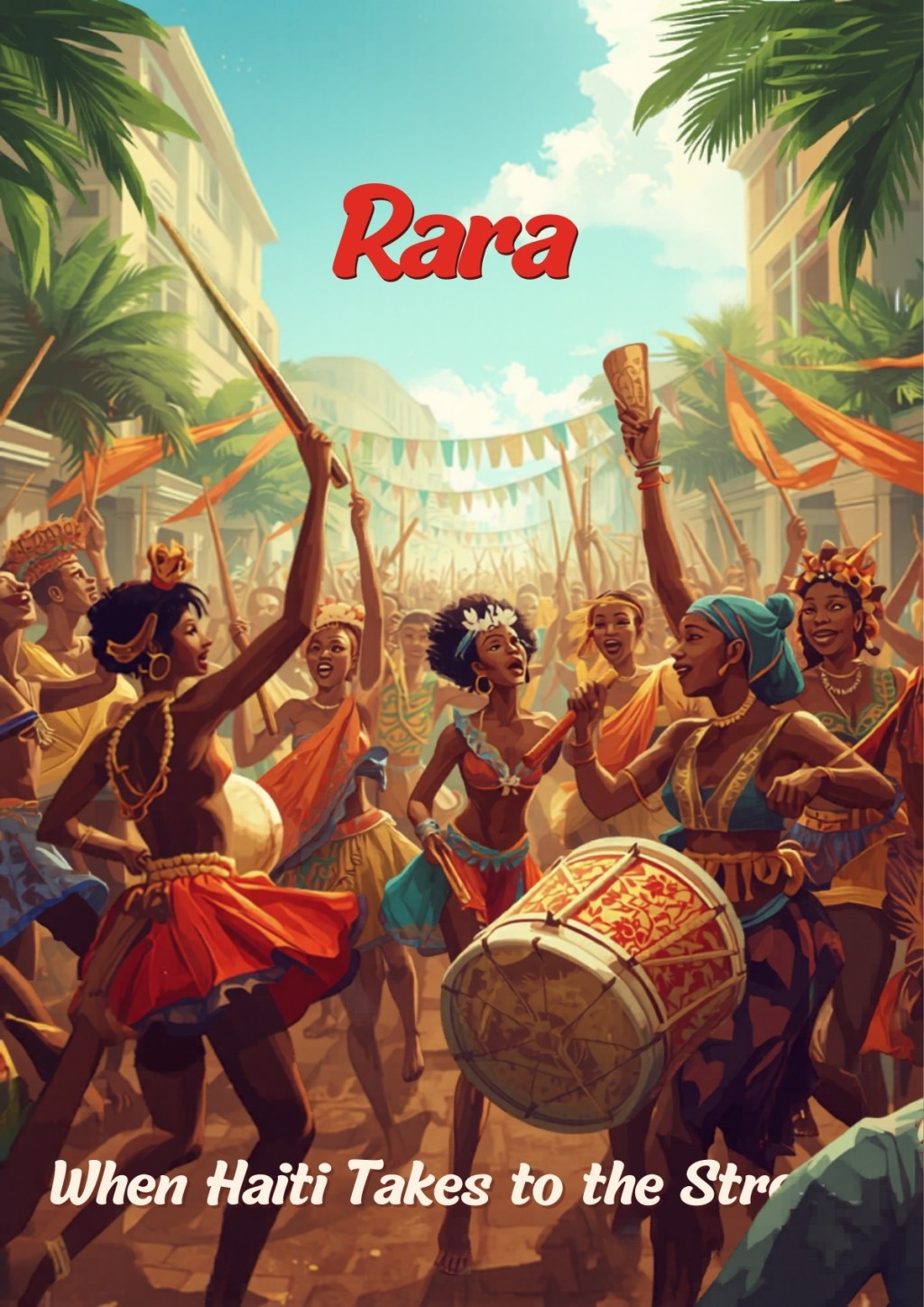
There is a moment each year, just as Lent settles over the Caribbean, when the ordinary rhythms of Haitian life give way to something extraordinary. From the narrow alleys of Léogâne to the dusty roads of the Artibonite Valley, a sound begins to build — a deep, pulsing call of bamboo trumpets layered over the urgent crack of goatskin drums. People pour out of their homes, their feet finding the beat before their minds catch up. This is Rara, and when it arrives, Haiti takes to the streets.
Rara is more than a music festival. It is a living, breathing expression of everything Haiti has been and everything it continues to fight for — a tradition that weaves together African spiritual practice, colonial resistance, communal joy, and political defiance into a procession that can stretch for miles and last until dawn. To witness Rara is to understand something essential about the Haitian soul.
The Season of Rara
Rara season begins on Ash Wednesday and builds in intensity over the forty days of Lent, reaching its explosive peak during Easter weekend — particularly on Good Friday and Holy Saturday. While the Catholic calendar frames the timing, the roots of the tradition reach far deeper than any European import. Historians trace Rara’s origins to the colonial period of Saint-Domingue, when enslaved Africans and Afro-Creole people adapted their ancestral musical traditions to the rhythms of plantation life. There is evidence that as early as the eighteenth century, enslaved people paraded with drums and handmade instruments on Easter Sunday, carving out a space for cultural expression even under the whip of slavery.
The choice of the Lenten season was no accident. While Catholic churches fell silent and the planter class retreated into solemn observance, the enslaved population found an opening — a window in the colonial calendar when music and movement could fill the streets with less scrutiny. Over the centuries, this strategic timing evolved into deep tradition. Today, entire communities organize their year around Rara season. Bands begin rehearsing months in advance, costumes are sewn, instruments are crafted, and the anticipation builds like pressure before a storm.
The Vaksin: Haiti’s Bamboo Voice
At the heart of every Rara band is the vaksin — a set of cylindrical bamboo trumpets that produce some of the most distinctive sounds in world music. Each vaksin is a simple tube, usually cut from bamboo, with a mouthpiece fashioned at one end. What makes them remarkable is not their individual sound but the way they are played together. Each musician blows a single note in a precise rhythmic pattern, and when a group of vaksin players locks in, the result is a technique called hocketing — an interlocking mosaic of tones that creates complex, hypnotic melodies from the simplest of elements.
The origins of the vaksin are debated among scholars. Haitian ethnographer Jean Bernard traces the instrument to the indigenous Taíno people who inhabited the island before European contact. Other researchers, including Robert Farris Thompson and Joseph Holloway, draw compelling links to the single-note bamboo trumpets called disoso used by Bakongo peoples in Central Africa, themselves rooted in the hocketing traditions of the Mbuti. Whatever its precise genealogy, the vaksin carries centuries of memory in every note.
Alongside the vaksin, Rara bands employ goatskin drums slung across the shoulder or held in the crook of an arm, metal bells and scrapers, maracas, and tchatcha shakers. Some bands incorporate kònè — horns made from recycled metal, often repurposed coffee cans — adding a metallic edge to the earthy tones of bamboo and skin. The combined effect is an orchestra of found materials and ancestral craftsmanship that transforms the streets into a rolling concert hall.
Sacred Work Behind the Celebration
To the casual observer, Rara might look like a Haitian version of Carnival — all color and rhythm and revelry. But beneath the secular outer layer lies a protected, sacred inner core. Rara is deeply intertwined with Vodou, Haiti’s ancestral spiritual practice, and many bands exist primarily to fulfill religious obligations to the lwa, the spirits who serve as intermediaries between humanity and the supreme creator, Bondye.
Each Rara band is typically placed under the patronage of a particular lwa, bound by a spiritual contract that can last seven years or more. The band’s leadership often includes an oungan (Vodou priest) or manbo (priestess) who oversees the ritual dimensions of the procession. Before the band takes to the streets, ceremonies are performed. Instruments are spiritually activated — “heated up” — through prayer and ritual. Members may receive a benyen, a protective herbal bath, to safeguard them during the march. In some traditions, it is the lwa themselves who instruct a devotee to form a Rara band, making the entire festival a gift offered in devotion.
As the procession winds through towns and countryside, it pauses to salute sacred sites — the graves of ancestors, crossroads where spirits are said to gather, particular trees and stones that hold spiritual significance. These stops are not performance breaks but moments of deep ritual engagement. The music itself becomes prayer, the dancing becomes offering, and the street becomes a temple without walls.
A Voice of Resistance
Rara has never been only about spirituality. From its earliest days, it has served as a vehicle for the voices of the dispossessed. During the colonial era, it was a rare space where enslaved people could express themselves publicly. After independence, Rara bands became channels for political commentary, their songs carrying sharp observations about power, injustice, and the struggles of ordinary Haitians. A Rara song might praise a local leader one year and savage a corrupt official the next, its lyrics spreading from town to town faster than any newspaper.
During the Duvalier dictatorship, Rara occupied an uneasy space — sometimes co-opted by the regime, sometimes suppressed, but always carrying undercurrents of dissent that the authorities could never fully control. In the democratic upheavals of the 1990s, Rara bands became openly political, their processions doubling as demonstrations. When President Jean-Bertrand Aristide was overthrown in 1991, Rara bands gathered in the streets to voice their outrage. The tradition proved once again that music in Haiti is never just entertainment — it is a form of collective speech, a way for communities to assert their presence and their demands.
Rara Beyond Haiti’s Borders
As Haitians have migrated across the Caribbean and to North America, Rara has traveled with them. In the Dominican Republic, a related tradition called Gagá thrives among Haitian-descended communities in the sugar-producing regions, maintaining the musical and spiritual practices while adapting to a new national context. In Cuba, echoes of Rara persist in the eastern provinces where Haitian migrants settled generations ago.
But perhaps the most vibrant diaspora expression of Rara can be found on the streets of Brooklyn, New York. In 1996, the group DJA-Rara was founded as a cultural gathering point for the Haitian community, and it has since become a beloved institution embraced by the diverse neighborhoods of New York City. During Easter weekend, the sound of vaksin and drums rings through Flatbush and Crown Heights, a sonic bridge connecting the sidewalks of Brooklyn to the dirt roads of rural Haiti. A song created in Léogâne might be heard in Brooklyn a week later, creating what scholars describe as a deterritorialized Haitian discourse — traditional knowledge rooted in peasant culture, now inflected with the experience of migration, circulating across borders and generations.
Rara bands in New York have also carried forward the tradition’s political dimension. Haitian communities have marched in Rara formation to protest police brutality, to demand justice, and to assert their identity in a city that can sometimes feel indifferent to immigrant voices. In these moments, the vaksin becomes a megaphone and the drum a heartbeat of collective purpose.
Rara is Haiti distilled into sound and motion — a tradition born in bondage, consecrated in faith, and carried forward by every generation that has refused to be silenced. When the bamboo trumpets call and the drums begin to roll, something ancient and unbreakable moves through the streets. It is the sound of a people who have always known that freedom is not a gift to be received but a rhythm to be claimed, step by step, song by song. At HaitiPAM, we believe that understanding Rara is understanding Haiti itself — resilient, sacred, joyful, and forever marching forward.
 HAITI PAM
Leave a comment