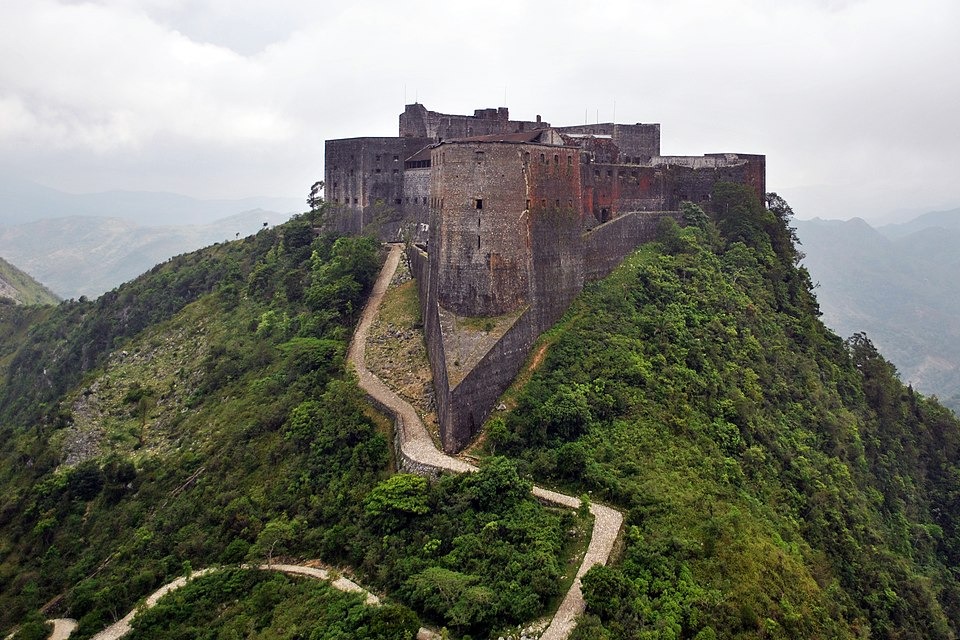
High above the emerald hills of northern Haiti, where the mist clings to mountain peaks like a whispered secret, there stands a fortress so massive, so audacious in its ambition, that visitors often fall silent at the sight of it. The Citadelle Laferrière — known simply as “La Citadelle” to Haitians — rises forty meters from the summit of Bonnet à l’Évêque, its angular walls cutting against the Caribbean sky like the prow of a great stone ship. It is the largest fortress in the Americas, a UNESCO World Heritage Site, and arguably the most powerful symbol of Haitian independence ever built. But the story behind these walls is as complex and layered as Haiti itself — a tale of revolutionary triumph, breathtaking engineering, brutal sacrifice, and an enduring question about what freedom truly costs.
Born from Revolution
To understand the Citadelle, you must first understand the world it was born into. In 1804, Haiti became the first nation in history to be founded by formerly enslaved people who overthrew their colonial masters. The Haitian Revolution had defeated Napoleon’s armies, shattered the myth of European invincibility, and sent shockwaves through every slaveholding society on earth. But independence did not bring peace of mind. France seethed with humiliation. Spain and Britain eyed the island with suspicion. And the newly free Haitians — who had paid for their liberty in blood — knew that the colonial powers would not accept their freedom quietly.
It was in this atmosphere of revolutionary pride and existential dread that Henri Christophe, one of the key generals of the revolution, ordered the construction of a fortress that would make Haiti unconquerable. Christophe had fought alongside Toussaint Louverture and Jean-Jacques Dessalines. He had seen what European armies could do, and he was determined that no foreign power would ever enslave his people again. In 1805, just one year after independence, construction began on the mountain above the town of Milot in the Nord department — a project that would consume the next fifteen years of Christophe’s life and the lives of thousands of his countrymen.
An Engineering Marvel in the Clouds
The Citadelle sits roughly 900 meters above sea level, perched on a peak that required hauling every stone, every cannon, every barrel of mortar up narrow mountain trails by hand and mule. The fortress covers an area of approximately 10,000 square meters, with walls that rise as high as 40 meters from the mountaintop. Its angular design was not mere aesthetics — the sharp geometric walls were intentionally calculated to deflect cannonballs, making a direct hit nearly impossible from the valleys below.
The mortar that holds the Citadelle together is itself legendary. Builders used a mixture of quicklime, molasses, and the blood of local cattle and goats — a binding compound that has proven astonishingly durable across two centuries of tropical storms, earthquakes, and the relentless creep of vegetation. Inside, the fortress was designed to be entirely self-sufficient: massive cisterns collected rainwater, storerooms could hold provisions for up to 5,000 defenders for an entire year, and the armory once boasted more than 150 cannons and over 50,000 cannonballs — many of them captured from the very European armies that had tried to keep Haiti in chains.
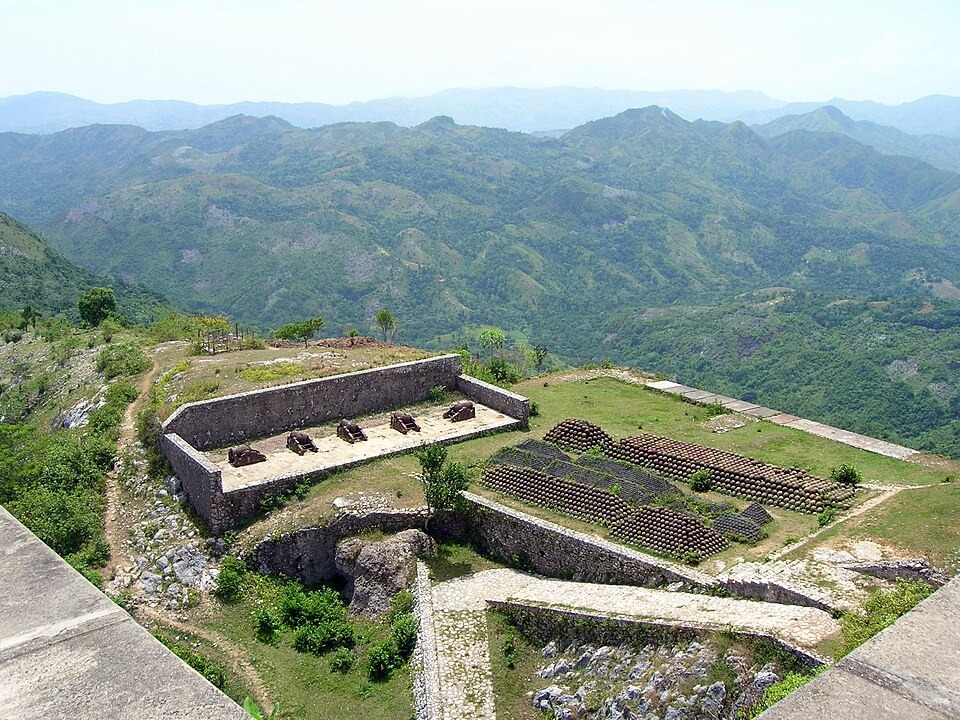
The strategic genius of the location cannot be overstated. From the summit, defenders had a commanding 360-degree view of the surrounding landscape, including the northern coastline where any invading fleet would appear. The mountain itself was the fortress’s greatest ally — any attacking force would have to march uphill for kilometers, exposed and exhausted, before even reaching the walls. Christophe’s vision was clear: if France ever returned, Haiti would retreat to the mountains and fight from an impregnable position until the invaders broke against these stones.
Stones, Sweat, and Sacrifice
The Citadelle’s grandeur comes shadowed by a painful truth. As many as 20,000 people were conscripted to build it, laboring under conditions that echoed the very plantation system they had just escaped. Workers hauled three-ton cannons up steep mountain paths. They cut stone in the tropical heat and mixed mortar under the watch of armed overseers. Estimates suggest that between 2,000 and 20,000 people died during the fifteen years of construction — a toll so devastating that a persistent Haitian belief holds that human blood runs through the Citadelle’s mortar alongside the blood of cattle.
Henri Christophe, who proclaimed himself King Henri I in 1811, ruled the northern part of Haiti with an iron hand. His ambitions extended beyond the Citadelle: he also built the magnificent Sans-Souci Palace at the foot of the mountain, a Caribbean Versailles meant to prove to the world that Black people could build civilizations to rival any in Europe. But the human cost of these monuments fueled resentment. The very people who had fought for liberation found themselves under a new form of compulsion, and the contradiction was not lost on them.
The paradox of the Citadelle — a monument to freedom built through forced labor — remains one of the most complex chapters in Haitian history. Christophe genuinely believed that the threat of a French return was real, and history would prove him at least partially right: France would extort a crippling “independence debt” from Haiti in 1825, just five years after Christophe’s death. But the means he chose left scars that complicate any simple celebration of the fortress as a purely triumphant symbol.
The Fall of a King
Henri Christophe never saw his fortress tested in battle. The French invasion he spent his life preparing for never came — at least not in the military form he expected. In August 1820, the king suffered a devastating stroke that left him partially paralyzed. As word of his condition spread, soldiers deserted, towns rose in rebellion, and the kingdom he had built began to crumble around him. On October 8, 1820, rather than face capture, Christophe shot himself through the heart with a silver bullet — or so the legend goes. He was 52 years old.
His body was carried up the mountain and buried within the Citadelle itself, entombed in the fortress he had spent his life building. Ten days later, his sixteen-year-old son and heir, Jacques-Victor Henri, was murdered by rebels at Sans-Souci Palace. The kingdom dissolved, and General Jean-Pierre Boyer reunited the northern and southern halves of Haiti under a single republic. The great fortress on the mountain fell silent, its cannons never fired in anger, its stores of gunpowder slowly dampening in the mountain mist.
An Enduring Symbol
Two centuries later, the Citadelle Laferrière remains Haiti’s most iconic landmark. It appears on the nation’s currency, its postage stamps, and the coat of arms. In 1982, UNESCO designated it a World Heritage Site alongside the ruins of Sans-Souci Palace and the nearby site of Ramiers — recognizing the complex as one of the most significant examples of post-colonial architecture in the Western Hemisphere and one of the few African-derived military fortifications in the New World.
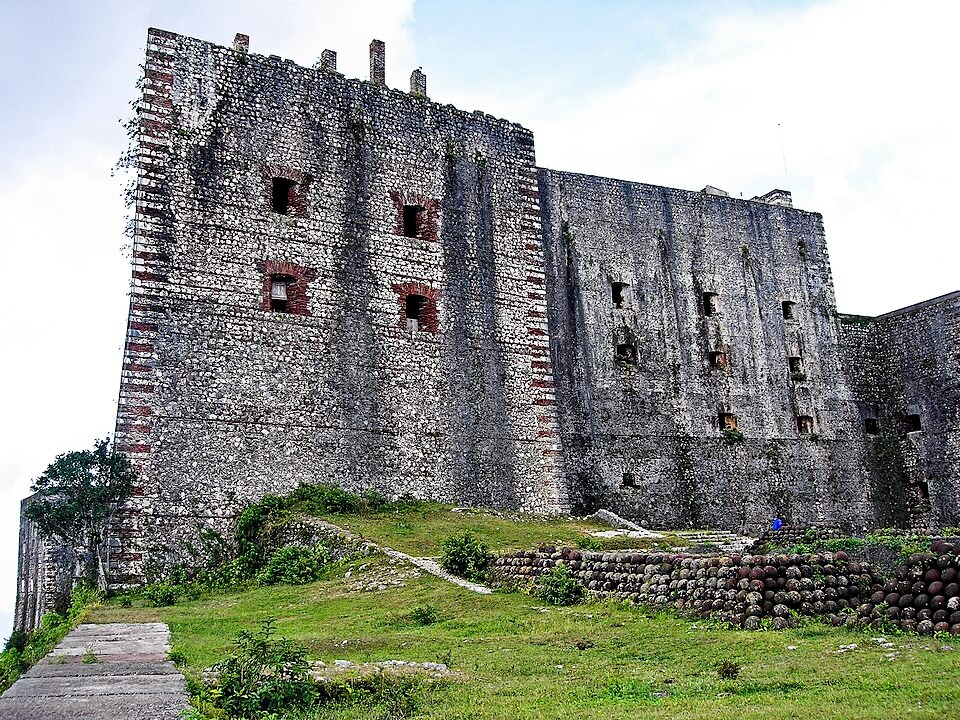
Today, restoration efforts continue to preserve the fortress for future generations. In recent years, Haiti’s Institute for the Preservation of National Heritage (ISPAN) has undertaken rehabilitation and paraseismic reinforcement work, with support from the World Monuments Fund. New skyway bridges now allow visitors to move between rooms that were previously inaccessible, and a small museum and art gallery have been added to the courtyard. Despite Haiti’s ongoing challenges, the Citadelle draws visitors from around the world — people who make the steep climb on foot or by mule, arriving breathless at the summit to stand in the shadow of walls that have withstood earthquakes, hurricanes, and the weight of history itself.
The Citadelle Laferrière is more than a fortress. It is a question carved in stone — about the price of freedom, the nature of power, and what a people will build when they refuse to be conquered. For Haitians, it stands as proof that even in a world designed to deny their humanity, they raised something magnificent toward the sky. At HaitiPAM, we believe that understanding monuments like the Citadelle — with all their glory and all their contradictions — is essential to understanding Haiti itself.
 HAITI PAM
Leave a comment