On the first day of 1804, in the dusty heat of Gonaïves, a formerly enslaved man stood before a crowd of battle-hardened soldiers and newly freed people and did something the world had never seen. Jean-Jacques Dessalines, scarred from years of plantation labor and forged in over a decade of revolutionary warfare, declared the independence of Haiti — a nation born not from the grievances of colonists seeking self-rule, but from the unbreakable will of enslaved people who refused to remain in chains. In that single, thundering act, Dessalines created the first free Black republic in history and dealt a blow to the institution of slavery that would echo across continents.
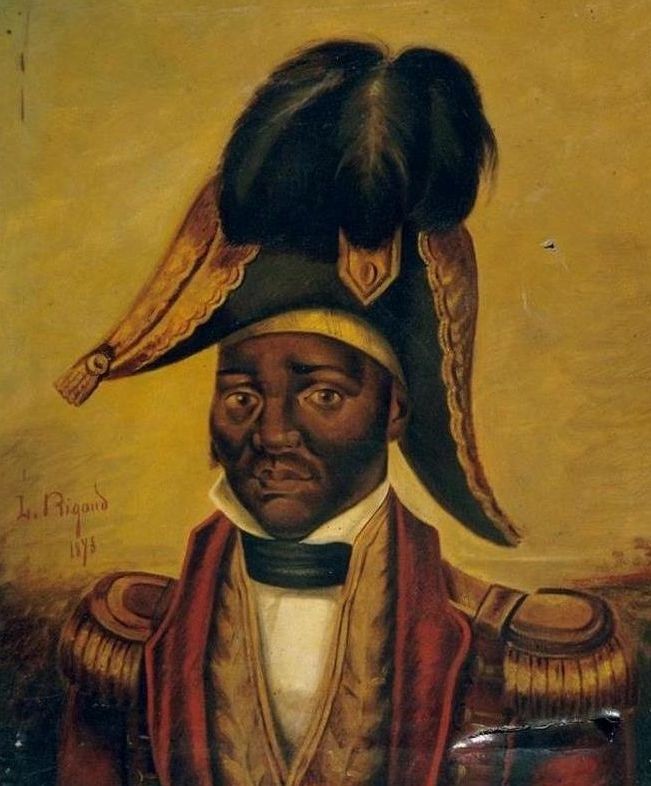
Forged in Chains: The Making of a Revolutionary
The exact details of Dessalines’s earliest years remain debated among historians. Born around 1758, he may have come into the world in west-central Africa or on the Grande Rivière plantation in the northern reaches of the French colony of Saint-Domingue. What is certain is that he was of Congolese heritage, and that the plantation system shaped him with its particular cruelty. For most of his enslaved life, Dessalines labored on the Duclos sugar plantation in Cormier, where the work was backbreaking and the discipline merciless. The sugarcane fields of Saint-Domingue demanded sixteen- to eighteen-hour days, and the mortality rate among enslaved workers was staggering.
Dessalines bore the physical marks of this brutality. His body carried scars from whippings and punishments that he would later show as proof of the system’s inhumanity. Despite these conditions, he rose to the rank of commandeur — a foreman among the enslaved — a position that gave him both authority and a deeper understanding of how the plantation machine operated. At some point, he was purchased by a free man of color named Dessalines, whose surname Jean-Jacques adopted and kept for the rest of his life.
When the great slave rebellion erupted on the northern plains in August 1791, Dessalines was among the thousands who rose up. He joined the forces led by Jean François Papillon and Georges Biassou in what would become the opening act of the Haitian Revolution — the most successful slave revolt in human history. It was here that Dessalines discovered his gift for warfare: a fearless, aggressive tactical mind combined with an iron determination that would eventually carry him to the very top of the revolutionary command.
The Right Hand of Toussaint — and Then Beyond
Through the chaotic early years of the revolution, Dessalines became one of the most trusted lieutenants of Toussaint Louverture, the brilliant strategist who emerged as the revolution’s central figure. Where Toussaint was diplomatic and calculating, Dessalines was direct and devastating on the battlefield. He served as a key military commander during Toussaint’s campaigns to consolidate control over the entire island of Hispaniola, proving himself repeatedly in engagements against Spanish, British, and French forces.
But when Napoleon Bonaparte sent his brother-in-law, General Charles Leclerc, with an expeditionary force of over 20,000 soldiers to reassert French control and restore slavery in 1802, the revolution entered its most desperate phase. Toussaint was captured through treachery and deported to France, where he would die in a cold prison cell in the Jura Mountains. The revolution needed a new leader — someone willing to fight without compromise, without negotiation, without mercy.
Dessalines stepped into that role with ferocious resolve. He united the formerly fractured revolutionary forces — Black and mixed-race alike — under a single banner. His military strategy was relentless. At the decisive Battle of Vertières on November 18, 1803, Dessalines’s forces dealt a crushing defeat to the French army, led by the Vicomte de Rochambeau. It was the final major engagement of the revolution. The French, battered by both Haitian fighters and the ravages of yellow fever, had no choice but to surrender and withdraw from the island.
January 1, 1804: The Day the World Changed
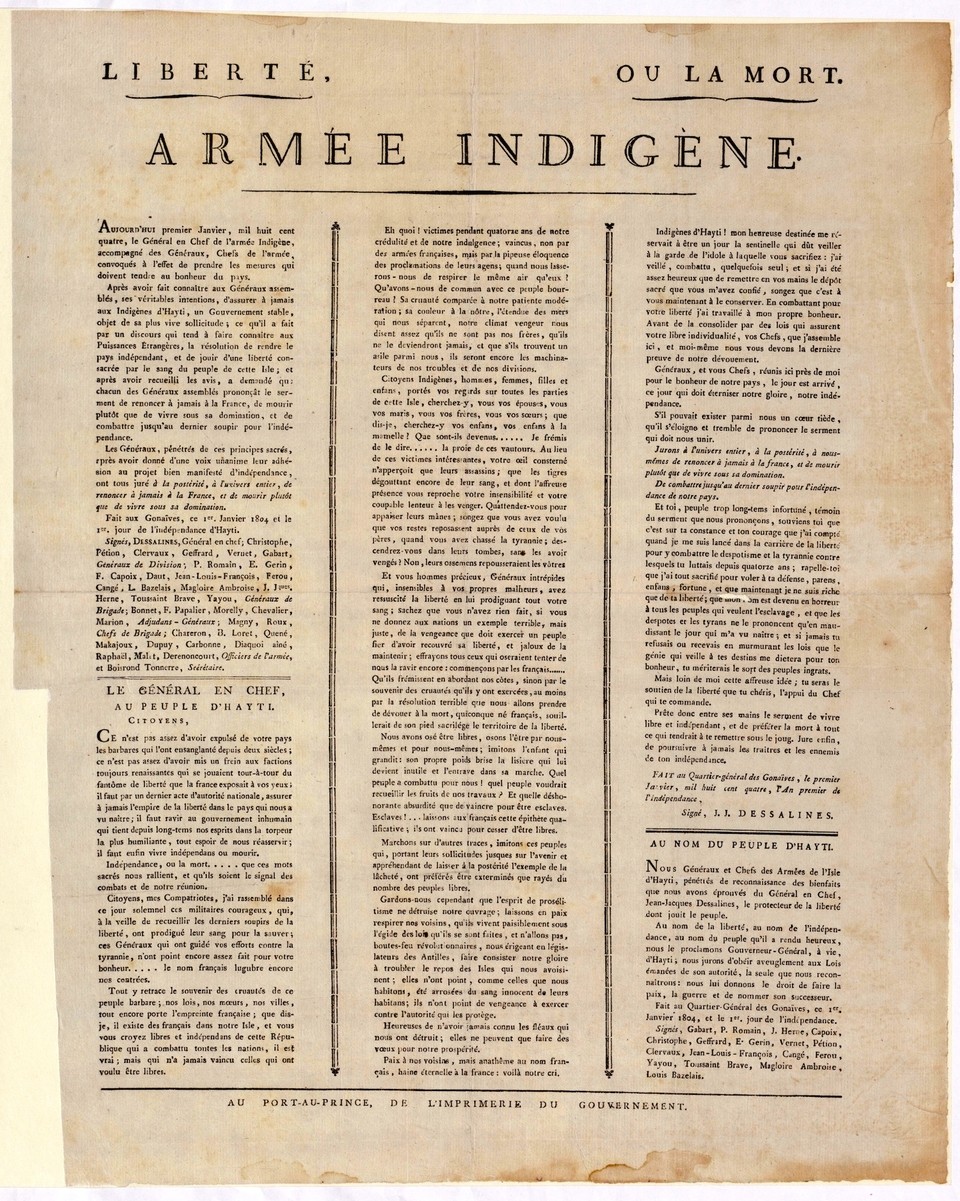
Less than two months after Vertières, Dessalines stood in Gonaïves and proclaimed independence. The declaration, written by his secretary Louis Boisrond-Tonnerre, was not a polite petition for recognition. It was a roar of defiance. Dessalines renamed the land Ayiti — the indigenous Taíno name meaning “land of mountains” — deliberately erasing the colonial name of Saint-Domingue. In doing so, he honored the island’s original inhabitants and declared a complete break from the European colonial project.
The declaration was a layered document, crafted for multiple audiences. To the French, it was a warning: Haiti would never again submit to colonial rule. To the mixed-race and Black populations of the new nation, it was a promise of unity and freedom. To the enslaved peoples of the Americas watching from afar, it was proof that liberation was not a dream but an achievable reality. And to the governments of Europe and the United States — both deeply invested in the continuation of slavery — it was a challenge they would spend decades trying to undermine.
Haiti became the second independent nation in the Western Hemisphere after the United States, and the first to permanently abolish slavery as part of its founding. The contrast with its northern neighbor was stark: while the United States was built on a declaration that proclaimed all men equal yet enshrined slavery in its constitution, Haiti was built by the enslaved themselves, who made equality not just an ideal but a lived reality.
Emperor, Reformer, and the Weight of Power
After declaring independence, Dessalines initially took the title of Governor-General for life. By September 1804, his generals proclaimed him Emperor Jacques I of Haiti. His reign was marked by bold decisions and deep contradictions. He ordered the drafting of Haiti’s first constitution in 1805, which declared that all Haitian citizens — regardless of skin color — would be known as “Black,” a radical reimagining of racial identity in a world obsessed with color-based hierarchy.
He implemented land reform, attempting to redistribute the vast colonial plantations among the population. He fortified the nation against the ever-present threat of French return, ordering the construction of defensive structures across the country. But Dessalines also enforced mandatory plantation labor to maintain economic production, a policy that generated resentment among the very people who had fought for their freedom. His rule grew increasingly autocratic, and tensions mounted between him, the mixed-race elite, and ambitious military commanders like Alexandre Pétion and Henri Christophe.
The Fall: Pont-Rouge, October 17, 1806
On October 17, 1806, Dessalines was traveling north of Port-au-Prince to confront a rebellion in the south when he was ambushed at Pont-Rouge (then known as Larnage). The conspiracy against him included some of his own officers, among them Pétion and Étienne-Élie Gérin. Dessalines was killed, and his body was mutilated by a mob. The father of Haitian independence, the man who had defeated the most powerful army in the world, met a violent and undignified end at the hands of his own countrymen.
His assassination plunged Haiti into division. The country split between a northern kingdom under Christophe and a southern republic under Pétion — a fracture that would take years to heal and that planted the seeds of political instability that would haunt the nation for generations.
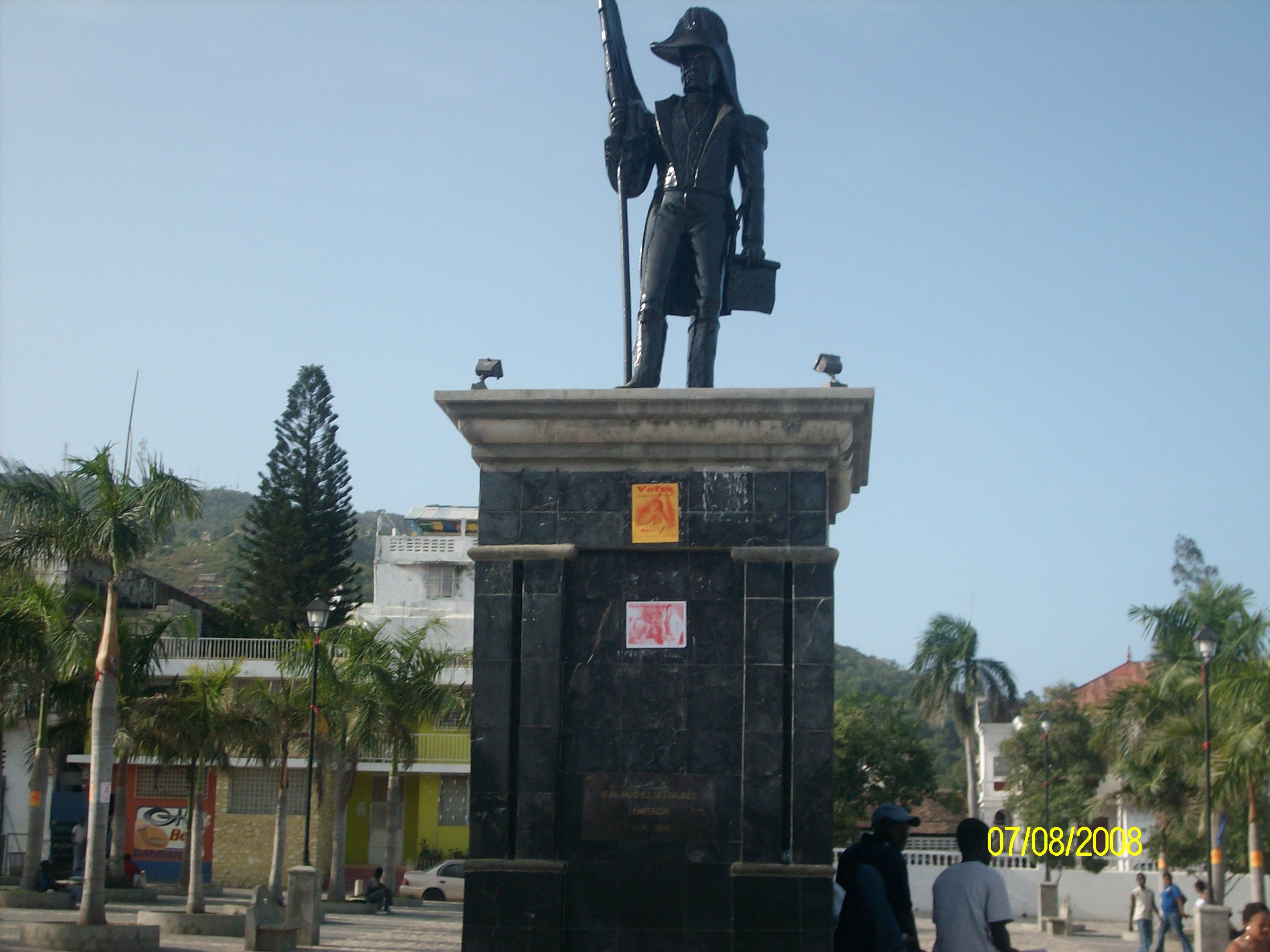
The Legacy That Refuses to Die
For decades after his death, Dessalines was a controversial figure — celebrated by some, condemned by others. But by the twentieth century, a reassessment took hold. Haitians began to reclaim Dessalines not as a flawed emperor, but as the embodiment of their nation’s founding spirit: uncompromising, courageous, and willing to pay any price for freedom. October 17, the anniversary of his assassination, is now a national holiday in Haiti. The national anthem, La Dessalinienne, bears his name and carries his spirit in every verse.
Dessalines’s legacy is complex, as the legacies of revolutionary leaders often are. He was a liberator who could be ruthless, a visionary who sometimes ruled with an iron fist, a man who bore the scars of slavery and used that pain to fuel a revolution that changed the course of world history. He is not easily reduced to a single narrative — and perhaps that is the point. Dessalines was a human being who did extraordinary things in extraordinary times, and Haiti exists as an independent nation because he refused to accept any outcome other than total freedom.
At HaitiPAM, we believe that understanding figures like Jean-Jacques Dessalines — in all their complexity, courage, and contradiction — is essential to appreciating the full richness of Haiti’s story. Dessalines did not simply fight for independence; he reimagined what a nation could be. His legacy challenges us to remember that the freedom we inherit was paid for in blood, sacrifice, and an unyielding belief that no human being was born to be a slave. That is a story worth telling, again and again.
 HAITI PAM
Leave a comment