
In the summer of 1791, on the sweltering northern plains of Saint-Domingue — the most profitable colony in the entire Western Hemisphere — a nearly fifty-year-old formerly enslaved man made a decision that would alter the course of world history. His name was François-Dominique Toussaint, and within a few short years, the world would know him as Toussaint Louverture — “The Opening” — a name that spoke to his uncanny ability to find gaps in enemy lines and, more profoundly, to open the door to freedom for an entire people.
Born Into Bondage, Destined for Greatness
Toussaint was born on May 20, 1743, on the Bréda plantation at Haut de Cap, along the northern coast of what is now Haiti. His father, Gaou Guinou, was said to be the son of a king of the Allada kingdom in present-day Benin, West Africa. Even in the brutal world of Caribbean slavery, Toussaint’s origins carried a whisper of royalty — and perhaps a sense of destiny.
Unlike the vast majority of enslaved people in Saint-Domingue, Toussaint received an education. He learned to read and write in both French and Haitian Creole, and his letters later revealed a familiarity with the works of Greek, Italian, and French philosophers. He won the favor of the plantation’s manager and rose through the ranks — from livestock handler to healer, coachman, and eventually steward of the entire estate. In 1776, at the age of 33, he was granted his freedom.
As a free man — an affranchi — Toussaint became a salaried plantation overseer, married Suzanne Simone Baptiste, and built a modest but comfortable life. He was a devout Catholic, a skilled horseman, and by all accounts a man of quiet dignity. Nothing about his outward life suggested revolution. But beneath the surface, something was building.
The Night the Mountains Burned
On the night of August 22, 1791, the enslaved people of Saint-Domingue’s northern plain rose up in a coordinated revolt that stunned the colonial world. Plantations were set ablaze. The sky over Cap-Français glowed orange for days. It was the largest slave uprising the Americas had ever seen, and it would become the only one to succeed.
Toussaint did not immediately join. At nearly fifty, he first ensured his former master’s family escaped safely — a gesture that revealed the complexity of the man. But within weeks, he had made his choice. He joined the rebel forces under Georges Biassou and began assembling his own army from the chaos.
What set Toussaint apart was not just courage — the revolution had no shortage of brave fighters. It was his mind. He trained his followers in guerrilla tactics, turning formerly enslaved farmers into disciplined soldiers. He understood supply lines, diplomacy, and the art of strategic patience. While other rebel leaders burned and raided, Toussaint built.
A Masterstroke of Political Chess
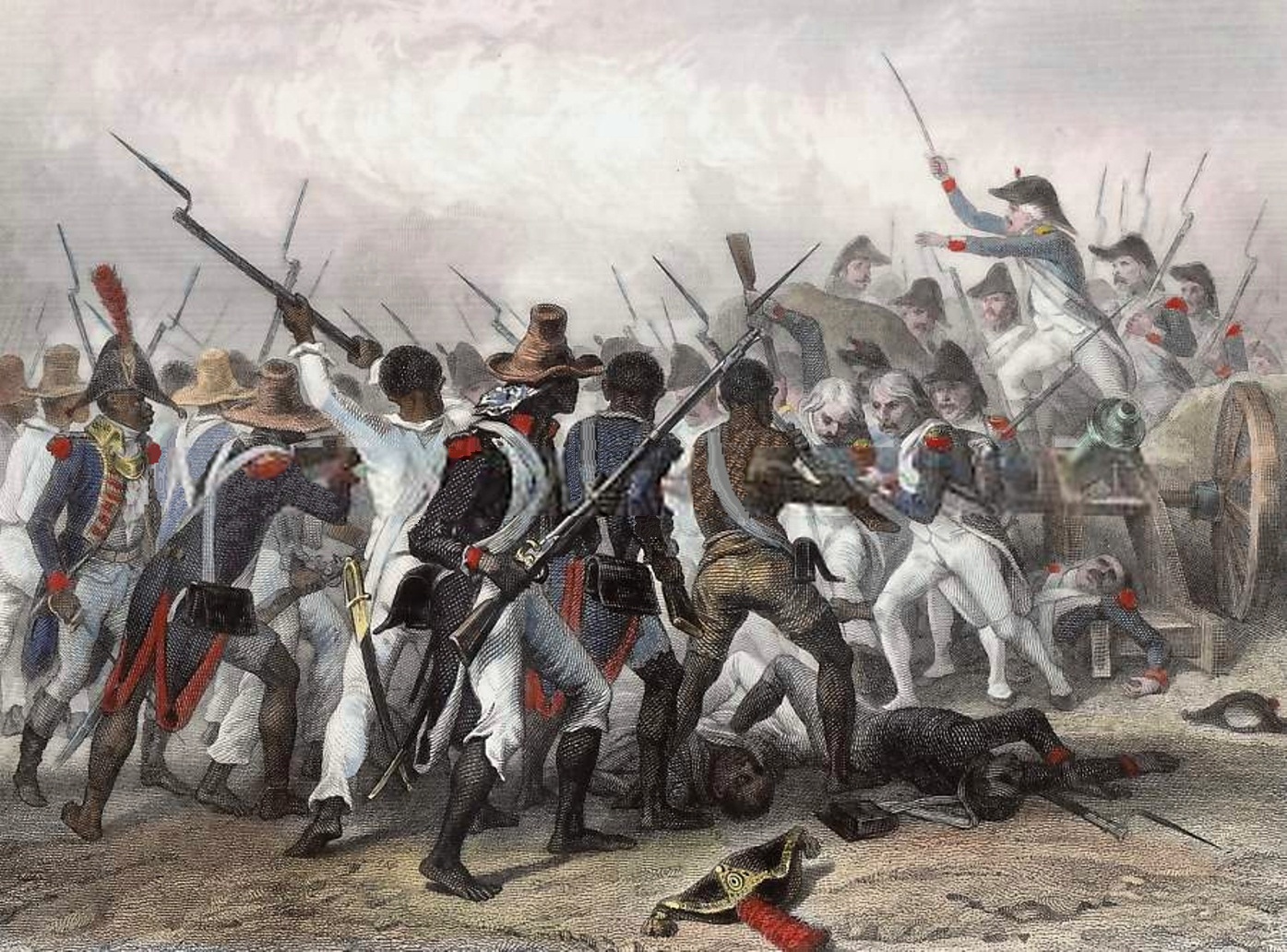
The geopolitics of the Caribbean in the 1790s were dizzyingly complex. France, Spain, and Britain all had interests in Saint-Domingue, and Toussaint played them against each other with remarkable skill. He initially allied with Spain, which controlled the eastern half of the island (Santo Domingo) and offered freedom to enslaved people who fought against the French. But when revolutionary France abolished slavery in its colonies in 1794, Toussaint made a pivotal switch — he brought his battle-hardened army over to the French side.
It was a masterstroke. With French backing, Toussaint defeated the Spanish forces and drove the British — who had invaded hoping to seize the colony — off the island entirely. By 1801, he controlled all of Hispaniola. He abolished slavery across the entire island, promulgated a new constitution, and declared himself Governor-General for life. A formerly enslaved Black man now ruled the wealthiest colony in the Western Hemisphere.
The Betrayal
Napoleon Bonaparte could not accept this. In 1802, he dispatched his brother-in-law, General Charles Leclerc, with an army of over 20,000 soldiers — one of the largest expeditions ever sent across the Atlantic — to reassert French control and, secretly, to restore slavery. After months of fierce fighting, Toussaint agreed to a truce and retired to his plantation. It was a trap. French soldiers seized him in June 1802 and shipped him to France, where he was imprisoned in the freezing Fort de Joux in the Jura Mountains.
Toussaint Louverture died in his cell on April 7, 1803, of pneumonia and malnutrition. He was 59 years old. Before his capture, he reportedly told his captors: “In overthrowing me, you have done no more than cut down the trunk of the tree of Black liberty in Saint-Domingue. It will spring back from the roots, for they are numerous and deep.”
He was right. Less than a year after his death, his lieutenant Jean-Jacques Dessalines defeated the remnants of the French army and declared independence on January 1, 1804. The new nation was named Haiti — the original Taíno name for the island, meaning “land of mountains.”
A Legacy That Echoes Through Centuries
Haiti became the first free Black republic in the world, the first nation in the Western Hemisphere to abolish slavery, and only the second independent nation in the Americas after the United States. The Haitian Revolution terrified slaveholding societies from Virginia to Brazil — and inspired enslaved and free Black people everywhere.
Historians credit the revolution with a staggering geopolitical consequence: it spooked Napoleon into abandoning his ambitions in the Americas, leading directly to the Louisiana Purchase of 1803, which doubled the size of the United States. In a very real sense, Toussaint Louverture shaped the map of North America.
Yet his legacy is not without complexity. The military-caste society he built, with its rigid labor codes designed to keep the plantation economy running, left a troubled imprint on Haiti’s social structure that persisted long after his death. Toussaint was a liberator, but he was also a pragmatist who believed economic stability required hard choices — choices that sometimes looked uncomfortably similar to the system he had overthrown.
This tension — between revolutionary idealism and the hard realities of nation-building — is part of what makes Toussaint Louverture such a fascinating and endlessly relevant figure. He was not a saint. He was something more interesting: a man of extraordinary intelligence and will who navigated an impossible situation and, against all odds, won.
Toussaint Louverture’s story is the story of Haiti itself — resilient, complex, and world-changing. This is the first in a series of articles exploring the people, history, and culture of Haiti. Welcome to HaitiPAM.
 HAITI PAM
Leave a comment