On a warm evening in Port-au-Prince, the sound of drums begins to rise from a modest concrete courtyard. A woman in white traces an intricate pattern on the earthen floor using fistfuls of cornmeal, her hand steady and sure. Around the central pillar of the temple, voices lift in song — not in French, not in English, but in the sacred language of a tradition that has survived centuries of oppression, misrepresentation, and scorn. This is Vodou, and to understand Haiti, you must first understand the faith that beats at its heart.
Born in Chains, Forged in Spirit
Haitian Vodou did not arrive in the Caribbean fully formed. It was built — painstakingly, secretly, and brilliantly — by enslaved Africans ripped from their homelands in what are now Nigeria, Senegal, Benin, the Congo, Ghana, and Cameroon. Between the 16th and 19th centuries, these men and women were forced onto the sugar plantations of Saint-Domingue, the French colony that would one day become Haiti. They brought with them fragments of their spiritual traditions: the worship of powerful spirits, the rhythms of sacred drums, the belief that the visible and invisible worlds are deeply intertwined.
On the plantations, the French Code Noir demanded that all enslaved people be baptized Catholic. But forced conversion could not erase what lived in the soul. Enslaved Africans found ingenious ways to preserve their beliefs, mapping their own spirits onto Catholic saints. The serpent deity Danbala Wèdo became associated with Saint Patrick. The fierce warrior spirit Ogou found a home behind the image of Saint James. The Virgin Mary became a vessel for Èzili Freda, the radiant spirit of love. What emerged was not a dilution of African faith, but a transformation — a new spiritual system that was uniquely Haitian, forged in the crucible of suffering and resistance.
Bondye, the Lwa, and the Invisible World
At the center of Vodou is Bondye — from the French Bon Dieu, or “Good God” — the supreme and transcendent creator of the universe. But Bondye is distant, uninvolved in the daily affairs of mortals. To navigate the struggles and joys of life, Vodouists turn to the lwa (also spelled loa): a vast pantheon of spirits who serve as intermediaries between humanity and the divine. There are believed to be over a thousand lwa, each with a distinct personality, set of preferences, sacred colors, and ritual songs.
The lwa are organized into nanchon — spiritual “nations” that reflect the diverse African ethnic groups who contributed to the tradition. The two most prominent are the Rada and the Petwo. The Rada lwa, rooted in the traditions of the Fon people of Dahomey, are generally considered cool, benevolent, and wise. They include Danbala Wèdo, the great serpent of creation, and Èzili Freda, the spirit of romantic love and luxury. The Petwo lwa, by contrast, carry the fire of the enslaved experience itself — they are fierce, hot, and unyielding. Èzili Danto, the fiercely protective mother spirit, belongs to this nation, as does the trickster spirit Simbi.
And then there is Papa Legba — the old man at the crossroads, keeper of the gate between the human world and the spirit world. No ceremony begins without first calling on Legba to open the way. Without his permission, no other lwa can be reached. He is the first greeted and the last thanked, a humble figure with a straw hat and a walking stick who holds the most essential power of all: access.
Inside the Peristyle: Ceremony and Sacred Art
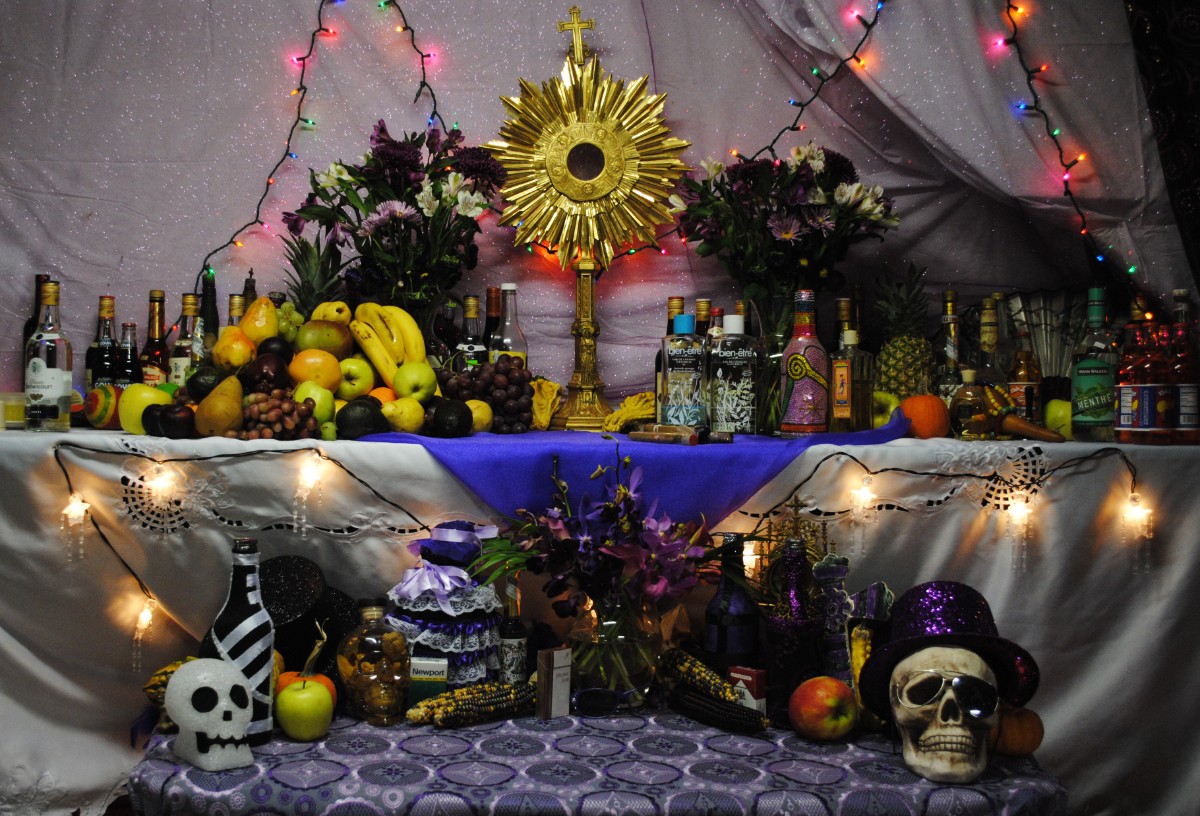
The heart of Vodou worship is the peristyle — the ceremonial space within the temple, or ounfò. At its center stands the poto mitan, a brightly painted wooden pillar that serves as the axis between heaven and earth, the highway through which the lwa descend into the human realm. The space is alive with color, sacred objects, and the pulse of drums — the tanbouch — which are not merely instruments but sacred voices that call to the spirits.
Before a ceremony begins, the oungan (priest) or manbo (priestess) traces a vèvè on the ground — an elaborate geometric symbol drawn in cornmeal or ash that represents the specific lwa being summoned. Each vèvè is a masterwork of sacred art: a heart for Èzili Freda, intertwined serpents for Danbala and Ayida Wèdo, a boat for Agwe the sea spirit, a machete for the warrior Ogou. These ephemeral drawings are both invitations and doorways, believed to compel the spiritual energy of the lwa to manifest.

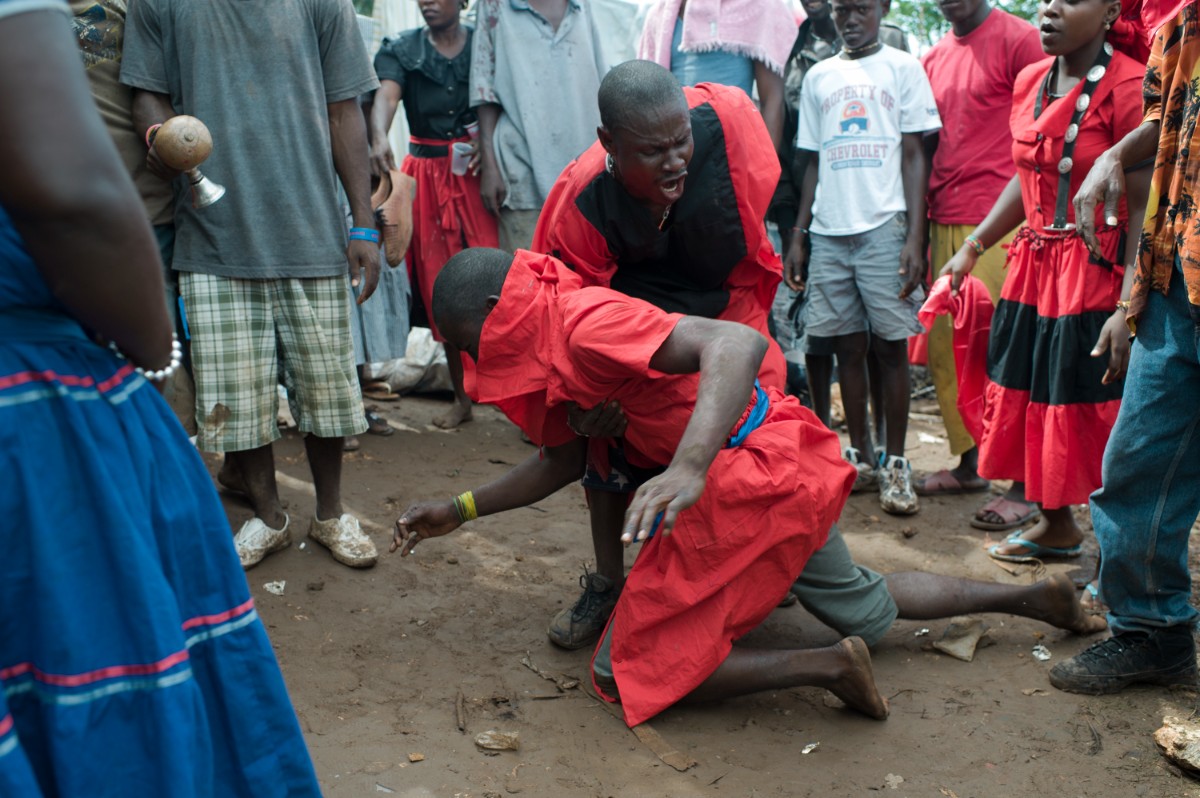
As the drumming intensifies and the congregation sings and dances, something extraordinary may happen: a lwa arrives. In Vodou, this is called possession — though the tradition’s own language is more poetic. The lwa is said to “mount” or “ride” a devotee, temporarily inhabiting their body. The person’s own consciousness steps aside, and the spirit speaks, dances, gives counsel, heals, or scolds through them. It is a moment of direct communion between the visible and invisible worlds, and it is treated not with fear but with reverence and celebration.
The Faith That Sparked a Revolution
No discussion of Vodou is complete without acknowledging its role in the most consequential event in Haitian history: the revolution that created the world’s first free Black republic. On the night of August 14, 1791, a Vodou ceremony took place in a forest called Bois Caïman in the northern mountains of Saint-Domingue. Led by Dutty Boukman, an enslaved man and oungan, and Cécile Fatiman, a manbo of mixed heritage, the ceremony brought together some two hundred enslaved Africans from surrounding plantations.
What happened that night was both spiritual and strategic. The enslaved participants called upon the lwa, swore blood oaths, and planned the uprising that would erupt days later across the Northern Plain. Plantations burned. The enslaved rose. And the thirteen-year war for liberation had begun — a war that would produce Toussaint Louverture, Jean-Jacques Dessalines, and, on January 1, 1804, the independent nation of Haiti.
French colonial authorities understood Vodou’s power well — which is precisely why they had tried to stamp it out. But the religion proved indestructible. As one scholar has written, Vodou was “one of the few areas of totally autonomous activity for the African slaves,” a source of “psychological liberation” that allowed them to “see themselves as independent beings” even while in chains. It gave them dignity. It gave them unity. And ultimately, it gave them freedom.
Beyond the Stereotypes
Perhaps no religion on earth has been more grotesquely caricatured than Haitian Vodou. Hollywood has spent decades reducing it to pin-stuck dolls, zombies, and sinister sorcerers — images that have almost nothing to do with the actual faith. The so-called “voodoo doll” is largely a product of Western imagination. Zombies, while part of Haitian folklore, play no role in Vodou’s formal spiritual practice. And the notion that Vodou is “black magic” or devil worship is a colonial slander that has been weaponized against Haiti for over two centuries.
The reality is far more beautiful and far more human. Vodou is a healing tradition. It is a community practice where people gather to sing, dance, pray, and seek guidance from their ancestors and the lwa. Oungan and manbo serve as counselors, herbalists, and spiritual guides. Ceremonies are celebrations of life — vibrant, musical, communal events where the boundary between the sacred and the everyday dissolves. In Haiti, it is common for people to practice both Vodou and Catholicism without any sense of contradiction, a testament to the tradition’s deep flexibility and its rootedness in lived experience rather than rigid dogma.
There is no pope of Vodou, no central authority, no single orthodoxy. It is a living, breathing tradition that varies from temple to temple, region to region, family to family. And that is part of its resilience. Vodou has survived slavery, colonialism, foreign occupation, hostile governments, evangelical campaigns, and centuries of international ridicule — and it endures because it speaks to something essential in the Haitian experience: the insistence on spiritual sovereignty, the refusal to let anyone else define your relationship with the divine.
To understand Vodou is to begin to understand Haiti itself — not as a land of poverty and disaster, as the headlines so often insist, but as a place of extraordinary spiritual depth, cultural richness, and unbreakable will. At HaitiPAM, we believe that these stories deserve to be told with the respect, nuance, and wonder they demand. The drums are still beating. The lwa are still listening. And Haiti’s soul remains very much alive.
 HAITI PAM
Leave a comment